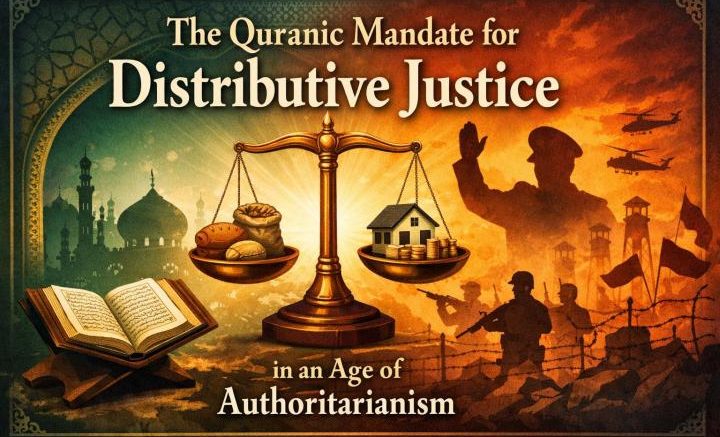
In the contemporary political landscape, where the rise of authoritarianism often masks systemic oppression under the guise of “law and order,” the Quranic concept of Qist (equity) offers a radical and necessary framework for liberation. Frequently translated as “justice,” such a simplification misses its revolutionary core: Qist is not a passive ideal, but a requirement for the active, public, and material distribution of rights.
As we navigate a world where civil liberties are shrinking and wealth is increasingly concentrated, understanding Qist provides a spiritual and political imperative to challenge the structures of modern tyranny.
The Anatomy of Qist: Beyond Abstract Justice
A distinction is often made between ‘Adl (universal justice) and Qist (distributive equity) in Islamic theology. While ‘Adl represents the inherent harmony of the universe, Qist is the practical application of justice in the marketplace, the courtroom, and the halls of power.
The root q-s-t carries the dual meaning of “giving each their due” and “the balance.” In the Quran, the concept of Qist is often intricately linked to the powerful imagery of the “Scale” (Mizan). This connection highlights the profound importance of balance and justice in our lives. It is the mechanism by which the marginalized; the orphans, the poor, and the oppressed, receive their rightful share of society’s resources and protections. For the contemporary activist, Qist means that a system is not “just” simply because it has laws; it is only just if those laws produce equitable outcomes for the most vulnerable.
Qist as a Counter-Authoritarian Force
Authoritarianism thrives on the suspension of accountability and the monopolization of truth. In contrast, the Quranic mandate for Qist demands an uncompromising transparency that transcends national or personal loyalty.
1. Accountability Beyond the State
In Surah An-Nisa (4:135), the Quran commands: “O you who have believed, be persistently standing firm in Qist, witnesses for Allah, even if it be against yourselves or parents and relatives.”
This verse serves as a direct rebuttal to the “cronyism” and “nepotism” that define modern autocracies. Under an authoritarian regime, loyalty to the Leader or the Party is the highest virtue. Qist, however, places the duty of truth above the state and the family. It empowers the individual to witness against the powerful, asserting that no person or institution is above the moral law of equity.
2. The Prophetic Mission: Empowering the People
Surah Al-Hadid (57:25) clarifies the very purpose of revelation: “We have already sent Our messengers with clear evidences and sent down with them the Scripture and the balance that the people may maintain [their affairs] in Qist.”
Crucially, the verse does not say the rulers should maintain justice, but that the people (al-nas) should uphold it. This empowers individuals to take an active role in upholding justice, spreading the responsibility across the community. In an authoritarian context where the state seeks to be the sole provider of “order,” the Quranic concept of Qist returns agency to the citizenry. It suggests that a society’s legitimacy is measured by its common people’s ability to live with dignity and equity.
Human Rights and the Eradication of Zulm
The opposite of Qist is Zulm: wrongdoing, darkness, and oppression. Modern authoritarianism often engages in “administrative zulm“: the use of bureaucracy, surveillance, and legal loopholes to strip individuals of their rights.
Qist demands more than the absence of violence; it requires the presence of fairness. In the context of contemporary human rights, Qist translates to:
- Economic Equity: Opposing systems that prioritize corporate profit over the “fair share” of the worker.
- Legal Equality: Challenging judicial systems that disproportionately target minorities or political dissidents.
- Protection of the Vulnerable: Ensuring that those without a “voice” in the halls of power are the first to be protected by the law.
Conclusion: The Persistent Stand
The Quran describes those who uphold justice as Qawwamina bil-qist. The word Qawwam implies a state of constant, unwavering persistence. It recognizes that justice is not a destination reached, but a continuous struggle against the gravity of human greed and the ego of the powerful.
In an era of rising autocracy, Qist is a call to action. It reminds us that silence in the face of inequity is a theological failure. To strive for Qist is to insist that every human being, regardless of their status, is entitled to their full “measure” of dignity, freedom, and bread. In the face of the authoritarian “strongman,” the believer is called to the “strong balance” of equity.