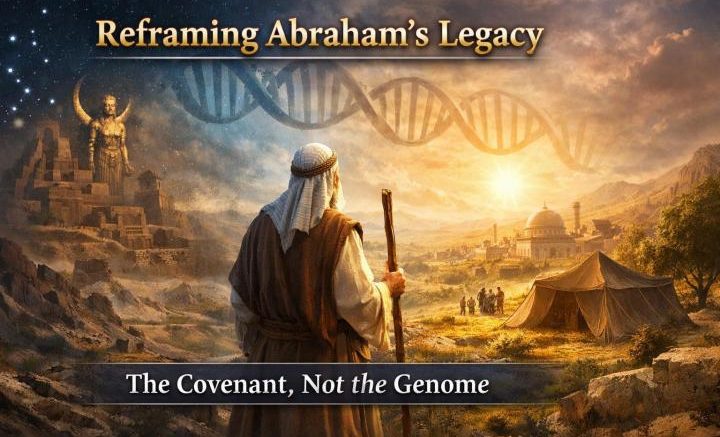
“He has shown you, O mortal, what is good. And what does the Lord require of you? To act justly, to love mercy, and to walk humbly with your God” Micah 6:8
Abraham’s Mission: From Biological Lineage to a Universal Code of Faith
While a literal reading of the biblical narrative may suggest that Abraham’s mission centred on establishing the precedence of his biological lineage, what modern discourse might call “DNA”, theological and historical analysis across the Abrahamic traditions presents a far broader vision. Judaism, Christianity, and Islam consistently portray Abraham not as the progenitor of genetic dominance, but as the architect of a spiritual transformation: the transition from fragmented, representational religion to ethical monotheism with universal implications.
Lineage and Promise: The Physical Dimension of the Covenant
The argument for biological precedence rests on explicit scriptural promises found in Genesis. Abraham, elderly and childless, is promised that he will become the ancestor of a “great nation,” with descendants “as numerous as the stars of heaven” and “as the sand on the seashore.”¹ Alongside progeny, Abraham is promised the land of Canaan as a physical inheritance for his “offspring.”²
1. The Rite of Circumcision
- Mandatory Sign: Every male descendant, and even non-biological members of the household (such as servants), had to be circumcised.
- Consequence of Neglect: Any uncircumcised male was considered to have “broken the covenant” and would be “cut off” from his people, losing his claim to the covenantal promises.
2. “Walk Before Me and Be Blameless”
Moral Integrity: Abraham and his descendants were expected to live coram Deo (before the face of God) with spiritual maturity and integrity.
- Ambassadorship: They were tasked with acting as authorized agents or “witnesses” of God’s will to the surrounding nations.
3. Training the Household in Righteousness
- Educational Duty: Abraham was specifically commanded to direct his children and his household after him to “keep the way of the Lord” by doing what is right and just.
- Ongoing Faithful Obedience: For the progeny, this meant continuing the same pattern of faith and obedience established by Abraham.
4. Faith and “Stepping Out”
- Actionable Faith: Abraham had to “go” from his country to receive the land. Progeny were likewise expected to trust God’s promises even when they seemed impossible (e.g., during the 400 years of slavery in Egypt).
- Be a Blessing: Abraham’s second command was to “be a blessing,” which required active service and righteousness rather than just being a recipient of favour.
5. Exclusion from the Unjust
This covenantal lineage is formally established through Isaac and then Jacob, whose twelve sons become the progenitors of the tribes of Israel.³ These elements firmly root the Abrahamic narrative in physical history, geography, and ancestry.
Yet the texts themselves repeatedly insist that lineage was instrumental, not ultimate.
A Covenant With Universal Intent
Interwoven with the promise of descendants is a striking universal declaration:
“In you all the families of the earth shall be blessed.”⁴
This refrain reframes the covenant as outward-facing rather than ethnically exclusive. The creation of a distinct people was meant to model a moral and spiritual order that could ultimately benefit all humanity. Biblical scholars have long noted that election in Genesis implies responsibility, not privilege.⁵
Abraham’s mission thus represents a shift in religious consciousness: the reorientation of humanity’s understanding of God, ethics, and human agency.
What Abraham Rejected: The Old Spiritual Code
Jewish and Islamic traditions situate Abraham in a Mesopotamian context dominated by idolatry, celestial worship, and divine kingship.
According to rabbinic Midrash, Abraham’s father, Terah, was an idol-maker, and Abraham famously destroyed the idols to demonstrate their powerlessness.⁶ The Qur’an echoes this narrative, portraying Abraham questioning and rejecting the worship of statues, stars, the moon, and the sun, arguing that what sets and disappears cannot be divine.⁷
Abraham also stands in opposition to tyrannical god-kings, most notably Nimrod, who claimed divinity and demanded obedience.⁸ This rejection represented a radical moral shift: no human authority could claim divine status.
Finally, Abraham turned away from fatalism, the belief that humans are helpless subjects of competing gods, and embraced a covenantal relationship grounded in moral responsibility and choice.⁹
What Abraham Established: A New Code of Faith
In place of the old religious order, Abraham articulated a new “code of faith” built upon enduring principles.
At its core was ethical monotheism: belief in one transcendent God inseparable from justice and righteousness.10 Faith was not ritual performance alone, but trust: “Abram believed the Lord, and it was credited to him as righteousness.”¹¹
This faith manifested socially through radical hospitality. Abraham’s open tent and care for strangers became a moral archetype in Jewish tradition.¹² The Qur’an likewise praises Abraham’s generosity to guests.¹³
Holiness was redefined as a collective mission rather than a solitary spiritual achievement. Abraham’s calling explicitly aimed at blessing all nations, expanding holiness from individual piety to social transformation.¹⁴
Above all, this code demanded active obedience: leaving the homeland, embracing uncertainty, and submitting what was most precious to the divine will.¹⁵
Ishmael and Isaac: Two Sons, One Abrahamic Legacy
Both Biblical and Qur’anic traditions affirm that Ishmael was Abraham’s firstborn son, born to Hagar when Abraham was 86 years old.¹⁶ Isaac was born fourteen years later to Sarah, in fulfilment of the divine promise.¹⁷
Where traditions diverge is not in the value of the sons, but in their covenantal roles.
In Judaism and Christianity, Isaac is the “son of the promise,” through whom the covenantal line formally proceeds.¹⁸ In Islam, Ishmael is recognized as a prophet, the legitimate firstborn, and the ancestor of the Prophet Muhammad (uwbp).¹⁹
Crucially, both traditions affirm that both sons are blessed, reinforcing Abraham’s universal legacy.²⁰
The Sacrifice Narrative: Faith Over Flesh
The near-sacrifice episode crystallizes the distinction between biological and spiritual precedence.
In Genesis, God commands Abraham: “Take your son, your only son Isaac, whom you love…”²¹ Though Ishmael was biologically the firstborn, Isaac is described as the “only son” in covenantal terms, particularly after Ishmael and Hagar are sent away.²² Christian theology later interprets this episode typologically, foreshadowing themes of sacrificial obedience.²³
In the Qur’an, the son is not named. Surah al-Saffat describes Abraham’s vision of a “forbearing boy” as a sacrifice, followed by the later announcement of Isaac’s birth.²⁴ Most Islamic scholars therefore identify the intended sacrifice as Ishmael.²⁵
In both traditions, the theological lesson is identical: obedience to God transcends lineage, and divine mercy ultimately prevails.
Beyond DNA: Spiritual Priority, Not Genetic Dominance
Later theological interpretations across all three traditions consistently de-emphasize biological exclusivity.
Christianity presents Abraham as the “father of all who believe,” making faith, not ancestry, the criterion of inheritance.²⁶ Islam portrays Ibrahim (Abraham) as a universal monotheist (ḥanīf), whose legacy is submission to God rather than ethnic ownership.²⁷ Judaism, while preserving lineage, frames it as a moral responsibility: to pursue justice, righteousness, and holiness.²⁸
The covenantal lineage thus functions as a vehicle, not a genome destined to replace all others.
Conclusion: Abraham’s Enduring Mission
Abraham’s mission was not to establish genetic supremacy but to inaugurate a moral and spiritual reorientation of humanity. He redirected the world away from idols, divine kingship, and fatalism toward a unifying vision of one God, ethical responsibility, and universal human dignity.
In modern theological discourse, Abraham’s proper precedence is therefore not biological, but spiritual, the establishment of a living code of faith capable of blessing all nations, across all lines of descent.
Muslims’ Daily Supplication
In each of the five daily prayers of Muslims, the following supplication is made:
O Allah, bestow Your blessings upon Muhammad and upon the family of Muhammad, just as You bestowed blessings upon the family of Ibrahim (Abraham). Indeed, You are Praiseworthy, Most Glorious. O Allah, bless Muhammad and the family of Muhammad, just as You blessed the family of Ibrahim. Indeed, You are Praiseworthy, Most Glorious.
Footnotes
- Genesis 12:2; 15:5; 22:17
- Genesis 12:7; 15:18
- Genesis 26:3–4; 28:13–14; 35:22–26
- Genesis 12:3; cf. 18:18; 22:18
- Jon D. Levenson, Sinai and Zion (San Francisco: Harper & Row, 1985), 86–90
- Genesis Rabbah 38:13
- Qur’an 6:74–79
- Genesis Rabbah 38; Qur’an 2:258
- Joshua Berman, Created Equal (Oxford: Oxford University Press, 2008), 45–49
- Micah 6:8; Genesis 18:19
- Genesis 15:6
- Babylonian Talmud, Sotah 10a
- Qur’an 51:24–27
- Genesis 12:3
- Genesis 12:1; 22:1–12
- Genesis 16:15–16
- Genesis 21:1–5
- Genesis 17:19–21; Romans 9:7
- Qur’an 2:127–129; 14:37
- Genesis 17:20; Qur’an 37:112–113
- Genesis 22:2
- Genesis 21:12–14
- Hebrews 11:17–19
- Qur’an 37:100–113
- Ibn Kathir, Tafsir al-Qur’an al-Azim, commentary on Qur’an 37:102
- Romans 4:11–17; Galatians 3:7–9
- Qur’an 3:67; 16:120
- Deuteronomy 16:20; Isaiah 42:6