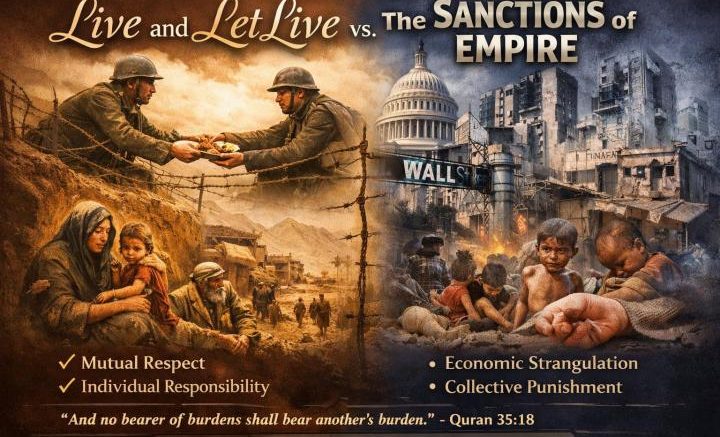
The phrase “live and let live” is more than a casual idiom; it is a foundational principle of pluralism. It suggests that peace is not achieved through forced conformity, but through the mutual recognition of autonomy. However, when this philosophy is contrasted with the geopolitical reality of long-term economic sanctions, a stark contradiction emerges between the ideal of sovereign tolerance and the practice of systemic strangulation.
Origins: From the Trenches to the Table
The exact linguistic roots of “live and let live” date back to the early 17th century, but its most poignant historical manifestation occurred during the “Live and Let Live” system of World War I. Amidst the brutal trench warfare, enemy soldiers occasionally reached tacit, non-aggressive agreements, refraining from firing during meal times or deliberately missing targets. They recognized that their survival depended on the restraint of the “other”.
In a broader sense, this encapsulates non-interference: the idea that individuals and nations should be allowed to pursue their own destiny without external dictation, provided they do not infringe upon the rights of others.
The Valley of Abi Talib: An Ancient Siege – A Historical Parallel
The struggle against economic coercion is not a modern phenomenon. In 617 CE, the Quraysh of Mecca imposed a total social and economic boycott on the Prophet Muhammad (p.b.u.h), his family (the Banu Hashim), and his followers. They were forced into a narrow mountain pass known as She’eb Abi Talib. This was not a targeted political move, but a three-year campaign of systemic starvation.
- The Experience: The sanctions prohibited any trade or marriage with the Muslims. Food became so scarce that historical accounts describe the cries of starving children echoing through the valley, and the besieged were forced to eat the leaves of trees.
- The Outcome: Much like modern sanctions, the primary victims were the vulnerable. The hardship of these three years is often cited as a contributing factor to the death of Khadija, Muhammad’s wife, and his protector, Abu Talib.
- The Resolution: The boycott only ended when a few Meccan leaders, moved by the “live and let live” sentiment and revolted by the cruelty, defied the decree. This event serves as a timeless archetype of how sanctions target the collective spirit by attacking the community’s physical body.
This ancient siege serves as a timeless archetype of how sanctions target the collective spirit by attacking the physical body of a civilian population.
The Modern “Empire” and the Architecture of Sanctions
In contrast to the “let live” philosophy stands the modern “Empire”, a term often used to describe hegemonic powers that utilize the global financial system as a weapon. While sanctions are framed as a “peaceful” alternative to kinetic warfare, decades of broad-based sectoral sanctions often tell a different story.
When a dominant power imposes severe sanctions on a nation for decades, the objective is typically to force a change in government behaviour or regime. However, the mechanism of this change often relies on economic strangulation.
- The Humanitarian Cost: Unlike targeted strikes, sanctions are blunt instruments. They degrade infrastructure, inflate the cost of basic goods, and collapse healthcare systems.
- The Civilian Toll: While the political elite often remain insulated, the “aspirational class”, students, doctors, and small business owners, find their futures extinguished.
- The Loss of Life: History shows that long-term sanctions can lead to increased infant mortality and the return of preventable diseases due to shortages of medicine and clean water.
Legal and Divine Prohibitions: Quranic and International Law
Both religious jurisprudence and modern international law provide a profound moral critique of this practice, labelling it as Collective Punishment.
The Quranic response to such aggression established a legal and ethical precedent that fundamentally opposes the logic of modern broad-scale sanctions. The primary principle is one of individual responsibility.
“And no bearer of burdens shall bear another’s burden”. (Quran 35:18)
This verse directly refutes collective punishment. In the Quranic view, it is a grave injustice to penalize an entire population for the decisions of their leaders or for the beliefs they hold. The discourse emphasizes:
- Proportionality: Justice must be targeted and precise.
- Humanity in Conflict: Even in states of war, the “let live” principle extends to non-combatants, the environment, and the infrastructure of life.
- The Prohibition of Starvation: Using food or water as a weapon of war or diplomacy is viewed as a violation of the “Covenant of Life” that God has established for all living beings.
Modern International Law:
The UN Charter and the Geneva Conventions echo this sentiment, though they are often bypassed by modern states.
- Article 33 of the Fourth Geneva Convention explicitly states, “No protected person may be punished for an offence he or she has not personally committed. Collective penalties and likewise all measures of intimidation or of terrorism are prohibited”.
- The Legal Loophole: Because modern sanctions are framed as “economic policy” rather than “armed conflict,” they often evade the scrutiny applied to kinetic warfare. However, under the UN Charter’s commitment to human rights (Articles 55 and 56), policies that cause mass civilian suffering are increasingly viewed by legal scholars as a breach of international obligations.
Comparison of Ethos
| Framework | Mechanism | Moral Verdict |
|---|---|---|
| “Live and Let Live” | Mutual Restraint | Peace through pluralism and autonomy. |
| Meccan Boycott | Starvation & Isolation | Condemned as “the severing of ties” and cruelty. |
| Quranic Law | Individual Accountability | Injustice to punish the innocent for the guilty. |
| Modern Sanctions | Financial Hegemony | Technically “policy,” ethically “Collective Punishment”. |
Modern Law and the “Empire”
The contrast between these ancient principles and modern “Imperial” sanctions reveals a regression in humanitarian ethics. While the Geneva Conventions (specifically Article 33 of the Fourth Convention) explicitly prohibit collective punishment, modern states often circumvent this through the financial system.
- The Legal Loophole: Because sanctions are framed as “economic policy” rather than “armed conflict,” they often evade the scrutiny applied to kinetic warfare.
- The Moral Gap: If “live and let live” is the benchmark for a civilized world, then decades-long sanctions are a failure of that civilization. They represent a “slow-motion siege” that mirrors the valley of Abi Talib, using the denial of resources to achieve political ends.
Comparison Summary
| Era | Method | Target | Moral Verdict |
|---|---|---|---|
| Meccan Siege | Social/Economic Boycott | Entire Clan (Banu Hashim) | Condemned as an act of “cruelty” and “severing of ties”. |
| Quranic Law | Individual Responsibility | The wrongdoer only | “No bearer of burdens shall bear another’s”. |
| Modern Sanctions | Financial Isolation | The “Aspirational” Civilian | Technically legal, yet ethically “Collective Punishment”. |
Conclusion
The journey from the starving valleys of 7th-century Arabia to the sanctioned nations of the 21st century highlights a recurring human tragedy: the powerful’s tendency to use the survival of the innocent as a bargaining chip. By returning to the ethos of “live and let live”, and to the Quranic insistence that no soul should suffer for another’s “burden”, we find a roadmap for a more humane global order that values the sanctity of life over the mechanics of empire.
“Live and let live” is a plea for humility in the exercise of power. It acknowledges that the world is a tapestry of different ideologies and cultures. When global powers pivot from this ethos toward a policy of “comply or perish” through economic warfare, the result is often a betrayal of the very humanity they seek to defend.
To truly “let live” requires more than the absence of bombs; it requires the allowance of a people to breathe and trade without the suffocating weight of external dictates. By returning to the ethos of “live and let live”, and the legal insistence that no soul should bear the burden of another, we find a roadmap for a more humane global order that values life over the mechanics of empire.
“O humanity! Indeed, We created you from a male and a female, and made you into peoples and tribes so that you may ˹get to˺ know one another. Surely the most noble of you in the sight of God is the most righteous among you. Allah is truly All-Knowing, All-Aware.” Quran Chapter 49:13