The word commensality literally means “eating at the same table,” or more broadly, “eating with others,” and it is a practice embedded in most, if not all, major faith traditions.
For Guyanese Muslims, commensality comes alive for the entire Islamic lunar month of Ramadan, which began last Thursday. It is a tradition, in Guyana and in countries where Muslims are either the majority or minority, for believers to voluntarily trade domestic commensality for a communal experience, often bringing along a dish prepared at home to share in the collective breaking of the fast.
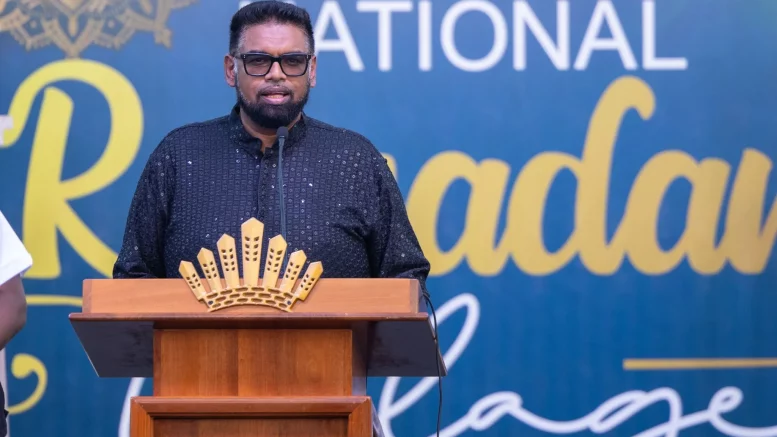
After an entire day abstaining from food and drink, it is perhaps natural that the nights of Ramadan unfold in the warmth of prayer and a shared meal. Yet what sets Guyana’s Ramadan Village apart, an initiative, it bears repeating, conceived by President Irfaan Ali, is that it moves the centre of gravity from the domestic to the communal, and now, to an institutional setting, nowhere more appropriate than the grounds of the Muslim Youth Organisation on Woolford Avenue in Thomas Lands. In doing so, it elevates the sacred act of breaking the fast, or iftar, from the intimacy of our neighbourhood masjids to a national platform, expanding the circle of fellowship and reaffirming our shared obligations as citizens bound by faith, community, and country.
More specifically, it is also an occasion to reflect on the production of the food we consume. More specifically, who are the farmers, small and big, that produce our food? What effort do they expend to ensure that the food nourishes our bodies instead of making us sick and unhealthy? How does it get from their farms to our markets and kitchens?
The majority of Guyanese, I am sure, are grateful to live in a country that produces all the food types we require as human beings to survive. On my way to the Parika market, it is hard to miss a large billboard celebrating this astonishing accomplishment. Under President Ali’s tenure and the stewardship of Guyana’s Minister of Agriculture, Zulfikar Mustapha, researchers from the University of Göttingen in Germany and the University of Edinburgh in the UK revealed that out of 186 countries, only Guyana has scored 100 per cent, giving it the distinction of being food self-sufficient.
And yet that’s hardly the full story of the food revolution quietly unfolding in Guyana. When President Ali walked through the Christmas farmers’ market, or I see him moving through the stalls at the Ramadan Village, marvelling at a juicy mango, a papaya or a pineapple on display, I hear echoes of the central thesis in his 2024 book, Achieving Global Food Security: The Caribbean Experience and Beyond. Dr Ali is not only consumed with growing more, but his vision is also to share the food Guyana produces with our neighbours in the wider Caribbean and with the world.
In a sound narration of the Prophet of Islam, he is reported to have said: “Indeed, the most beloved food in the eyes of God is that upon which the hands are many.” That is not just a pious sentiment; it is akin to a social and political challenge. President Ali understands that if Guyana is to share its food in that spirit, if we are to move toward a truly national commensality, then the country must build food systems that are efficient enough to feed more people, inclusive enough to reach the margins of society, and environmentally resilient enough to endure climate change.
And that’s exactly what staff at the Ministry of Agriculture, under the stewardship of the Hon. Zulfikar Mustapha, have been busy doing. Guyana is now using GIS and data-driven decision-making to drive up crop yields. The government invested roughly US$165,000 in advanced crop-management drones, software and training for Guyana Rice Development Board staff, then made these same high-end services available to small farmers free of cost.
In doing so, President Ali and Minister Mustapha are pairing field-level tools with system-level reform, launching a national Agriculture Information System that pulls daily reports from extension officers, feeds real-time dashboards and gives policymakers a live, data-rich picture of the sector to plan production, manage risk and attract new investment.
The message is simple: science, precision farming, biotech labs, nano‑fertilisers and digital platforms are designed to make Guyana both an oil producer and a regional agricultural powerhouse. I believe the Ramadan Village is a living metaphor for a kind of commensality that is a moral ideal and not just a warm, fuzzy feeling one gets from the scent of freshly cooked dhal.
National commensality will only become real when the Ramadan Village ethic of shared plates and crowded tables is reflected in how we value our food, how the state supports production and farmers, feeds schoolchildren and cushions the vulnerable.
Each time we pass a plate to a stranger at the Ramadan Village, we are indeed observing a spiritual act, but we are also performing a civic duty. If President Ali’s food security project succeeds, it will not be measured only in yields and export figures, but in how many hands, at home and across the Caribbean, find their way to the same national plate.
This opinion piece was first published in the Sunday Chronicle, February 22, 2026.