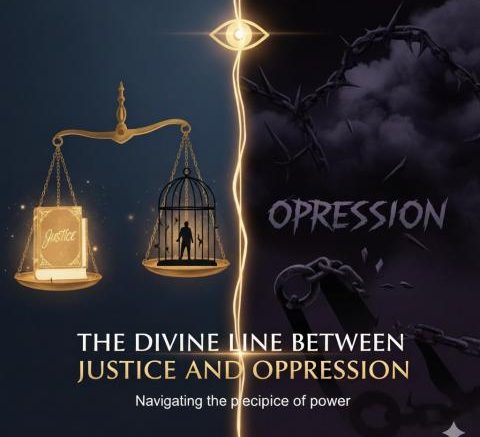
Why the absence of justice is itself a moral crime.
In political and social philosophy, the absence of justice is widely characterized as injustice, and it is frequently identified as a fundamental component or precursor of oppression. While the two terms are closely related, they are often distinguished by their scale and impact.
Section I. Injustice vs. Oppression: A Conceptual Framework
Injustice and Oppression: Not the Same, But Never Separate
- Injustice is generally defined as the absence or opposite of justice, referring to unfairness, violation of rights, or uncorrected malfeasance within a legal or social system.
- Oppression is the systemic and institutionalized use of power to subordinate, restrict, or discriminate against specific groups.
Philosophers like Iris Marion Young argue that injustice manifests primarily through two disabling constraints: domination and op
Section II: The Relationship Between Them
Silence, Power, and the Architecture of Oppression
- Failure of Duty: A state’s failure to perform its duty to fulfil human rights and protect citizens is a form of oppression.
- The “Five Faces” of Oppression: Oppression is characterized by five specific conditions: exploitation, marginalization, powerlessness, cultural imperialism, and systemic violence.
- Silence and Inaction: Remaining silent in the face of injustice is frequently described as a tool that allows oppression to continue unchecked.
Section III: Justice Beyond the Absence of Oppression
Justice is More Than Survival
- Modern perspectives suggest that true justice requires more than just stopping harm. As noted by leaders like Barack Obama, “Justice is not only the absence of oppression; it is the presence of opportunity.”
- Justice is the presence of equity and the elimination of barriers that prevent individuals from realizing their full potential.
In summary, while the absence of justice (injustice) is the broader condition, it becomes oppression when that lack of fairness is used systemically to maintain power over others.
Section IV: The Concept of Justice (‘Adl)
Justice as balance, duty, and Divine command
- Definition: Justice is “placing everything in its right position” and ensuring everyone receives their due rights without discrimination.
- Divine Command: The Quran commands believers to be “persistently standing firm in justice,” even if it is against themselves, their parents, or their kin (Quran 4:135).
- Impartiality: Justice must be maintained regardless of social status, wealth, or even hatred toward a people. Quran 5:8 instructs: “Let not the hatred of a people prevent you from being just.”
- Prophetic Mission: Establishing justice is identified as the primary purpose for which Allah sent messengers and scriptures (Quran 57:25).
Section V: Understanding Zulm (Oppression)
Zulm: The Sin Allah Forbade Even for Himself
- Definition: Oppression is “misplacing something” or “putting something where it does not belong”. It is considered one of the most heinous crimes and a grave sin.
- Divine Prohibition: In a powerful Hadith Qudsi, Allah states: “O My servants, I have forbidden oppression for Myself and have made it forbidden amongst you, so do not oppress one another”.
- Forms of Zulm: It encompasses three main types:
- Injustice against Allah: Shirk (associating partners with God).
- Injustice against others: Violating the rights, lives, or property of fellow humans.
- Injustice against oneself: Committing sins that harm one’s own spiritual well-being.
Section VI: Responding to Injustice and Oppression
Faith Demands Action
- The Supplication of the Oppressed: Hadith teachings emphasize that there is “no barrier between the supplication of the oppressed and God,” meaning their prayer for justice is directly heard and answered.
- Duty to Act: Muslims are commanded to oppose oppression actively. The Prophet Muhammad (PBUH) instructed: “Help your brother, whether he is an oppressor or an oppressed one.” When asked how to help an oppressor, he replied, “By preventing him from oppressing others”.
- Consequences of Silence: Remaining silent in the face of an oppressor is warned against; one hadith states that if people see an oppressor and do not stop him, they may all be subject to divine punishment.
- Spiritual Consequences: Oppression is “darkness on the Day of Judgment” (Zulm is Zulumaat). Oppressors will face severe accountability, where God may transfer their good deeds to those they wronged.
1. The Three Tools of the Prophetic Mission
- Clear Proofs (Bayyinaat): These include miracles and undeniable evidences that establish the truth of the message, ensuring people are guided by reason and conviction rather than blind faith.
- The Scripture (Al-Kitab): The Book serves as the legislative foundation, detailing divine and human rights and providing clear laws to prevent their violation.
- The Balance (Al-Mizan): Often interpreted as the “criterion” of right and wrong, the Balance provides a standard for evaluation. It ensures that human affairs—social, ethical, and economic—remain in a state of just equilibrium.
2. The Objective: “That Mankind May Uphold Justice”
- Self-Governance: Justice is established when individuals are intellectually and spiritually developed enough to recognize and fulfill their obligations to God and others.
- Institutional Fairness: The prophetic mission aims to build a social system that eliminates all forms of extremism and safeguards every individual’s rights.
3. The Role of Power (“Iron”)
- Enforcement as a Last Resort: Classical tafsir, such as Ma’arif-ul-Quran, notes that while education and the “Book” come first, “Iron” (representing state and military power) is sent to protect the just system.
- Protecting the Vulnerable: Power is viewed as a necessary tool to stop tyrants from perpetuating oppression and to ensure that divine justice can be practically implemented in a world where some will always resist fairness.
Conclusion Section:
Standing Firm: Justice, Oppression, and the Divine Mission
In our modern landscape, the conversation around social equity often oscillates between legal definitions and personal activism. But is the mere absence of justice enough to constitute oppression? According to the Quran and Hadith, the answer is a resounding yes; the two are closely linked through the concept of Zulm.
The Fine Line Between Injustice and Oppression
In political philosophy, injustice is often seen as a specific failure—a broken law or an unfair ruling. However, oppression is systematic; it is the institutionalized use of power to subordinate others.
In Islamic thought, this distinction blurs into the singular concept of Zulm. Linguistically, Zulm means “misplacing something” or putting it where it does not belong. When justice (‘Adl) is absent, things are inherently misplaced. Thus, the absence of justice is not just a “void”; it is an active form of oppression that restricts human potential and violates divine decree.
Moving Beyond Silence
In 2026, let us remember that “helping” a brother who is an oppressor means stopping them from committing further injustice. Whether it is through physical intervention, speaking truth to power, or at least hating the wrong in our hearts, the Prophetic mission demands active engagement.
True justice is more than the absence of harm; it is a system in which every individual has their “due right” and the opportunity to thrive. As the Quran reminds us, standing for justice is a “sacred duty,” even if it goes against ourselves or those closest to us.