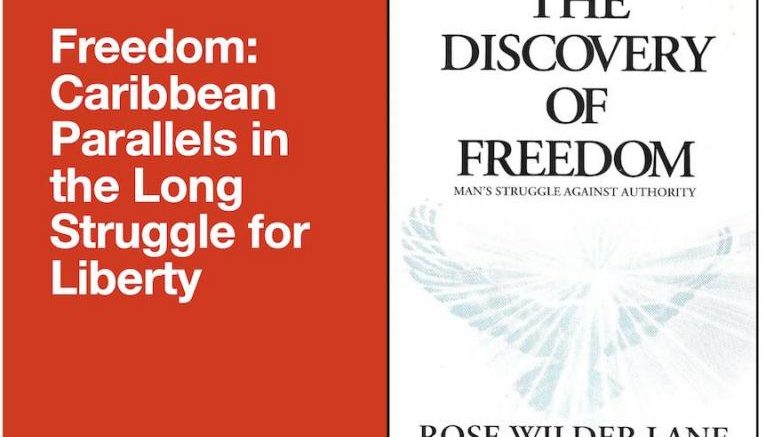
The ideas associated with Islam, especially the emphasis on individual responsibility, legal order, and intellectual inquiry, “advanced human freedom in a way that had a profound historical impact” (Rose Wilder Lane) before modern Europe and America. Scholars who have studied Lane’s work confirm that her narrative identifies Muhammad (pbuh) and Islamic civilization as the “second attempt” in history to establish liberty in the world, following Abraham (pbuh) and preceding the French and American Revolutions.
The Discovery of Freedom: Caribbean Parallels in the Long Struggle for Liberty
For Caribbean societies shaped by enslavement, indentureship, and colonial rule, freedom has never been theoretical. It has been contested, delayed, and often denied. In The Discovery of Freedom (1943), American writer and political thinker Rose Wilder Lane offered a framework that resonates strongly with the Caribbean experience: freedom is not a Western gift, nor a modern invention, but a rare human discovery, one that appears, disappears, and must be consciously defended.
Lane’s insights allow Caribbean readers to place their own history within a global narrative of resistance to absolute power.
Freedom begins in the human conscience
Lane wrote: “Freedom is the discovery that the human mind is free.”
This idea mirrors the earliest acts of resistance in the Caribbean. Long before emancipation laws, enslaved Africans asserted freedom internally, through language, religion, culture, and revolt. Maroon communities across Jamaica, Suriname, and Guyana embodied this discovery by rejecting the moral authority of slave systems and governing themselves beyond plantation control.
Freedom in the Caribbean began not in legislatures, but in refusal.
Islam and Caribbean resistance to dehumanization
Lane’s identification of Islam as the second great freedom movement gains special significance in the Caribbean context.
She wrote of Islam: “No man could rule another by divine authority.”
This principle echoed among enslaved West African Muslims in the Caribbean, many of whom were literate, legally trained, and spiritually grounded before enslavement. Historical figures such as Ayuba Suleiman Diallo (though enslaved elsewhere in the Americas) reflect a broader Atlantic reality in which Islam provided a language of dignity and equality under brutal conditions.
In Trinidad, Guyana, Suriname, and Jamaica, Islam survived through enslaved Africans and later through indentured South Asians. For these communities, Islam functioned not as conquest, but as moral resistance, affirming personhood in societies built on racial hierarchy.
Lane’s framing helps modern Caribbean readers understand Islam as part of the region’s freedom heritage, not an external import.
The American Revolution and Caribbean contradictions
Lane viewed the American Revolution as successful because it restrained government rather than merely replacing rulers: “The American Revolution was not a revolt against government, but against unlimited government.”
The Caribbean, however, experienced this revolution’s contradiction firsthand. While liberty was proclaimed in North America, slavery intensified in the British and French Caribbean to sustain imperial economies.
This contradiction fueled Caribbean resistance, most notably the Haitian Revolution (1791–1804) — the most radical assertion of freedom in the Atlantic world. Enslaved Africans in Saint-Domingue did what no European revolution fully achieved: they made freedom universal and irreversible, abolishing slavery entirely and permanently.
From Lane’s perspective, Haiti represents freedom discovered not in theory, but in existential necessity.
The French Revolution and the warning of centralized power
Lane’s critique of the French Revolution is particularly relevant to Caribbean history.
She warned: “When the state becomes the source of rights, freedom is already gone.”
The French Revolution proclaimed liberty, yet delayed abolition in its colonies and later reimposed slavery under Napoleon. Caribbean people experienced firsthand what Lane described: freedom promised in words, but withdrawn by centralized authority.
This lesson extends into the post-emancipation and post-independence Caribbean. Political independence did not automatically dismantle colonial structures of power. In some cases, state authority simply replaced imperial authority, leaving economic inequality and social control largely intact.
Maroons, indentureship, and lived freedom
Lane’s insistence that freedom must be limited power, not transferred power, aligns with Caribbean experiences beyond slavery.
•Maroons negotiated treaties that recognized autonomy, not subordination.
•Indentured labourers from India resisted coercion through legal petitions, religious preservation, and eventual political organization.
•Post-emancipation villages across Jamaica, Barbados, and Guyana represented grassroots efforts to live beyond plantation authority.
These were not ideological revolutions, but practical discoveries of freedom, lived, defended, and often fragile.
Why Lane’s framework matters for the Caribbean today
Rose Wilder Lane’s work challenges Caribbean societies to ask difficult questions:
•Does independence limit power, or merely relocate it?
•Are rights inherent, or dependent on the state?
•Is freedom cultural and moral, or only political?
Her warning remains urgent: “Freedom is not secure. It can be lost.”
For Caribbean nations still navigating post-colonial governance, economic dependency, and cultural identity, The Discovery of Freedom offers not a solution, but a lens, one that situates Caribbean struggles within a global, multi-civilizational pursuit of human dignity.
A shared human inheritance
Lane’s great contribution was to insist that freedom belongs to no single people or continent. The Caribbean’s history, from Maroon resistance to the Haitian Revolution, from Muslim survival under slavery to post-independence self-definition, confirms her insight.
Freedom is not inherited.
It is discovered, and rediscovered, by those who refuse to accept domination as destiny.
Jihad: The Struggle for Justice and Freedom of Worship
Any serious reflection on freedom must also address struggle, for liberty has never emerged without resistance. In Islamic thought, that struggle is expressed through the concept of jihad, a term often misunderstood, yet deeply connected to justice and freedom of conscience.
At its root, jihad means striving, on moral, spiritual, and social levels, to uphold what is right. Classical Islamic teachings emphasize that the highest form of jihad is not violence, but the struggle against injustice, oppression, and moral corruption, beginning within the self and extending into society.
This understanding aligns closely with the freedom movement Rose Wilder Lane identified in early Islam. The Qur’an’s insistence that “there is no compulsion in religion” (Qur’an 2:256) established freedom of belief as a moral principle long before it became a political one. Worship, in Islam, must be voluntary, sincere, and uncoerced, a direct challenge to systems that enforced belief through power.
In the Caribbean, where freedom of worship was historically denied to enslaved Africans and restricted under colonial rule, this principle carries particular weight. Enslaved Muslims were punished for prayer, language, and dress; African religions were suppressed; later, indentured communities faced pressure to abandon their faiths. Yet resistance endured, through quiet devotion, communal solidarity, and cultural survival.
Jihad, in this sense, mirrors the Caribbean experience of freedom as patient resistance. It is the struggle of Maroons who defended their autonomy, of enslaved people who preserved faith under threat, and of post-emancipation communities who insisted on dignity without permission. It is not a call to domination, but a refusal to submit conscience to coercion.
Rose Wilder Lane warned that freedom is lost when authority goes unquestioned. Islamic thought offers a parallel warning: power is accountable, and injustice, whether committed by rulers or states, must be resisted. In both traditions, freedom is anchored in moral responsibility, not political slogans.
To understand jihad as a struggle for justice and freedom of worship is to reclaim its ethical core. It reminds us that liberty is not sustained by force, but by conscience; not guaranteed by the state, but defended by individuals and communities.
In this light, the Caribbean story, Islamic tradition, and Lane’s philosophy converge on a shared truth: freedom is discovered whenever human beings refuse to surrender their moral agency and choose justice over fear.