Abstract
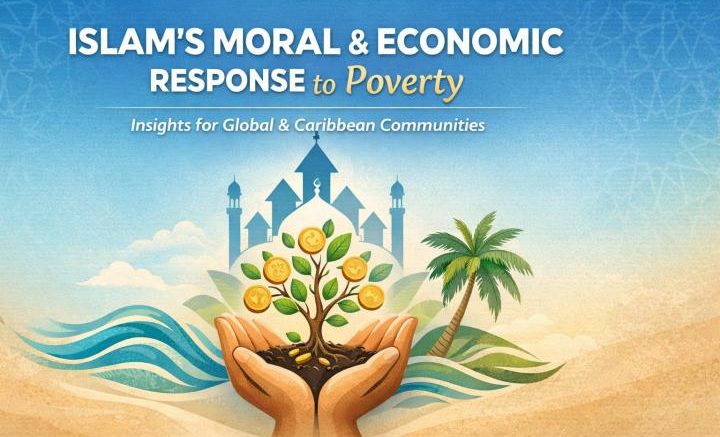
Poverty remains one of the most persistent global challenges, undermining human dignity, social stability, and sustainable development. While modern poverty discourse often focuses on policy and market-based solutions, religious traditions have historically shaped redistributive ethics and welfare systems. This paper argues that Ramadan should be understood not merely as a seasonal charitable period but as an integral component of Islam’s comprehensive structural framework for poverty alleviation. By examining theological foundations, institutional mechanisms, behavioural incentives, and Caribbean realities, the paper demonstrates that Ramadan operates as an annual moral and economic accelerator within a broader system designed to prevent wealth concentration and protect the vulnerable. The analysis highlights the continued relevance of faith-based economic ethics in contemporary poverty discourse, particularly in small and vulnerable economies such as those in the Caribbean.
1. Introduction: Poverty as a Global and Caribbean Imperative
From an analytical perspective, it is important to distinguish between poverty and structural poverty. Poverty generally refers to a condition of material deprivation in which individuals or households lack sufficient resources to meet basic needs. Structural poverty, however, denotes systemic and institutional arrangements that reproduce deprivation across time through unequal access to assets, opportunities, and economic participation. While Ramadan plays a significant role in mitigating immediate hardship through accelerated redistribution and heightened charitable activity, the broader Islamic economic framework, including Zakah, inheritance dispersion, prohibition of exploitative finance, and social welfare obligations, aims more fundamentally at preventing the persistence of structural poverty. This distinction is essential for understanding Ramadan not as an isolated charitable season but as a reinforcing mechanism within Islam’s comprehensive approach to economic justice.
Poverty remains one of the defining moral and developmental challenges of the 21st century. Globally, more than 800 million people continue to live in extreme poverty, while over one billion experience multidimensional deprivation affecting health, education, housing, and nutrition. Although substantial progress was achieved between 1990 and 2015, recent years have witnessed a slowdown due to economic shocks, climate vulnerability, conflict, and post‑pandemic instability.
The Caribbean region reflects these global dynamics in context-specific ways. Many Caribbean states have achieved moderate to high human development indicators; however, structural vulnerabilities persist. Small island developing states face limited economic diversification, high public debt, exposure to climate change, and dependence on tourism and external markets. Income inequality remains pronounced in several territories, and pockets of poverty persist among rural populations, youth, informal workers, and female-headed households.
In this environment, poverty reduction is not merely an economic objective but a moral and social imperative. While state-led interventions remain critical, non-state actors, including faith-based institutions, play an important complementary role. This paper situates Ramadan within Islam’s broader structural response to poverty and argues that its annual observance strengthens both the moral and material foundations of social protection.
2. Islam’s Structural Approach to Poverty
Islam offers a comprehensive framework for economic justice, with poverty alleviation at its core. Classical Islamic scholarship identifies the preservation of life, dignity, and social stability among the higher objectives (maqasid) of the Shariah. Within this framework, poverty is treated not as an inevitable condition but as a social failure requiring corrective intervention.
Islam’s structural approach rests on several interlocking pillars:
• Obligatory redistribution through Zakah
• Prohibition of exploitative accumulation (riba/usury)
• Encouragement of productive enterprise and lawful trade
• Inheritance laws that disperse wealth across generations
• Waqf endowments for long-term public welfare
• Family-based financial responsibility
• State responsibility for public welfare
Together, these mechanisms aim to ensure the circulation of wealth, protect the vulnerable, and prevent extreme inequality. Ramadan must therefore be understood within, not outside, this structural architecture.
3. Ramadan as an Annual Moral and Economic Accelerator
Ramadan, the ninth month of the Islamic lunar calendar, is distinguished by the obligation of fasting from dawn until sunset. While the fast is fundamentally spiritual, aimed at cultivating taqwa (God‑consciousness), its socio‑economic implications are profound.
Ramadan does not create a separate welfare system. Rather, it intensifies and reactivates Islam’s permanent redistributive framework. During this month:
• Zakah payments are frequently discharged
• Voluntary charity increases significantly
• Feeding programmes expand
• Communal solidarity is strengthened
Ramadan functions as an annual recalibration mechanism. It renews commitment to redistribution, mobilizes dormant charitable capital, and reinforces social responsibility. In this sense, Ramadan operates as a periodic accelerator embedded within a continuous structural system.
This positioning is critical. Without Islam’s structural economic rules, Ramadan’s charitable surge could risk being a temporary relief. Conversely, without Ramadan’s moral intensification, structural mechanisms could weaken through complacency. The two operate symbiotically.
4. Embodied Empathy and Behavioural Transformation
A distinctive feature of Ramadan is the universal experience of hunger and thirst among adult Muslims, regardless of socio-economic status. For the affluent, deprivation becomes experiential rather than theoretical.
This embodied empathy performs a powerful psychological function. When hunger is personally experienced, the emotional distance between the rich and the poor narrows. Numerous Muslim communities worldwide report significant increases in charitable giving during Ramadan, suggesting measurable behavioural effects.
From a behavioural economics perspective, Ramadan creates a temporary but powerful moral environment that shifts social norms toward generosity. Spiritual incentives, communal expectations, and heightened awareness of inequality combine to stimulate redistributive behaviour.
In Caribbean Muslim communities, where minority populations often rely heavily on communal networks, this effect is particularly visible through mosque-led feeding initiatives, food hamper distributions, and interfaith outreach.
5. Institutional Mechanisms Activated During Ramadan
Ramadan reinforces several formal redistributive instruments within Islamic law.
Zakah Concentration: Although payable annually, many Muslims choose to discharge Zakah during Ramadan, resulting in a seasonal liquidity surge directed toward the poor and vulnerable.
Fidya and Expiation: Individuals permanently unable to fast must feed a poor person for each missed day. Intentional violation of the fast requires either sixty consecutive days of fasting or feeding sixty poor persons. These provisions ensure that personal incapacity generates social benefit.
Sadaqat‑ul‑Fitr: At the conclusion of Ramadan, every eligible Muslim must pay a compulsory charity specifically intended to provide food for the poor before Eid celebrations.
Together, these mechanisms institutionalize redistribution and ensure that Ramadan produces tangible material impact alongside spiritual development.
6. Dignity, Inclusion, and Psychological Empowerment
Ramadan’s impact on poverty extends beyond financial transfers. The poor participate equally in fasting, reinforcing moral equality before God. Their spiritual status is not diminished by economic condition.
For one month, physical hunger becomes a shared experience across class lines. This symbolic equalization strengthens dignity, belonging, and communal cohesion. Such psychological empowerment is an often overlooked but essential dimension of poverty alleviation.
In plural Caribbean societies, Ramadan activities frequently extend beyond Muslim beneficiaries, strengthening inter‑communal solidarity and reinforcing social inclusion.
7. Caribbean Relevance and Development Implications
The Caribbean presents a unique socio-economic landscape marked by structural vulnerability, climate exposure, and persistent inequality. While state welfare systems provide important support, fiscal constraints and economic volatility limit their reach.
Faith-based redistributive mechanisms, therefore, play a meaningful complementary role. In territories such as Trinidad and Tobago, Guyana, and Suriname, Ramadan regularly mobilizes significant community resources through:
• Mosque feeding programmes
• Community food drives
• Financial assistance initiatives
• Collaborative interfaith outreach
These efforts provide short-term relief while reinforcing longer-term cultures of giving and mutual support. For small and vulnerable economies, such moral economies can strengthen social resilience alongside formal policy measures.
8. Limitations and Structural Considerations
Despite its significant contributions, Ramadan alone cannot eradicate structural poverty. Sustainable poverty reduction requires employment generation, access to education, economic diversification, and sound public policy.
However, dismissing Ramadan as merely symbolic would overlook its measurable redistributive effects and its role in shaping ethical economic behaviour. The most effective poverty strategies often combine institutional design with moral motivation. Islam’s framework, within which Ramadan operates, attempts precisely this synthesis.
9. Conclusion
Ramadan should be understood not as a standalone charitable season but as an integral part of Islam’s comprehensive framework for alleviating structural poverty. Through obligatory redistribution, moral incentivization, empathy cultivation, and institutionalized feeding mechanisms, Ramadan annually renews the Islamic commitment to social justice.
In a world marked by widening inequality and recurring economic shocks, Ramadan offers an instructive model of how ethical transformation can reinforce structural redistribution. Particularly within vulnerable regions such as the Caribbean, the integration of moral economies with formal development strategies deserves renewed scholarly and policy attention.
Ultimately, enduring poverty solutions require both sound institutions and ethical renewal. Ramadan powerfully demonstrates how the two can work together.