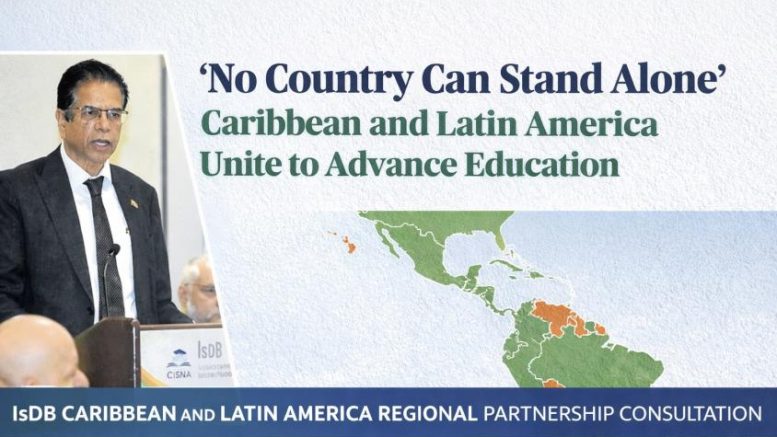
As regional representatives gathered in conference under the theme “Empowering Communities in the Caribbean and Latin Americas,” a clear message emerged: the challenges facing education today transcend national borders and demand collective solutions.
The Islamic Development Bank (IsDB) CARIBBEAN AND LATIN AMERICA REGIONAL PARTNERSHIP CONSULTATION was held in Port of Spain, the capital city of the Republic of Trinidad and Tobago, between December 4 and December 6, 2025. The Consultation was carried out by the IsDB (Special Assistance Division) in collaboration with the Council of Islamic Schools of North America (CISNA) and its representative, Sufia Azmat, and with the support and cooperation of the Islamic Missionaries Guild in Trinidad, and with network support from the Organization for Islam in Latin America and the Caribbean (OIPALC).
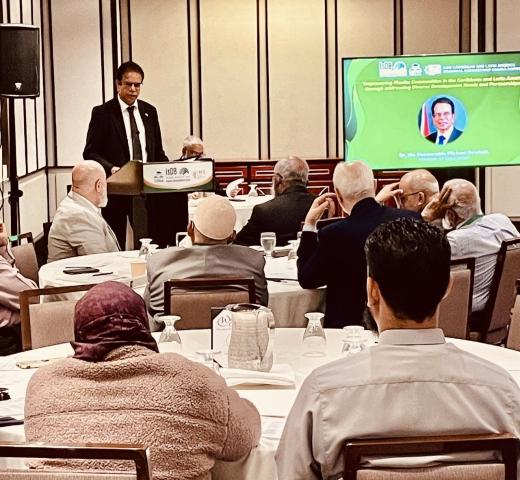
Minister Dowlath addresses the Consultation
Education as a Shared Regional Journey
In his address, Minister Dowlath reflected on the region’s interconnected history and emphasized education as a unifying force. He noted that across the Caribbean and Latin America, societies have been shaped by movement, diversity, resilience, and an enduring pursuit of progress. Education, he said, has always stood at the centre of this journey “your journey, our journey, and the journey of all who work to uplift communities through knowledge, values, and opportunity.”
The Minister reaffirmed Trinidad and Tobago’s commitment to strengthening education systems through partnerships that prioritize early intervention, equitable access to technology, and support for vulnerable learners. His remarks resonated strongly with delegates, reinforcing the consultation’s emphasis on collaboration over isolation.
From Donor-Recipient to Co-Creation
A defining feature of the consultation was the IsDB’s strategic shift in engagement with Muslim communities in non-member countries. Recognizing the “double burden” faced by these communities: balancing religious identity within secular societies while confronting economic marginalization and widening digital gaps, the IsDB piloted a Co-Creation Model.
Rather than relying solely on financial assistance, the model brought together regional leaders to co-design solutions rooted in local realities. This approach marked a transition from a traditional donor–recipient framework to a strategic partnership model, aimed at building resilient educational ecosystems.
The Tripartite Partnership Model
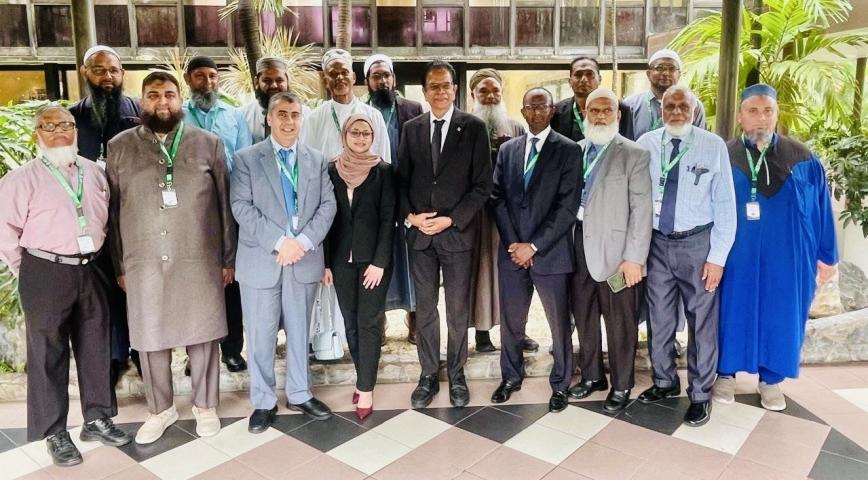
Consultation Participants
This collaborative framework demonstrated that coordinated interventions yield higher-impact and more sustainable outcomes than isolated efforts. To ensure continuity, participants proposed establishing a Steering Committee comprising representatives from IsDB, IMG, CISNA, and OIPALC. The committee would meet quarterly to monitor progress, ensure accountability, and guide the release of seed funding aligned with agreed milestones.
Broad Regional Participation and Practical Learning
The consultation attracted high-level participation from seventeen countries and territories, spanning the English-speaking Caribbean, Central America, and South America. Delegates represented Antigua and Barbuda, Barbados, Dominica, Grenada, Jamaica, St. Lucia, Trinidad and Tobago, the US Virgin Islands, Costa Rica, El Salvador, Mexico, Panama, Bolivia, Brazil, Guyana, Suriname, and Venezuela.
On the second day, participants toured three established Muslim schools in Trinidad, an experience many described as transformative. The visits demonstrated that, with vision, commitment, and community support, schools of excellence can be successfully established across the region.
Towards a Regional Educational Network
One of the key outcomes of the consultation was a proposal to establish a Muslim Educational Network of the Caribbean and Latin America, designed to facilitate knowledge-sharing, curriculum development, leadership training, and institutional support. An exploratory group has been formed to advance this initiative, marking a significant step toward long-term regional collaboration.
The consultation also provided participants with an invaluable opportunity to reconnect, strengthen bonds, and renew a shared sense of purpose. Over three days of dialogue and exchange, delegates identified pathways to build resilient, high-quality educational institutions that serve their communities with excellence.
A Shared Commitment to the Future
The presence of Dr Aiyna Ali, Deputy Speaker of the House, and Brother Abdelhakim Yessouf, Manager at the Islamic Development Bank, further underscored the gathering’s significance. Their participation reflected a growing recognition that education is not only a national priority, but a regional responsibility.
As the consultation concluded, one message stood out clearly: the future of education in the Caribbean and Latin America will be shaped not by isolated efforts, but by unity, shared vision, and strategic partnership. In the words echoed throughout the gathering, the region must—and can—rise together.