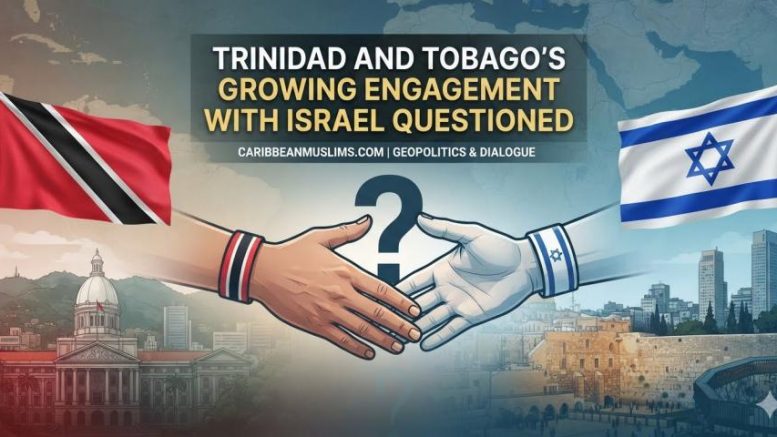
The relationship between Trinidad and Tobago and the State of Israel has once again come under strong criticism from the Islamic Missionaries Guild (IMG) President and the Concerned Muslims of Trinidad and Tobago (CMTT) Public Relations Officer, Imtiaz Mohammed.
In a media release, in response to the Government’s recent
diplomatic engagement with Israel, Mohammed argued that recent foreign policy decisions represent a departure from the principles many expected the Government to uphold, particularly at a time when the humanitarian crisis in Gaza continues to draw widespread international concern.
The Immediate Concern
The controversy follows a meeting between Minister of Foreign and CARICOM Affairs Sean Sobers and Israel’s Non-Resident Ambassador, Eynat Shlein, during which discussions reportedly centred on expanding cooperation in areas aligned with Trinidad and Tobago’s national development priorities. According to the Ministry, the discussions focused on establishing a practical framework for bilateral cooperation.
For Mohammed, however, the meeting represents more than routine diplomacy.
He contends that recent decisions by the Government, including strengthening relations with Israel, supporting legislation designating Hamas, Hezbollah and other organisations as terrorist entities, and voting against the reappointment of United Nations High Commissioner for Human Rights Volker Türk, collectively signal a foreign policy that distances Trinidad and Tobago from those advocating for Palestinian human rights.
Concerns Shared Across the Muslim Community
In its statement, ASJA argued that the vote was inconsistent with Trinidad and Tobago’s longstanding reputation as a principled advocate for international law, human rights and the protection of vulnerable populations. The organisation noted that Volker Türk has repeatedly raised concerns about the humanitarian situation in Gaza and has consistently called for all parties to the conflict to comply with international humanitarian law. ASJA questioned why Trinidad and Tobago would oppose the continuation of a UN official whose mandate is to speak out against human rights abuses wherever they occur.
The intervention by both ASJA and the Islamic Missionaries Guild underscores that concerns over the Government’s approach to Israel and Palestine are shared across different segments of the national community. While the organisations may express themselves in different ways, both have urged the Government to ensure that its foreign policy remains firmly anchored in justice, respect for international law and the defence of universal human rights.
A Wider Political Critique
In the media release, Mohammed also alleged that the Government has increasingly aligned its foreign policy with the United States’, citing regional security cooperation and other strategic decisions as evidence of the shift. He warned that expanding ties with Israel while the conflict in Gaza continues risks alienating significant sections of Trinidad and Tobago’s Muslim community.
His comments culminated in a call for Muslims to reconsider their political support for the governing United National Congress (UNC), framing the issue as one of moral accountability rather than ordinary political disagreement.
Trinidad and Tobago’s Legacy in International Criminal Justice
The debate surrounding Trinidad and Tobago’s vote on the reappointment of United Nations High Commissioner for Human Rights Volker Türk has also prompted renewed reflection on the country’s historic contribution to the development of international criminal justice.
Few nations of Trinidad and Tobago’s size have left such a profound mark on international law. In 1989, then Prime Minister A. N. R. Robinson took the bold initiative of reviving before the United Nations General Assembly the long-dormant proposal for the establishment of a permanent International Criminal Court (ICC). While the immediate catalyst was the growing threat posed by international drug trafficking, Robinson recognised the need for a standing international tribunal capable of prosecuting individuals responsible for the gravest crimes when national courts were unable or unwilling to do so. His initiative ultimately helped set in motion the diplomatic process that culminated in the adoption of the Rome Statute in 1998 and the establishment of the International Criminal Court in 2002. (ICC Court of Arbitration)
Today, the ICC serves as the world’s permanent court for the prosecution of genocide, crimes against humanity, war crimes and the crime of aggression. Consistent with the vision championed by Robinson, the Court has the authority to investigate alleged perpetrators and, where the legal threshold is met, issue arrest warrants that are to be executed by States Parties to the Rome Statute. Over the years, the Court has issued warrants against heads of state, military commanders and leaders of armed groups accused of committing some of the world’s most serious international crimes.
Against that historical backdrop, some observers have questioned whether Trinidad and Tobago’s recent vote against the reappointment of Volker Türk is consistent with the country’s longstanding reputation as a champion of international justice and accountability. For many, Robinson’s legacy serves as a reminder that Trinidad and Tobago once played a pivotal role in strengthening the international legal institutions designed to protect human dignity and ensure that no individual is above the law.
A Matter of Principle
For many people of conscience around the world, support for the Palestinian people is viewed not as a partisan political issue but as a moral obligation grounded in justice, compassion and the protection of human dignity.
Across the Caribbean, numerous organisations have repeatedly called upon governments to:
- recognise and defend the rights of the Palestinian people;
- advocate for an immediate ceasefire;
- support humanitarian relief efforts;
- uphold international humanitarian law; and
- ensure accountability for violations regardless of the party responsible.
These concerns have intensified as international organisations, human rights experts and United Nations officials continue to warn about the humanitarian consequences of the conflict in Gaza.
Balancing Diplomacy and Conscience
Governments routinely maintain diplomatic relations with countries whose policies may be controversial. Diplomatic engagement, by itself, does not necessarily constitute endorsement of every action taken by another state.
At the same time, democratic societies depend upon citizens and civil society organisations being free to question foreign policy decisions, particularly where they believe fundamental principles of justice and human rights are at stake.
The concerns expressed by Mohammed therefore contribute to a broader national conversation about how Trinidad and Tobago should balance diplomatic engagement, international partnerships and its longstanding commitment to human rights and international law.
Looking Ahead
Whether or not one agrees with the criticisms advanced by Muslim organisations, the interventions by both the Islamic Missionaries Guild and ASJA reflect a broader unease within Trinidad and Tobago regarding the country’s evolving foreign policy towards Israel and Palestine. Their statements suggest that the issue extends beyond partisan politics to questions of moral consistency, international law and the protection of human dignity. As the humanitarian crisis in Gaza continues, the challenge for policymakers will be to demonstrate that diplomatic engagement does not come at the expense of Trinidad and Tobago’s longstanding commitment to justice, human rights and the equal worth of every human life.
For many citizens, the ultimate question extends beyond politics: Can a nation strengthen diplomatic ties while simultaneously remaining an unequivocal advocate for international law, human rights and the protection of vulnerable civilian populations? That is a conversation likely to continue both within Trinidad and Tobago and throughout the wider Caribbean.
Read the Media Release below:
|
*Media Release*
The Hon. Kamla Persad Bissessar Prime Minister of Trinidad and Tobago since coming into office, has been carrying out the Caribbean agenda of the United States of America.
After coming into office in April 2025 as Prime Minister, her support for the USA has been very bold and clear.
As PM, she allowed the USA to use T&T geographical location plus facilitated a radar system in Tobago to strengthen the USA plans to bring down the President of Venezuela Nicholas Maduro.
Not too long after, our PM and government through parliament declared Hamas, Hezbollah and others as terrorist groups in the law books of T&T in light of a most barbaric Genocide in Palestine in progress.
The PM and her government voted against the reappointment of the UN High Commissioner for Human Rights Mr. Volker Türk, this is a blatant disrespect to everyone whose human rights have been violated in some way or the other. Mr. Volker Türk has an outstanding reputation and has condemned strongly the genocide in Palestine. Any right thinking person with a heart would never vote for his removal.
Judging by her actions, our PM has shown her full support for the most barbaric genocide in Palestine witnessed by the world and committed by the Israelis with the most sophisticated weapons supplied by the USA and some European countries.
Recently, the non – resident Israeli ambassador visited T&T with an aim to strengthen ties with T&T, any decision to do so, will be seen as another betrayal of the Muslim community and even others in T&T.
These actions mentioned above are not what Muslims expected or voted for in April 2025.
By towing this line of thinking, actions and partnering with Israel, our Prime Minister seem to have chosen to support the killing of civilians, especially babies, children, women and men in Gaza, West Bank, other parts of Palestine and Lebanon.
The Prime Minister decisions and actions are unforgivable and it is a slap in the face of all Muslims in T&T.
It is a disgrace that she has chosen to align herself and T&T with President Donald Trump and the ICC most wanted man Benjamin Netanyahu Prime Minister of Israel.
The time is now for Muslims to stop voting UNC in the future.
Imtiaz Mohammed
President
The Islamic Missionaries Guild
And
PRO
Concerned Muslims of Trinidad & Tobago
|