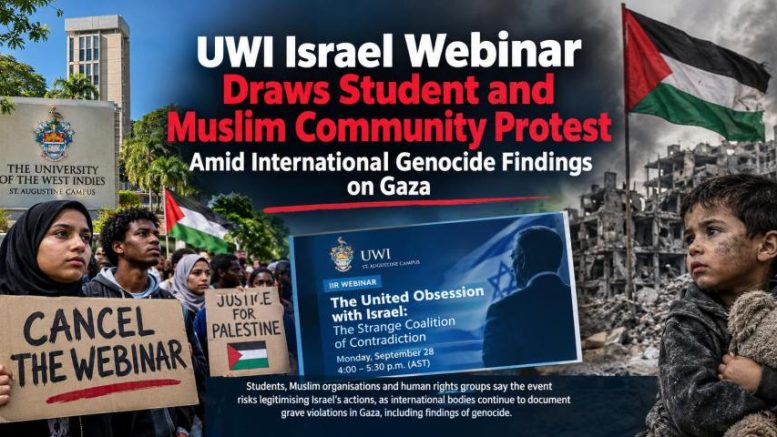
PORT OF SPAIN, Trinidad and Tobago — A planned webinar featuring Israeli diplomat Ephraim Ben Matityau at The University of the West Indies (UWI), St Augustine Campus, has triggered protests from students and Muslim community organizations, who are calling on the university to cancel the event and questioning the framing of its subject.
The online event, scheduled for Monday, September 28, from 4:00 to 5:30 p.m. AST, is being promoted under the title “The United Obsession with Israel: The Strange Coalition of Contradiction.” According to material circulated in connection with the event, the university’s Institute of International Relations (IIR) is facilitating it.
The controversy comes as international human-rights bodies and a United Nations investigative commission have issued increasingly grave findings concerning Israel’s conduct in Gaza since October 2023.
Students challenge the framing
A petition initiated by students associated with the Institute for Gender and Development Studies (IGDS), IGDS Ignite calls on the IIR to cancel the webinar.
The students argue that “There are no ‘sides’ in genocide” and that “there is no ‘neutrality’ in colonization”. They are critical of their university’s silence and supposed neutrality and use the hashtag #notmycampus to signal that colonizers have no place at The UWI campus.
They particularly object to the characterization of international concern over Israel as an “obsession,” arguing that criticism must be understood against the background of the destruction and loss of life in Gaza.
The petition also questions how the event was publicized. The students say they first learned about the webinar through a WhatsApp broadcast and later confirmed its authenticity by contacting the Institute. They claim that, at the time of their complaint, the event had not been publicly promoted through UWI’s principal communications channels or listed on the Institute’s calendar.
The students say this raises questions about transparency and the motive behind its underpromotion, citing the backlash the IIR received in 2024 when they attempted to spotlight another Israeli Ambassador.
The petition, created on September 22, had attracted hundreds of verified signatures by September 23.
Muslim organizations join the call
The controversy has also drawn a strong response from the Concerned Muslims of Trinidad and Tobago (CMTT).
In a media release attributed to CMTT President and Islamic Missionaries Guild public-relations officer Imtiaz Mohammed, the organization calls on UWI to cancel the webinar and urges the public to boycott it.
CMTT describes the event as an attempt to provide legitimacy to Israel’s conduct in Gaza and argues that an Israeli diplomatic presentation cannot provide a complete account of the historical and contemporary Palestinian question.
The organization also points to proceedings before the International Court of Justice (ICJ) and an arrest warrant issued by the International Criminal Court (ICC) as evidence that Israel’s conduct is under serious international legal scrutiny.
The language used by CMTT accuses UWI of facilitating what it describes as genocide and calling Israel’s conduct criminal.
What international human-rights investigations have found
The allegations of genocide are not confined to advocacy organizations.
In September 2025, the United Nations Independent International Commission of Inquiry on the Occupied Palestinian Territory, including East Jerusalem, and Israel concluded that Israeli authorities and security forces had committed and were continuing to commit genocide against Palestinians in Gaza.
The Commission identified four acts falling within the Genocide Convention: killing members of the group; causing serious bodily or mental harm; deliberately inflicting conditions of life calculated to bring about physical destruction in whole or in part; and imposing measures intended to prevent births. It further concluded that these acts were committed with the specific intent required under the Genocide Convention.
The Commission subsequently reiterated its findings in 2026. In June, it reported that Israeli authorities and security forces had deliberately targeted Palestinian children and said that the conduct resulted in genocide, crimes against humanity and war crimes in Gaza.
The findings reflect the conclusions of a UN investigative body, not a final judgment by the International Court of Justice.
Amnesty International
Amnesty International reached its own conclusion in December 2024 that Israel had committed genocide against Palestinians in Gaza.
Its investigation examined killings, destruction of civilian infrastructure, forced displacement, obstruction of humanitarian assistance and restrictions on electricity and other essential services. Amnesty said its assessment of the pattern of conduct and statements by Israeli decision-makers led it to conclude that the acts met the definition of genocide.
Amnesty subsequently maintained that conclusion in its reporting in 2025, stating that genocide continued through mass starvation, killings, displacement and extensive destruction of civilian property and infrastructure.
Human Rights Watch
Human Rights Watch (HRW) has likewise documented what it describes as war crimes, crimes against humanity, ethnic cleansing and acts of genocide in Gaza.
Its 2026 World Report said Israeli forces had killed, maimed, starved and forcibly displaced Palestinians and destroyed homes, schools and infrastructure on an unprecedented scale. HRW cited the September 2025 UN Commission of Inquiry’s genocide finding as part of what it described as a growing body of evidence concerning Israel’s conduct in Gaza.
Earlier, in January 2025, HRW reported that Israeli authorities had deliberately deprived civilians in Gaza of food, water and other necessities of survival and said this constituted atrocity crimes, including acts of genocide and mounting evidence of genocidal intent.
The International Court of Justice
The legal position requires an important distinction.
The International Court of Justice has not yet issued a final judgment determining whether Israel committed genocide. South Africa instituted proceedings against Israel under the Genocide Convention in December 2023, and the case remains before the Court.
However, in January 2024, the ICJ found that at least some of the rights claimed by South Africa under the Genocide Convention were plausible and issued binding provisional measures requiring Israel to take measures within its power to prevent acts falling within Article II of the Convention and to enable humanitarian assistance to reach Palestinians in Gaza.
The Court subsequently reaffirmed and expanded those provisional measures, including measures concerning humanitarian assistance and conditions in Rafah.
Thus, the present legal position is more precise than either side of the political debate sometimes suggests: the ICJ case alleging genocide is ongoing, while a separate UN Commission of Inquiry and organizations including Amnesty International have independently concluded that genocide has occurred.
A question of academic neutrality
At the heart of the Trinidad and Tobago controversy is therefore a broader question: what constitutes academic neutrality when an institution gives a state representative a platform during an ongoing international legal and human-rights controversy?
IGDS Ignite has organised under its Caribbean Students Stand with Palestine campaign since 2023, demanding that The UWI and the government of Trinidad and Tobago condemn Israel’s colonisation of Palestine. The students argue that UWI should not provide a platform for Israeli officials, representatives, and associates. Ignite has even made a conscious effort to emphasize the voices of Palestinian citizens and officials, as seen in their hosting a meet-and-greet with Trinidad and Tobago’s first Palestinian Ambassador, Dr. Linda Sobeh Ali, their Palestinian film screenings and teach-ins.
The students, like many other university students around the world, object to a decolonial academic institution hosting a representative whose government is committing genocide and scholasticide.
That criticism takes on added significance because the UN Commission of Inquiry, Amnesty International and Human Rights Watch have documented serious allegations against Israel using the language of genocide, war crimes and crimes against humanity.
A debate extending beyond UWI
The dispute also reflects a much wider debate across universities, governments and civil society internationally: whether engagement with Israeli institutions and officials represents legitimate diplomatic and academic dialogue, or whether it risks normalizing conduct under investigation or condemnation by international bodies.
The debate is particularly sensitive in the Caribbean, where questions of colonialism, self-determination, racial justice and the historical experience of peoples under foreign rule have a strong place in public discourse.
Trinidad and Tobago’s Muslim organizations have already expressed concern about the country’s expanding engagement with Israel. In August, several national Muslim organizations issued an open letter urging the Government to reconsider any expansion of diplomatic, commercial or security relations with Israel while the Gaza crisis and international legal scrutiny continue.
The responses to the forthcoming UWI webinar signal a wider debate on and off the university campus.
Whether the Institute of International Relations proceeds with the September 28 event, modifies its format, or responds to the demands for cancellation remains the immediate question.
But beneath the controversy lies a larger issue: whether universities can provide meaningful space for diplomatic perspectives while simultaneously confronting the evidence, legal findings and human-rights documentation concerning the conduct of the states whose representatives they invite.
For the students and organizations opposing the webinar, the issue is not an “obsession” with Israel but the obligation, as they see it, to ensure that the ongoing genocide and violations of international law are not ignored and that a space is not provided at The UWI to legitimize colonization.
For an academic institution, the challenge is to ensure that whatever position is presented is subject to rigorous scrutiny, and that the search for understanding does not become a substitute for accountability.
This post has been updated to clarify the students’ position.