How the colonial Indian upheaval of 1857 reshaped Muslim institutions and eventually the sectarian landscape of colonial Indian Islam
The upheaval of 1857 did not simply end the East India Company’s rule. It marked the collapse of the last symbolic remnants of Mughal political sovereignty and forced Indian Muslims to confront a question for which there was no easy historical answer:
How does a community preserve its faith, identity and institutions after losing political power?
The answer that emerged over the next century was one of the most consequential developments in modern Muslim history.
Muslims built schools, madrasas, associations, publishing houses, charities, mosques and educational institutions. They created new intellectual movements and revived older traditions. They organised themselves through civil society rather than through political sovereignty.
But there was a paradox.
The same institutional reconstruction that enabled Muslims to preserve their religious identity also gave durable organisational form to differences within Islam.
Those differences would eventually travel far beyond colonial India, to Pakistan, Britain, the Caribbean, the Americas and the wider Muslim diaspora.
Understanding that history requires going back to 1857.
The year that changed the question
By 1857, the Mughal Empire was already a shadow of its former self. The emperor in Delhi exercised little effective territorial authority. Yet the Mughal court remained a powerful symbol of Muslim political memory.
When the uprising began at Meerut in May 1857, the rebels moved towards Delhi and appealed to the ageing Mughal Emperor Bahadur Shah Zafar to serve as their symbolic sovereign.
The British recaptured Delhi in September.
Bahadur Shah Zafar was subsequently tried and exiled to Rangoon, where he died in 1862. Members of the Mughal family were killed, dispersed or dispossessed, while Delhi experienced executions, confiscations, expulsions and profound social disruption.
The uprising itself was not simply a Muslim rebellion against Britain. Hindus and Muslims participated, and the rebellion brought together people with very different grievances and objectives.
But its aftermath had particular consequences for Muslims.
A political order associated with centuries of Muslim rule had disappeared. The old relationship between political authority, religious scholarship, patronage and Muslim society could no longer be sustained in its previous form. Peter Hardy describes the destruction of Delhi as a Muslim cultural centre and the dispersal of members of the old Mughal establishment.
The question was no longer how to govern an empire.
It was how to preserve a community.
The Company disappears, but British rule remains
The British Crown responded to the uprising by abolishing the East India Company’s governing authority.
The Government of India Act of 1858 transferred control to the Crown. The Governor-General became the Viceroy, while London reorganised authority under a Secretary of State for India.
This transferred colonial authority, but it did not end British rule.
Yet the political environment changed.
The British government sought to reassure colonial Indian subjects that it would not arbitrarily interfere in their religions and customs. Non-interference was intended in part to counter fears about religious conversion and cultural intrusion that had contributed to the atmosphere preceding the uprising.
Queen Victoria’s Proclamation of November 1858 became an important statement of this new policy.
It promised religious non-interference, equal protection under the law and access to public office according to qualification rather than race or creed.
For Muslims, this created an important new space: they could rebuild religious and communal life without expecting the state to provide the political framework within which that life had previously existed.
But the proclamation should not be understood simply as the arrival of modern religious freedom.
As historian Brannon Ingram has shown, the proclamation helped establish a form of “colonial secularity” in which religion was increasingly understood as belonging to belief and worship, while matters classified as public were placed under colonial authority. Thus, the state could promise non-interference in religion while simultaneously redefining the boundaries of what counted as religion.
That distinction would matter greatly.
|
The architecture of a new Muslim civil society The transformation from political sovereignty to civil society was not merely an idea. It acquired an organisational structure. The Societies Registration Act of 1860 provided a legal framework through which groups could establish themselves as registered societies for literary, scientific, educational and charitable purposes. Seven or more persons could subscribe to a memorandum stating the society’s name, objectives and governing body, together with its rules and regulations. The Act also required an annual filing of the names and details of those entrusted with managing the society. A typical association could therefore be organised broadly along these lines: Members / Founding Subscribers The Act did not impose a single structure. The legislation recognised a governing body, while the society’s own rules determined its officers and internal arrangements. The Act also gave the governing body a legally recognised role in holding property and allowed societies to sue or be sued through designated officers. This mattered because it changed the practical meaning of Muslim collective life. Leadership could now be exercised through committees, memberships, constitutions, minutes, subscriptions, schools, publications and charitable programmes rather than through a court, aristocratic patron or political sovereign. The colonial state did not need a policeman sitting in every meeting. Registration created administrative visibility. The state could know the society’s stated purposes, its governing body and, through the legal record, its continuing institutional existence. The Act itself was not a special system of police surveillance, and political or other activities could still fall under separate colonial laws. In this sense, the new legal framework produced an important historical paradox: the colonial state created a grammar of association that Muslims could appropriate for their own purposes. Muslims used that framework not simply to survive, but to build durable institutions of education, religious scholarship, charity and community life. That institutional capacity would become one of the defining features of modern colonial Indian Islam. |
From sovereignty to civil society
In 1860, the British enacted the Societies Registration Act.
It was not specifically a law for Muslims. It provided a legal framework for voluntary associations devoted to literary, scientific, educational and charitable purposes.
Its significance for Muslims lies in the institutional environment it helped formalise.
A community that had once lived within an imperial order increasingly had to organise itself through voluntary institutions: schools, madrasas, associations, charities, journals, publishing houses, mosques and educational societies.
This was the beginning of a major transformation: From Muslim sovereignty to Muslim civil society.
The transformation was not imposed upon Muslims. Muslims themselves became the principal architects of Muslim civil society.
They disagreed profoundly about what the future should look like, but they shared the recognition that the old political order was gone and that survival required new forms of organisation.
There was no single Muslim response
The remarkable feature of the post-1857 period is that Muslims did not produce one response.
They produced many.
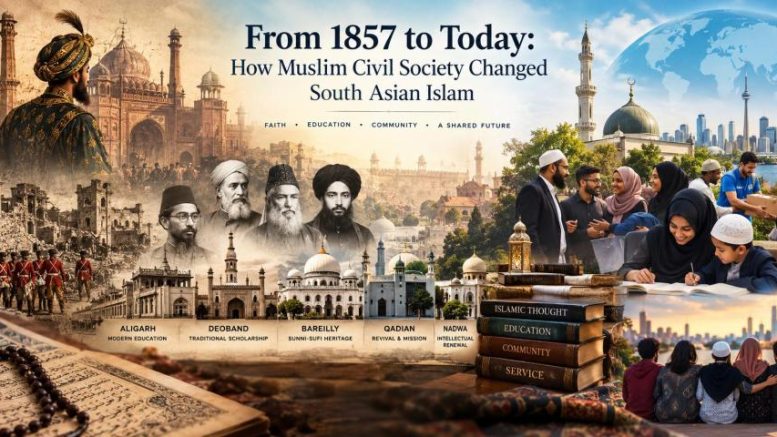
Sir Syed Ahmad Khan and the Aligarh movement placed modern education and scientific knowledge at the centre of Muslim advancement. His Scientific Society promoted translating modern works, while the Muhammadan Anglo-Oriental College, established at Aligarh in 1875, became the centre of a wider educational project.
The underlying question was straightforward:
How could Muslims acquire the knowledge needed to live successfully in a radically changed world?
Darul Uloom Deoband, established in 1866, approached the crisis differently.
Its priority was to preserve and transmit the Islamic scholarly tradition: Qur’an, Hadith, jurisprudence, Arabic, and the traditional religious sciences.
Its central concern was:
How can Muslims remain rooted in their religious intellectual tradition when the political order that once supported it has disappeared?
Neither approach can be reduced to a simple reaction to British rule. Both were Muslim attempts to determine what survival and renewal should mean.
Bareilly, Qadian and the multiplication of religious identities
Other responses soon emerged.
Ahmad Raza Khan of Bareilly, born in 1856, became one of the most influential scholars of the Ahl-i Sunnat, or Barelvi, tradition. His scholarship defended Hanafi jurisprudence and traditional Sunni-Sufi devotional practices.
His movement developed its own network of religious education, scholarship and publishing.
Then came an entirely different development.
Mirza Ghulam Ahmad of Qadian laid the foundations of the movement that became the Ahmadiyya community in 1888–89. He presented himself as a religious reformer and advanced distinctive claims about the Mahdi and the Messiah. The movement made extensive use of writing, printing and organised missionary activity.
Nadwat-ul-Ulama represented yet another attempt to address the educational and intellectual challenges facing Muslims.
These were not merely different organisations.
They represented different answers to the same historical crisis.
And that distinction is important.
The sectarian landscape of modern colonial Indian Islam was not created overnight by 1857. It emerged as older theological and devotional differences were carried into a new world of permanent institutions, mass literacy, printing and organised communal life.
When difference became institutionalised
Religious differences had existed among Muslims for centuries.
What changed in nineteenth-century colonial India was their scale and permanence.
A scholarly disagreement could now become a published controversy.
A theological position could be reproduced through a madrasa.
A fatwa could circulate far beyond the scholar who issued it.
A religious movement could establish schools, newspapers and associations capable of reproducing its worldview across generations.
The printing press therefore did more than spread knowledge.
It helped turn local religious traditions into organised identities.
Cambridge scholarship on the period shows how Barelvi and Deobandi scholars established madrasas, published religious literature and issued fatwas while debating questions of religious practice and belief. The Ahmadiyya movement likewise used print extensively.
The result was a new kind of religious geography.
Muslims no longer belonged simply to communities of locality, lineage, or shared worship.
Increasingly, they could identify with movements.
From theological difference to communal politics
Colonial administration added another dimension.
As the population was increasingly classified according to religious and other communal categories, identity became easier to count, organise and represent.
Religion could now intersect with questions of education, employment, political representation and public institutions.
This did not mean that the British invented Muslim identity or sectarianism.
Rather, older differences entered a new political and administrative environment in which communities could be represented as demographic and political constituencies.
Historian Sadia Saeed has argued that the institutionalisation of mass democratic politics in British colonial India made questions of religious authenticity increasingly important to Muslim political mobilisation.
The distinction between theological difference and political sectarianism therefore becomes crucial.
Muslims could disagree over jurisprudence, theology or devotional practice without making those differences the basis of political exclusion.
But once religious identity became tied to political representation and state power, the stakes rose sharply.
1947 changed the question again
Partition transformed the political geography of colonial Indian Islam.
Pakistan created a Muslim-majority state.
But this did not resolve the question of Muslim identity. It changed it.
Before Partition, one major question had been:
How can Muslims preserve themselves without political sovereignty?
After Partition, another emerged:
What should a Muslim-majority state be, and who has the authority to define Islam within it?
This was a fundamentally different problem.
Questions that had previously been matters of theology, scholarship or communal debate could now intersect with constitutional and legal authority.
The subsequent history of Pakistan illustrates the consequences of that transformation, including the eventual constitutional and legal treatment of the Ahmadiyya community.
The question had shifted from:
Which interpretation of Islam do I follow?
to a much more consequential one:
Who has the authority to determine who a Muslim is?
Colonial India: Muslim life without Muslim sovereignty
For Muslims who remained in colonial India, the challenge was different.
There was no Muslim state to protect them.
The answer once again lay largely in institutions.
Mosques, madrasas, schools, universities, waqf institutions, charities, publishing houses and community organisations became vehicles through which Muslim religious and social life continued.
The nineteenth-century transformation had therefore achieved something remarkable.
Muslim identity had learned to survive without Muslim political sovereignty.
That institutional inheritance would soon cross national borders.
The diaspora inherited the institutions, and the differences
Colonial Indian migration carried these traditions into Britain, the Americas, the Caribbean and elsewhere.
Deobandi, Barelvi, Tablighi, Jamaat-i-Islami, modernist and other traditions established mosques, schools, seminaries, charities and publishing networks.
Studies of Muslims in Britain, for example, document the continuing influence of colonial Indian reform movements and the establishment of new institutions adapted to Western circumstances.
The diaspora therefore inherited more than Islam.
It inherited the institutional history through which colonial Indian Muslims had learned to preserve Islam.
That inheritance has been both a strength and a challenge.
A mosque preserves worship.
A madrasa preserves scholarship.
A charity preserves service.
A school preserves education.
A journal preserves intellectual memory.
But institutions also preserve boundaries.
The same structures that protected Muslim identity could therefore preserve the divisions that had developed within it.
The opportunity hidden in the paradox
This history has another side, however.
The circumstances that produced these divisions have changed.
Muslims in the Caribbean, Britain, the Americas and other diaspora societies are not attempting to restore the Mughal Empire.
They are not living under the political conditions that produced the nineteenth-century struggle for communal survival.
They are citizens and neighbours living alongside people of different faiths and no faith.
That creates an opportunity that earlier generations did not possess.
A Muslim does not have to surrender a theological conviction in order to cooperate with another Muslim.
A mosque can feed the hungry without asking about madhhab.
A Muslim charity can work alongside churches, synagogues, temples and secular organisations.
Muslims from different traditions can build schools, respond to homelessness, support refugees, serve hospitals and engage civic institutions together.
The objective need not be theological uniformity.
It can be Muslim solidarity without theological uniformity.
That distinction matters.
To believe that one’s interpretation is correct is one thing.
To make rejection of another Muslim the organising principle of communal life is another.
When institutional memory outlives historical memory
Consider a Muslim in the colonial Indian diaspora who is now generations removed from the ancestral migration.
He or she may have been born in Britain, the Americas, the Caribbean or elsewhere. Colonial India may exist primarily as a family story: an ancestral village whose name is becoming less familiar, a surname, a few recipes, photographs of grandparents, perhaps a language no longer spoken fluently.
Yet that generation of Muslims may still carry the religious imprint of developments that began after 1857.
This is because institutions can transmit what individual memory cannot.
A mosque, madrasa, Islamic school, family tradition, religious teacher, prayer practice, marriage custom, devotional practice or community organisation can carry forward an intellectual and religious inheritance long after the original historical circumstances have disappeared from consciousness.
That generation of Muslims may know little about Deoband, Bareilly, Aligarh or the debates of colonial India. Yet the institution in which he or she learned Qur’an, the scholar whose teachings shaped the family, the prayer practices considered customary, or even the mosque to which the family belongs may reflect one of the religious trajectories that took institutional form in nineteenth-century colonial India.
Scholars have documented this durability precisely. The major colonial Indian reform movements that emerged in the nineteenth and early twentieth centuries continue to influence Muslim identity outside modern India. Research on contemporary Western institutions likewise shows how movements such as Deoband have established institutions that retain their colonial Indian intellectual inheritance while adapting it to Western circumstances.
The significance is deeper than the survival of particular organisations.
The post-1857 transformation changed how Muslim identity could be transmitted.
It no longer depended on political sovereignty. It could be reproduced through civil society.
A child could inherit Islam through a mosque rather than a Muslim state; through a teacher rather than a court; through a madrasa rather than a royal institution; through books, associations and family practice rather than political authority.
That was an extraordinary achievement.
But the same mechanism transmitted the distinctions that had become institutionally embedded within colonial Indian Islam. Deobandi, Barelwi and other maslak (a specific school of jurisprudence, creed, doctrine, or religious persuasion) identities were not simply theological propositions. They became associated with institutions, teachers, curricula, publications, devotional practices and communal networks. Scholars have cautioned that these boundaries were often fluid and should not simply be equated with fixed “sects”; nevertheless, they became increasingly consequential over the twentieth century.
A remarkable historical process becomes visible.
The later generations of Muslims may have forgotten the circumstances that produced the institutional inheritance while continuing to live inside its consequences.
This does not mean that every colonial Indian-descended Muslim inherits a particular maslak, nor that ancestry determines religious identity. Identity is shaped by family, education, marriage, migration, personal conviction, local community and the wider society. Institutional inheritance also does not necessarily prevent Muslims from moving between traditions or developing identities broader than the categories inherited from colonial India.
But it helps explain why nineteenth-century colonial Indian religious debates remain relevant in communities thousands of miles from where they began.
The paradox of the post-1857 colonial Indian Muslim civil society therefore reaches across generations.
What was created to preserve Muslim identity after the loss of political power became one of the principal means by which particular interpretations of Muslim identity were preserved as well.
For later generations of diaspora Muslims, the question is no longer simply how to preserve an inheritance.
It is also how to understand it.
Which elements belong to the enduring essentials of Islam? Which reflect the intellectual circumstances of nineteenth-century colonial India? Which are cultural practices carried across generations? Which differences remain theologically meaningful? And which have become boundaries largely because institutions, communities and inherited loyalties have kept reproducing them?
These questions do not require abandoning inherited traditions. They require becoming conscious of them.
The Muslim diaspora may therefore represent a new stage in a historical process that began after 1857. The first generation of post-1857 Muslims had to learn how to preserve Islam without sovereignty. Later generations learned how to carry that inheritance across borders.
Later generations face a different task:
to inherit without being imprisoned by inheritance; to preserve faith without confusing historical institutions with the entirety of Islam; and to build solidarity without demanding theological uniformity.
What began after 1857 may now require a new chapter
The generation that lived through the aftermath of 1857 faced an extraordinary historical rupture.
They had lost political sovereignty.
They responded by building institutions.
Aligarh built educational capacity.
Deoband preserved a scholarly tradition.
The Ahl-i-Sunnat movement defended a particular Sunni-Sufi inheritance.
Ahmadiyya developed a distinctive religious and missionary tradition.
Nadwa and other movements pursued different forms of intellectual renewal.
Thousands of less famous organisations built mosques, schools, charities and associations.
Together, they demonstrated something historically important:
Muslim identity could survive the disappearance of Muslim political power.
But that generation’s institutional success also produced a paradox.
The structures that preserved Islam could preserve its internal divisions.
Today, particularly in the diaspora, Muslims have an opportunity to write another chapter.
The challenge is not to erase the traditions inherited from colonial India. Nor is it to pretend that theological differences do not matter.
It is to place those differences within a larger understanding of community.
The question after 1857 was:
How can Muslims survive without a Muslim state?
The question facing many Muslims today may be:
How can Muslims flourish together without requiring one another to become the same?
Perhaps the next stage of Muslim civil society is not eliminating difference, but maturing solidarity.
The institutions created in the aftermath of political loss once served to preserve Muslim identity.
They can now serve another purpose as well:
to demonstrate that Muslims can preserve their faith, honour their differences and still work together for the common good.