Remembering Sr. Roza Hussein and her contribution to reviving Guyana’s Muslim Community.
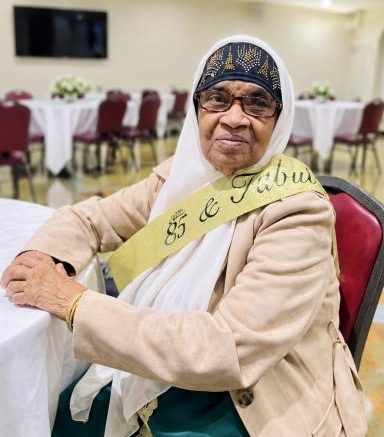
Last Sunday (September 27, 2026) I had the honour of attending and speaking at the milestone achievement of the 85th birthday of Sr. Roza Hussein of New Jersey (formerly of Guyana, South America).
I leave these words in honour of her amazing achievement and contribution.
Sr. Roza
Some contributions to an Islamic movement are measured by positions held, lectures delivered, books written or institutions established. Others are woven more quietly into the life of the community through open homes, generous hearts, wise counsel, hospitality and steadfast service.
Sr. Roza was one of those people.
Her contribution to the early development and success of the GIT was critical. As a pioneer of the Islamic work in Guyana, she helped give the emerging community stability, warmth, confidence and resilience. She understood that Islamic work was not the responsibility of a few officeholders, but a collective trust in which everyone had something to contribute.
The Qur’an reminds us: “…And cooperate with one another in righteousness and piety…” (Qur’an 5:2)
Sr. Roza lived that principle through her example.
A Woman Who Led by Example
One of the clearest ways she led was through her commitment to hijab at a time when there was considerable ignorance about its importance and uncertainty among many young Muslim women about expressing their Islamic identity.
She was an early adopter, and her example mattered. By carrying herself with confidence and dignity, she showed younger sisters that Islamic identity was not something to hide or apologize for. Her personal practice helped create an environment in which others could follow with greater confidence.
She was also a mature and trusted voice in the Islamic work. Her pragmatism, wisdom and compassion enabled her to guide younger brothers and sisters through the complexities of life. Although she was not a teacher in the conventional sense, she was unquestionably a teacher in her own right.
Her classroom was her “bottom house”, the living room, the kitchen, the dining table, the car travelling to an event, the conversation after a study circle and the private discussion with a newly married couple. She advised newlyweds, supported families, encouraged young people and listened to those who needed counsel. She taught through example, conversation and action.
A Home That Became an Institution
Her home was never simply her home. It was a place of knowledge, refuge, friendship and sisterhood; a place where visiting scholars could stay and where brothers and sisters could enter and feel that they belonged.
Her door, table and heart were open.
She organized study circles, arranged social trips, prepared food for the annual Christmas Eve food sale, helped finance community initiatives, hosted scholars and welcomed people who needed a place to sit and talk. She gave her home to the work and herself to the people.
The Prophet Muhammad ﷺ taught: “Allah is in the aid of His servant as long as the servant is in the aid of his brother.” (Sahih Muslim 2699)
Sr. Roza embodied this teaching. Much of her service consisted of making life easier for others, and that too is an immense act of worship.
She Did Not Give Up on People
One story I remember concerns her brother, Walton, I believe that was his name. He faced many challenges, and an ordinary person might have concluded that the effort was not worthwhile.
Not Sr. Roza.
She was determined to bring him into the circle of brothers who gathered for study and companionship. She persisted, encouraged him and continued engaging him. Over time, there was a marked increase in his practice of Islam.
This revealed something central about her character: she did not give up on people.
The Qur’an says: “Let there be arising from you a nation inviting to all that is good, enjoining what is right and forbidding what is wrong.” (Qur’an 3:104)
Sr. Roza understood this invitation not merely as a matter of words, but of relationships. She gave people time, opportunity and encouragement because she believed change was possible.
Generosity as a Way of Life
Her generosity was legendary. She supported initiatives that benefited people, contributed financially, provided food, hosted others and gave freely of her time and attention.
Her generosity extended even to those who showed her animosity. She remained compassionate when compassion was not necessarily returned. She understood that disagreement did not have to become hatred, and that another person’s shortcomings did not justify abandoning them.
Her generosity was not occasional; it was a disposition of the heart.
A Woman of Family and Service
For all she gave to the Islamic work, she never lost sight of her family. She was deeply devoted to her children and a dedicated wife who stood by her husband during difficult periods.
The Prophet Muhammad ﷺ said: “The best of you are those who are best to their families, and I am the best of you to my family.” (Jamiʿ al-Tirmidhi 3895)
Sr. Roza demonstrated that commitment to family and service to the wider community were not competing responsibilities. Properly understood, they strengthened one another.
She also never backed away from major undertakings. Whether it was the National Sports Day in Skeldon, the Nadwatul Ulama Conference held at the school or the National Conventions, she was at the forefront. She organized, planned, solved problems and gave whatever she had to make each effort successful.
That is how movements are built: through people willing to take responsibility and perform the necessary work, often behind the scenes.
My Personal Debt to Her
I was honoured to be considered like a son to her. As a teenager, I frequently appeared at her home, yet she never made me feel that I was imposing. Despite her family responsibilities, financial obligations and countless demands on her time, she listened to me, discussed plans, strategized and evaluated what we were doing.
She constantly asked, in one way or another: How can we make this better?
Only with the passage of years does one fully appreciate the value of an older person’s willingness to give a young person attention, confidence and wisdom. Sr. Roza did that for me, and I know she did it for many others.
A Legacy Measured in People
When we speak of pioneers, we often look for buildings, institutions, programs and financial milestones. But the true measure of a pioneer is found in the people whose lives became better because that person was there.
Young women gained confidence from her example. Young brothers and sisters received counsel. Newly married couples found guidance. People were fed at her table. Scholars found hospitality in her home. Initiatives received support. Those who might have drifted away remained connected because she refused to give up on them.
These things may not appear in an annual report, but they are the foundation from which communities are built.
The Prophet ﷺ taught that relieving the hardship of a believer is an act for which Allah promises relief on the Day of Resurrection, and that Allah aids His servant so long as that servant aids others.
By that measure, Sr. Roza’s legacy is written in many hearts.
May Allah Accept Her Work
Sr. Roza became part of the history of the Islamic work in Guyana.
She was not merely a pioneer of institutions, but a pioneer of people. She helped young Muslims find confidence, families find direction, initiatives find resources, visitors find hospitality, and struggling people find another chance.
She helped a young Islamic movement find its footing and helped create a sense that this was our community, our work and our responsibility.
Institutions do not emerge fully formed. They are built through sacrifice, persistence, generosity, courage and ordinary acts performed consistently over many years. Among those who gave of themselves so that the Islamic work in Guyana could take root and flourish was Sr. Roza.
May Allah ﷻ accept every act of service she offered, every dollar she spent in His cause, every meal she prepared, every person she welcomed, every young person she encouraged, every family she helped and every sacrifice known only to Him.
May He reward her for the knowledge she helped nurture, the community she helped build and the lives she touched. May her legacy be the continuous work of those she nurtured.
For that is perhaps the greatest tribute to a pioneer:
that the work to which she gave her life continues to grow.
Ameen.
First published on the author’s Substack here