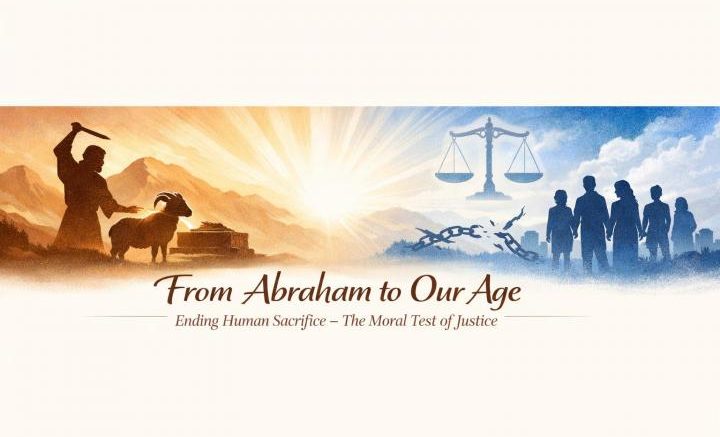
One of the most profound moral moments in sacred history is the story of Abraham and his son Ishmael. In the Qur’anic narrative, Abraham receives a vision commanding him to sacrifice his beloved son. When father and son submit to the will of God, the sacrifice is halted and replaced with a ram. The Qur’an recounts:
“And We ransomed him with a great sacrifice.” (Qur’an 37:107)
The deeper meaning of this moment extends far beyond the ritual commemorated each year during Eid al-Adha. The episode symbolizes the end of human sacrifice as a religious act. God did not desire the blood of a child; rather, the story reoriented sacrifice away from human life toward moral submission, compassion, and obedience to divine justice.
Profoundly, the Abrahamic legacy eliminated the notion that human lives can be sacrificed to appease power, fear, or devotion.
Yet as we look at the modern world, we must ask an unsettling question: has humanity truly moved beyond human sacrifice, or has it merely changed its form?
Today, entire populations are treated as expendable; civilian lives are destroyed, cities reduced to rubble, and the language of security, deterrence, or geopolitical necessity justifies suffering. Human beings are no longer sacrificed on stone altars as they were in ancient times, but they are often offered up on the altar of power and political interests.
In this sense, the moral test that began with Abraham continues.
When Morality Becomes Tribal
In today’s geopolitical climate, a troubling moral logic appears to be taking hold: “My murderer is better than yours, because he is ours.” Violence is condemned when committed by an enemy but excused, sometimes even justified, when carried out by a friend.
The standard of justice is no longer universal; it is increasingly tribal.
The language of international law, human rights, and a “rules-based order” is invoked selectively. Civilian suffering is amplified when it suits political narratives and minimized when it does not.
For Muslims, however, moral standards are not meant to shift with political alliances. The ethical framework of Islam, rooted in the Qur’an and the teachings of the Prophet (uwbp), establishes justice as a universal obligation that transcends tribe, nation, and faction.
Justice Beyond Tribal Loyalty
The Qur’an directly confronts the human instinct to defend one’s own side regardless of wrongdoing:
“O you who believe! Stand firmly for justice as witnesses for God, even if it be against yourselves, your parents, or your relatives…” (Qur’an 4:135)
Justice in Islam is therefore not conditional on identity or allegiance. It does not permit the moral compromise of defending wrongdoing because it is committed by “our people.”
Another verse reinforces this principle:
“Do not let the hatred of a people cause you to depart from justice. Be just; that is nearer to righteousness.” (Qur’an 5:8)
Even in conflict, perhaps especially in conflict, the believer is commanded to maintain moral discipline.
The Islamic Rules of War
One of the most misunderstood aspects of Islamic history is that warfare in Islam was never meant to be lawless. Long before modern conventions, Islamic teachings placed strict ethical limits on combat.
When early Muslim armies were sent out, the first Caliph, Abu Bakr, instructed them:
• Do not betray or commit treachery
• Do not mutilate the dead
• Do not kill women, children, or the elderly
• Do not destroy trees or burn crops
• Do not slaughter livestock except for food
• Do not destroy inhabited places
These instructions reflected the teachings of Muhammad (uwbp), who repeatedly prohibited the killing of non-combatants. When he saw a woman killed in battle, he condemned it and declared that women and children were not to be targeted.
Classical Islamic jurists later developed detailed legal principles emphasizing:
• Protection of civilians
• Protection of religious clergy and places of worship
• Prohibition of unnecessary destruction
• Humane treatment of prisoners
War, in the Islamic tradition, was never a license to abandon moral boundaries.
The Destruction of Civilians and Property
The devastation of civilian populations, the destruction of homes, hospitals, farms, and entire communities, represents a direct violation of the ethical limits outlined in Islamic teachings.
Civilian life carries sanctity in Islam. The Qur’an declares:
“Whoever kills a soul… it is as if he has killed all of humanity.” (Qur’an 5:32)
This verse reflects a foundational principle: the preservation of life is sacred.
Similarly, the wanton destruction of property and livelihoods contradicts the Qur’anic prohibition against spreading corruption and ruin on the earth:
“Do not spread corruption in the land after it has been set right.” (Qur’an 7:56)
The targeting of civilians or collective punishment of populations cannot be reconciled with the Islamic ethical tradition.
The Duty to Resist Oppression
Islamic ethics not only prohibit injustice, they also demand resistance to it.
The Qur’an asks:
“What is wrong with you that you do not fight in the cause of God and for the oppressed men, women, and children who cry out, ‘Our Lord, rescue us from this town whose people are oppressors’?” (Qur’an 4:75)
This verse establishes that indifference to oppression is not an option for believers.
At the same time, resistance must remain ethical. Islam does not permit the abandonment of moral principles even in the face of injustice.
The Prophet ﷺ articulated the responsibility of the Muslim conscience:
“Whoever sees an injustice should change it with his hand; if he cannot, then with his tongue; and if he cannot, then with his heart, and that is the weakest of faith.”
Resistance therefore includes moral witness, speaking truth, supporting justice, and standing with the oppressed.
The Crisis of Selective Morality
Today’s global environment often rewards power over principle. Civilian casualties are sometimes treated as unfortunate necessities, while large-scale destruction is justified through political narratives.
The deeper danger lies in the normalization of selective morality.
When societies begin to believe that the crimes of their allies are acceptable while those of their enemies are unforgivable, moral reasoning collapses into tribal loyalty.
This is precisely the mentality the Qur’an sought to dismantle.
The Muslim Conscience in a Fractured World
For Muslims witnessing global conflicts today, the challenge is not merely political, it is moral.
The temptation to adopt the same tribal logic is powerful: to excuse injustice if it benefits one’s side or to justify suffering if it afflicts an adversary.
But the Qur’anic ethic refuses this compromise.
The believer is called to maintain a consistent moral compass:
• Justice must be universal
• Civilian life must be protected
• Destruction must never be normalized
• Oppression must be resisted
The story of Abraham reminds humanity that God rejected the sacrifice of a human life even in the most sacred of contexts.
How then can the destruction of innocent lives be justified in the name of politics, security, or national interest?
A Higher Standard
The legacy of Abraham was meant to end human sacrifice.
Yet in our time, the sacrifice of human lives often continues—only now it occurs through bombs, sieges, and policies that treat entire populations as expendable.
The Qur’an calls believers back to a higher moral horizon: justice that transcends tribe, compassion that embraces all civilians, and resistance to oppression without abandoning ethics.
The real test of moral integrity is not how we judge our enemies.
It is how we judge those we consider our own.
In a world increasingly governed by the logic of “our crimes versus their crimes,” the Qur’anic call remains both simple and revolutionary:
Stand firmly for justice, even when it is against your own side.