Some lives are best remembered not by the wealth accumulated, the businesses built, or the awards received, but by the moments when a human being was confronted with another person’s vulnerability and chose to act.
Churchill Azad Akaloo was such a man.
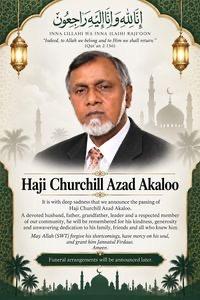 His death on the night of September 11th 2026, marks the passing of a Trinidadian businessman whose name became synonymous with Sheik Lisha Ltd., but whose legacy reached considerably beyond the world of commerce.
He was an entrepreneur. He was a manufacturer. He was an employer. He was a philanthropist.
But perhaps most importantly, he was a humanitarian.
And in remembering him, we remember something larger: the kind of society Trinidad and Tobago has historically aspired to be, and the responsibilities that accompany success.
The measure of a businessman
Churchill Akaloo inherited responsibility for his family’s business after his father became ill in 1960.
The enterprise his parents, Ishmael and Sahidan Akaloo, established in 1954 began modestly, producing vermicelli, split-peas powder, and curry powder. Under Churchill’s leadership, it developed into a significant manufacturing and distribution enterprise serving Trinidad and Tobago and markets throughout the Caribbean, North America and Canada.
That achievement should not be diminished.
Businesses matter.
They create employment. They sustain families. They provide opportunities. They manufacture products that people need. They contribute to a country’s economic independence.
Churchill Akaloo understood that dimension of enterprise.
But his life also demonstrated that the true measure of business success is not simply what a person can acquire through business, but what he is prepared to do with what business makes possible.
That is where his story becomes particularly meaningful.
The warehouse that became a sanctuary
In November 2018, Trinidad encountered a humanitarian situation that could easily have become someone else’s problem.
Dozens of Cuban asylum seekers, desperate for a future outside Cuba, had been protesting near the United Nations offices in Port of Spain. Authorities arrested them and later released them without a place to stay.
Churchill Akaloo had been watching their plight.
He had already been going to the protesters and providing them with food and water.
Then came the request for shelter.
His response was extraordinary.
He opened one of his warehouses in Warrenville and let the refugees turn it into a temporary home. He provided materials and equipment to help make the facility habitable. What began as a one-month offer was eventually extended to 75 days.
The refugees themselves spoke of his kindness with gratitude.
But perhaps the most revealing words came from Akaloo himself.
He explained that he was moved by their suffering and could not stand to see human beings on the streets without food or shelter.
“These people are humans too,” was essentially the principle behind his action. (Trinidad Guardian)
That is a remarkably simple philosophy.
And perhaps that is why it is so powerful.
He did not begin by asking what religion they followed.
He did not begin by asking what political position they held.
He did not begin by asking whether their circumstances were convenient.
He saw people in distress.
And he responded.
The Islamic meaning of compassion
For Muslims, this should resonate deeply.
Islam does not regard compassion as merely an optional personality trait. Rahmah, mercy and compassion, is at the heart of the Prophetic character.
God describes the Prophet Muhammad ﷺ as:
“a mercy to all the worlds.”
(Qur’an 21:107)
The Qur’an repeatedly calls upon believers to establish justice, feed the vulnerable, care for the orphan, assist the needy, and give from what God has entrusted to them.
There is an important distinction here.
Wealth in Islam is not condemned. Wealth is a trust.
The question is not merely how much one possesses.
The question is what one’s possession makes possible.
Churchill Akaloo’s life provides an example of an entrepreneur who appears to have understood that distinction.
His warehouse was an asset on a balance sheet.
For a time, he transformed that asset into shelter for people with nowhere else to go.
That is when property becomes service.
That is when business becomes humanitarianism.
And that is when wealth acquires a meaning beyond itself.
Akaloo funded the construction of a learning centre and masjid in Warrenville, providing a place for religious and community life.
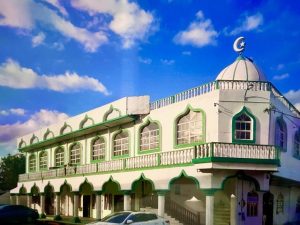
Warrenville Masjid and Learning Centre
For a Muslim, such acts carry a significance beyond immediate charity. They represent sadaqah jariyah, goodness whose benefit can continue after the giver has left this world.
Trinidad at its best
Churchill Akaloo’s story deserves to be remembered for another reason.
It speaks to something profoundly Trinidadian.
Trinidad and Tobago has always been a society in which people of different faiths, ethnicities, languages and histories have had to negotiate the meaning of living together.
Our diversity has not always been easy.
Tensions, prejudices, and divisions have existed.
But something remarkable has also emerged: the capacity of ordinary people to recognise one another’s humanity across the boundaries society sometimes constructs.
A Muslim businessman opening his warehouse to Cuban asylum seekers was more than an act of private charity.
It was a small but powerful demonstration of what pluralism can look like when it moves beyond speeches and becomes action.
The refugees were strangers.
Their nationality was different.
Their circumstances were unfamiliar.
Yet their humanity was sufficient.
That is a lesson worth preserving.
The quiet side of giving
Another dimension of Akaloo’s legacy deserves attention.
His philanthropy was not confined to the dramatic episode that made national headlines.
He was also known for assisting families privately, without necessarily seeking recognition.
That distinction matters.
Some charity seeks an audience.
Other charity seeks only to relieve a burden.
The Qur’an praises those who give without seeking praise or reward from people.
Perhaps the most enduring acts of generosity are those whose beneficiaries may never know the full identity of the person who helped them.
In that respect, the private side of Churchill Akaloo’s philanthropy may ultimately prove as important as the public side.
More than awards
His contribution was recognised publicly.
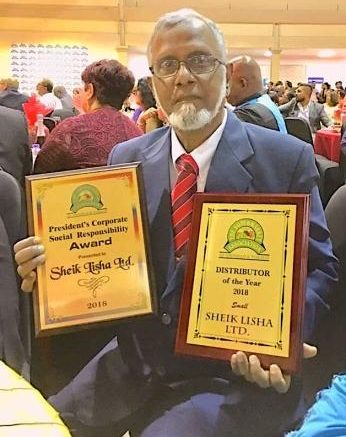
In 2018, Akaloo received the President’s Corporate Social Responsibility Award, as well as recognition connected to his business achievements. (Trinidad Guardian)
Such honours have their place.
But institutions ultimately give awards.
Legacy is given by people.
And the most meaningful testimony to a person’s life often comes not from a certificate on a wall, but from someone saying:
“He helped me when I needed help.”
That is a different kind of achievement.
What remains after death?
Death has a way of reducing all our distinctions to their proper proportion.
The businessman eventually leaves his business.
The wealthy leave their wealth.
The powerful leave their positions.
The famous leave their public recognition.
What remains?
The Qur’an asks us to think about what we send forward for ourselves.
“Whatever good you put forward for yourselves, you will find it with God.”
(Qur’an 2:110)
And the Prophet ﷺ taught that when a person dies, his deeds come to an end except for three: ongoing charity, beneficial knowledge and a righteous child who prays for him.
That provides a particularly appropriate framework for remembering Churchill Azad Akaloo.
Perhaps his greatest legacy will not be found in the products manufactured by Sheik Lisha.
Perhaps it will be found in the people.
The worker who earned a livelihood.
The family that received assistance.
The young person who benefited from a community institution.
The stranger who was given dignity.
The refugee who was given shelter.
The hungry person who received a meal.
These are the human dividends of a life well lived.
A Trinidadian Muslim legacy
Churchill Akaloo’s life also belongs to the broader history of Trinidad and Tobago’s Muslim community.
Our community’s story is not simply a story of mosques, Eid celebrations and religious observance.
It is also a story of enterprise, education, philanthropy, institution-building and service to the wider society.
Muslim businessmen and women have helped build this country not only through commerce but through their contributions to schools, mosques, charities, community organisations and humanitarian causes.
Churchill Akaloo stands within that tradition.
But his example also challenges the community.
Success should never be an excuse to retreat from society.
Rather, success should increase our capacity to serve it.
The more God gives a person, the greater the opportunity to become a means through which others receive.
What should we remember?
We should remember the entrepreneur who inherited a small family enterprise and helped build it into a major Trinidadian manufacturing business.
We should remember the employer whose success created livelihoods.
We should remember the philanthropist who gave quietly.
But above all, we should remember the man who, when confronted by vulnerable strangers sleeping on the streets, opened his warehouse instead of closing his heart.
That is the image of Churchill Akaloo that deserves to endure.
Not simply the businessman standing beside his business.
But the human being standing beside other human beings.
In an increasingly polarised world, where refugees are too easily reduced to statistics, migrants to political arguments, and strangers to problems belonging to somebody else, his example reminds us of something very simple:
Before they are migrants, refugees, foreigners, Muslims, Christians, Cubans, Trinidadians or anything else, they are human beings.
And sometimes humanity begins with something as simple as opening a door.
Churchill Azad Akaloo opened one.
May God accept the good that he did, forgive his shortcomings, elevate his rank among those who served humanity, and grant comfort and strength to his family, friends, colleagues and all who mourn him.
May the benefits of the good he initiated continue beyond his lifetime.
And may those of us who remain learn from his example that the greatest legacy of success is not what we leave behind for ourselves, but what we leave behind in the lives of others.
Inna lillahi wa inna ilayhi raji’un (To God we belong and to Him we return).