Georgetown, Guyana, September 13, 2026: I remember the morning of September 11, 2001, with the clarity of something that happened yesterday. As I walked into the lobby of the Canadian Broadcasting Corporation’s (CBC) Toronto building, the images of smoke and fire on the large television screens stopped me in my tracks. They seemed less like news and more like something out of a movie.
I got to my desk and removed a book I was reading from my knapsack. The few chapters of “The New Jackals: Ramzi Yousef, Osama bin Laden and the Future of Terrorism, written by the author and investigative journalist Simon Reeve, that I had left to read took on a new urgency. It didn’t take me long to realise that the February 26, 1993 bombing at the North Tower of the World Trade Centre might have been a dress rehearsal of what was now unfolding in New York City that morning.
I had obsessed for years with trying to understand what motivated Ramzi Ahmed Yousef and his associates to pack 1500 pounds of explosives into a Ryder rental van and park it on the B-2 level of the parking garage beneath the World Trade Centre. That explosion was so massive it left six people dead and injured over 1,000. Ramzi’s intention was to have the North Tower collapse into the South, resulting in death and mayhem for thousands.
Two years after that explosion, a remarkable sequence of events culminated in Ramzi’s capture at the Su Casa guesthouse in Islamabad, Pakistan. En route by helicopter to be arraigned at the Daniel Patrick Moynihan Courthouse in lower Manhattan on an 11-count indictment, senior FBI agent William Gavin lifted Ramzi’s blindfold and pointed to the twin towers. “Look down there,” he said, “they’re still standing.” Ramzi calmly responded: “They wouldn’t be if I had had enough money and explosives.”
Ramzi is still serving two life sentences without the possibility of parole at the notorious federal Supermax prison in Colorado. He spends nearly 24 hours a day isolated in a high-security, 7-by-11-foot concrete cell. On 9/11, his maternal uncle, Khalid Sheikh Mohammed (KSM), succeeded where his nephew had failed, and the Twin Towers came crashing down.
KSM, too, was captured in Pakistan, but instead of facing a federal judge on the US mainland like his nephew, he and over 900 men of Middle Eastern origin were sent to the US prison at Guantanamo Bay, Cuba. Evidence of his torture ultimately led a judge to exclude his 2007 confession as involuntary, and two days ago, a US military judge set June 5, 2028, as the trial date for him and three co-defendants.
I visited the U.S. detention facility at Guantánamo Bay four times, but only once did I attend proceedings involving KSM and others accused by the United States of planning the 9/11 attacks. I still struggle to describe the dread that engulfed me as KSM declared that he had been responsible for 9/11 and demanded that the military judge sentence him to death, a punishment he said he welcomed as martyrdom.
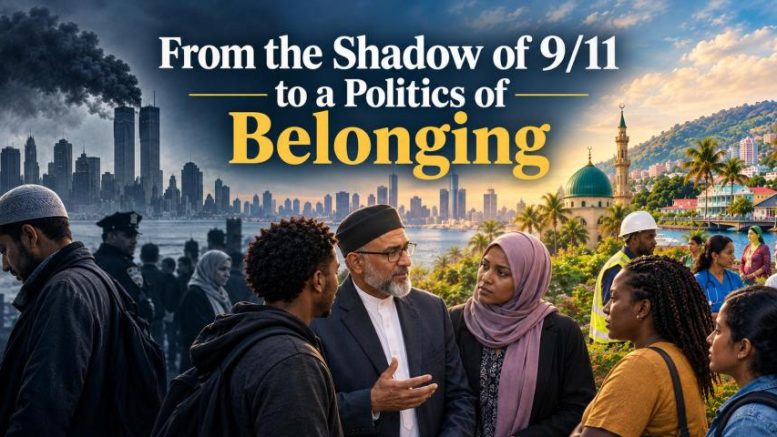
The legacy of 9/11 cannot be reduced to the horror of that day or the long, unresolved pursuit of justice against those accused of planning it. It must also reckon honestly with what followed, acknowledge how fear became public policy, and suspicion stained entire faith minority communities.
Within hours after 9/11, Muslims became security subjects. Governments did not only pursue those who had committed terrorism; they increasingly built systems to identify people thought capable of becoming terrorists. The focus shifted from proven violence to suspicion about what a person might think, believe, say or become.
Muslims were sorted into categories: “moderate,” “radical,” “vulnerable”, or “at risk”. These categories created a climate in which faith, political conviction and ordinary religious practice were viewed through a narrow security lens.
Imams, scholars and community leaders across the world lined up to condemn 9/11 in the strongest terms, but the needle barely moved. And now, a more hopeful politics, one rooted in the common concerns of cost of living, housing, healthcare, jobs, dignity and the future of working people, is succeeding where denunciations alone could not. In New York, Michigan and other states, this emerging political trend is making Muslim identity less a matter of suspicion and more a normal part of public life.
New York Mayor Zohran Mamdani, the city’s first Muslim mayor, and Dr Abdul El-Sayed, the Democratic nominee for the United States Senate in Michigan, are evidence that a Muslim name, heritage and faith need not be apologised for. Leaders like Mamdani and El-Sayed are signs that another political future in America and the world is possible.
It’s a lesson Guyanese should take seriously. The politics associated with Azruddin Mohamed may generate applause in some circles through the performance of an outsider’s defiance. But a public confrontation is not a plan for schools, hospitals, jobs, safer communities or national cohesion. Guyana cannot afford to confuse online popularity with the discipline, competence and moral seriousness required to lead a country through our current era of profound transformation.
This column was first published in the Sunday Chronicle on September 13th 2026