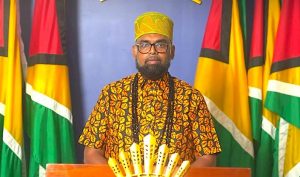
President Irfaan Ali
In his Emancipation Day 2026 message, President Irfaan Ali, decked out in what appears to be an outfit associated with the Hausa and Fulani Muslims of West Africa, offered the citizens of Guyana more than just ceremonial greetings.
His message is a reminder that Emancipation must be understood not only as the end of slavery, but as the beginning of a long and determined journey toward dignity. I am not here to persuade anyone to like the President, but it is hard to ignore the scale of what has been achieved in land ownership, education, health, social services, and nation-building. This President has earned the right to say something that remains central to Guyana’s development story: freedom means little unless it is translated into real opportunities for everyone.
His message paid homage to the resistance, resolve, resourcefulness, and resilience of our African ancestors. That language matters, because it reminds us that the enslaved were never just victims of history. They were builders, survivors, and visionaries who refused to let the brutality of the transatlantic slave system have the final word. Even in bondage, they held fast to the idea that a better future was possible, and when freedom came, they rushed to shape it with determination and purpose.
That purpose was expressed in practical and transformative ways. Through the village movement, African descendants pooled resources to purchase land and establish communities that became foundations of resilience and self-worth. Through education, they sharpened minds; through farming, they fed households and markets; through entrepreneurship, they created livelihoods; through mining, they contributed to the nation’s wealth. Their story is not only one of survival, but of development. It is the story of people who turned the pain of enslavement into an architecture of progress.
This is where the President’s message connects with the desire for freedom. While freedom is a historical achievement, it is not a static state. Freedom has to be defended, cherished, celebrated, and nurtured in every generation. Freedom is the work of building a society where people can advance with dignity, where communities are connected to services and infrastructure, and where national growth is shared in ways that lift every citizen.
That is why the initiatives, programmes, and policies of the state matter so much: they are the instruments through which the promise of freedom can be made visible in people’s lives.
The religious undertones of President Ali’s message are equally significant. The call to weep together, pray together, and build together speaks to the moral and spiritual foundation on which communities are sustained.
For African people in the era of slavery, faith was not a passive comfort; it was a form of survival and resistance. Among enslaved Muslims especially, Islam offered discipline, identity, inner order, and a way of preserving humanity in a system designed to erase it. Scholars such as Sylviane Diouf, Sulayman Nyang, Allan Austin and Abdullah Hakim Quick have shown that enslaved African Muslims relied on their intellectual traditions, spiritual discipline, and a profound sense of self that helped resist the mental violence of slavery.
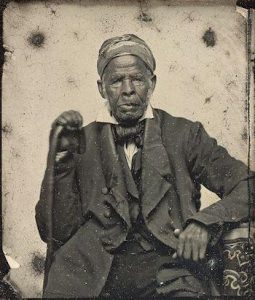
Omar ibn Said
Omar ibn Said, a scholar from Futa Toro in modern Senegal who was captured at 37 and sold in South Carolina, left behind a rare Arabic autobiography. Abdulrahman Ibrahim Ibn Sori, the West African military commander from Futa Jallon, endured 40 years of enslavement in Mississippi before gaining freedom. Ayuba Suleiman Diallo (Job ben Solomon), the Fulani prince from Bundu, was kidnapped in 1730 and later freed after he wrote from memory two or three copies of the entire Quran by hand. Bilali Mohammed, the Islamic leader on Sapelo Island, preserved a manuscript on Islamic law. Yarrow Mamout, a Fulani Muslim who survived 44 years in bondage in Maryland, USA, became a property owner after earning his freedom.
These extraordinary lives show that Islam was not only a faith carried across the Atlantic, but also a source of discipline, learning, dignity, and inner freedom that helped enslaved Africans resist the dehumanising force of bondage.
President Ali’s appeal for us to avoid suspicion and enmity is worth underscoring. It speaks to the civic lessons of emancipation. If our ancestors transformed sorrow into solidarity, then the task before us is to protect that inheritance by rejecting division and embracing mutual respect. A free people cannot build a strong nation while trapped in distrust. Unity, therefore, is not a slogan; it is a national necessity.
The dream of our ancestors was never only to survive slavery, but to build a freer, fairer, and more prosperous society. They laid pillars that still support modern Guyana, and our duty is to strengthen those pillars through work, faith, discipline, and collective purpose so that freedom is not just remembered, but experienced in our lives.
This column was first published in the Sunday Chronicle on August 02, 2026