“Our Lord, forgive us and our brothers who preceded us in faith, and do not place in our hearts any resentment toward those who believe.” (Qur’an 59:10)
Every year, Emancipation Day reminds us of one of humanity’s darkest chapters: the transatlantic slave trade. We remember the millions of African men, women and children who were captured, transported across the Atlantic, and forced into lives of bondage. Yet within that history lies a chapter that is too often overlooked: the story of the thousands of Muslims who were among the enslaved.
Recovering their story is not about claiming exclusive ownership of the African experience. Rather, it is about restoring an important historical truth that has too often been omitted from public memory.
Africa Was Not a Continent Without Civilization
One of the enduring myths created during the colonial era was that Europeans brought civilization to Africa. This false narrative helped justify conquest, enslavement and colonial rule.
Long before the first European slave ships reached West Africa, flourishing Muslim societies had already existed there for centuries.
Islam spread peacefully across the Sahara through trade, scholarship and diplomacy beginning in the eighth century. By the thirteenth and fourteenth centuries, powerful Muslim kingdoms and centres of learning flourished throughout West Africa.
The great empires of Ghana, Mali and Songhai became renowned for commerce, governance and scholarship.
The city of Timbuktu housed libraries containing thousands of manuscripts on theology, astronomy, medicine, mathematics, law and philosophy.
Universities and centres of Islamic learning attracted scholars from across Africa and the wider Muslim world.
When many Africans were captured into slavery, they were not leaving “primitive societies.”
Many were leaving organized states, vibrant intellectual traditions and sophisticated Islamic cultures.
How Many Were Muslims?
Historians estimate that between 10 and 20 percent of the Africans transported across the Atlantic were Muslims, although the proportion varied by time and place.
Many originated from regions where Islam had been firmly established for centuries, including:
- Senegambia
- Futa Toro
- Futa Jallon
- Hausaland
- Bornu
- Parts of Mali and Guinea
Among those enslaved were merchants, judges, teachers, military leaders and scholars who had memorized the Qur’an.
Many could read and write Arabic at a time when literacy rates in Europe itself remained relatively low.
The Atlantic slave trade therefore uprooted not merely labourers but educated members of sophisticated Muslim societies.
Scholars in Chains
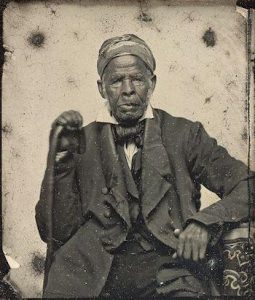
Omar ibn Said
Perhaps the best-known example is Omar ibn Said.
Born in present-day Senegal around 1770, Omar spent decades studying the Qur’an, Arabic grammar, jurisprudence and theology before being captured and sold into slavery.
While enslaved in North Carolina, he wrote an autobiography in Arabic and copied passages from the Qur’an entirely from memory.
His surviving manuscripts remain among the most remarkable documents produced by an enslaved African in North America.
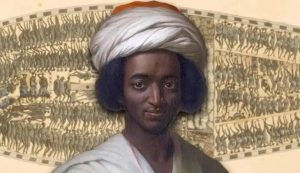
Ayuba S Diallo
Another extraordinary figure was Ayuba Suleiman Diallo.
A respected Muslim scholar from present-day Senegal, Ayuba was captured while travelling on business.
His learning, dignity and command of Arabic eventually attracted the attention of British officials, who arranged for his freedom.
His story challenged European stereotypes about Africans and demonstrated that many enslaved people came from highly educated backgrounds.
Others included Mahommah Gardo Baquaqua, Salih Bilali, Abdul Rahman Ibrahima Sori, and many whose names have been lost to history.
Holding onto Faith
- Enslavement sought to erase every aspect of identity.
- Families were separated.
- Languages disappeared.
- Traditional names were replaced.
- Religious practices were discouraged or prohibited.
Yet many enslaved Muslims struggled to preserve their faith.
Historical records describe Muslims performing prayers in secret, reciting verses of the Qur’an from memory, observing fasting when possible and writing Arabic supplications.
Some continued to wear protective Qur’anic amulets.
Others quietly taught fellow captives.
Even where Islamic practice gradually disappeared over generations, fragments survived in language, customs and memory.
Their perseverance reminds Muslims today of the Qur’anic promise:
“Indeed, with hardship comes ease.” (Qur’an 94:5–6)
Islam and Human Equality
The existence of enslaved Muslims also reminds us of a profound irony.
Many of those who were enslaved belonged to a faith that had already proclaimed racial equality more than one thousand years earlier.
The Qur’an teaches:
“O mankind! We created you from a male and a female and made you into peoples and tribes so that you may know one another. Surely the most honoured among you in the sight of Allah is the most righteous.” (Qur’an 49:13)
The Prophet Muhammad ﷺ reinforced this teaching in his Farewell Sermon:
“No Arab has superiority over a non-Arab, nor a non-Arab over an Arab; neither a white person over a black person nor a black person over a white person except through righteousness.”
These principles directly contradicted the racial ideologies that later justified the Atlantic slave trade.
Islam’s Gradual Elimination of Slavery
Some critics ask whether Islam permitted slavery.
The honest historical answer requires understanding context.
Islam emerged in a world where slavery already existed across virtually every civilization. Rather than creating slavery, the Qur’an sought to transform society by restricting its sources, protecting those who were enslaved, encouraging emancipation and making freedom a recurring religious obligation.
The Qur’an repeatedly praises those who free people from bondage:
“And what will make you understand what the steep path is? It is the freeing of a person in bondage.” (Qur’an 90:12–13)
Freeing enslaved people became an expiation for certain sins, one of the legitimate uses of zakāh, and among the highest acts of charity.
The Prophet ﷺ himself freed enslaved people and encouraged his companions to do the same.
Islam’s moral trajectory pointed consistently toward liberation and the restoration of human dignity.
Why Has This History Been Forgotten?
There are several reasons.
For many years, historians focused primarily on the economic dimensions of slavery while paying less attention to the religious identities of the enslaved.
In other cases, enslaved Muslims gradually lost their religious practices after generations of forced separation, conversion and cultural suppression.
Colonial narratives also tended to portray Africa as lacking intellectual and religious sophistication before European contact.
Recovering the stories of Muslim Africans challenges these myths.
It reminds us that Africa possessed rich civilizations, centres of scholarship and deep spiritual traditions long before colonialism.
Lessons for Today
The story of Muslim Africans is not merely about the past.
It challenges Muslims to reject every form of racism, tribalism and ethnic prejudice within our own communities.
It reminds us that scholarship, faith and dignity can survive even under unimaginable oppression.
It teaches that human worth is measured not by wealth, race or social status, but by taqwā—consciousness of Allah.
Most importantly, it reminds us that justice requires remembering those whom history has forgotten.
The Qur’an commands:
“Indeed, Allah commands justice, excellence and generosity…” (Qur’an 16:90)
Remembering the forgotten Muslims of the Atlantic slave trade is an act of justice.
- It restores names to those who were reduced to numbers.
- It restores humanity to those who were treated as property.
- It restores history to those whose voices were nearly silenced.
As we commemorate Emancipation Day, let us remember not only that slavery ended, but also those whose faith endured despite chains, whose dignity survived despite oppression, and whose legacy deserves its rightful place in our shared history.
May Allah grant them His infinite mercy, reward their patience, and inspire us to uphold the justice for which they suffered.
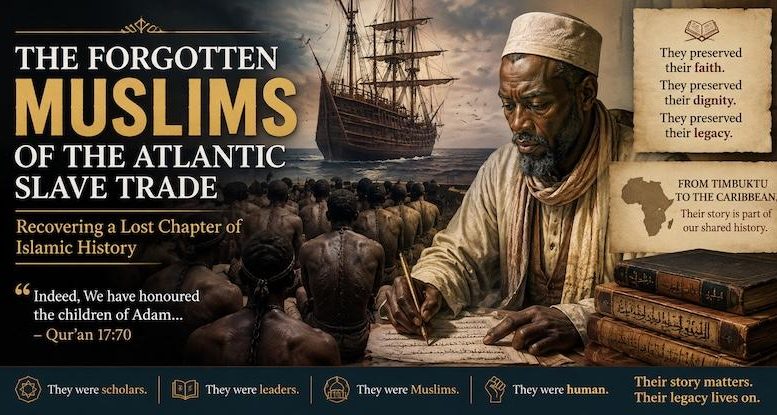
“Indeed, We have honoured the children of Adam.” (Qur’an 17:70)
Their story is part of that honour.
Our duty is to ensure it is never forgotten.