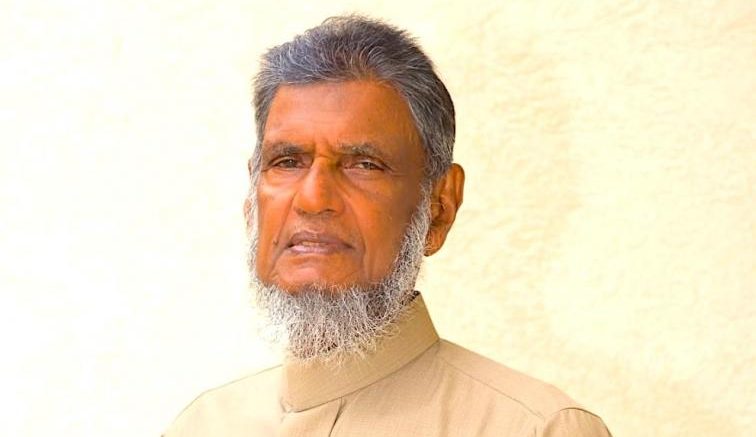
PORT OF SPAIN, Trinidad and Tobago; September 11, 2026: Trinidad and Tobago’s Muslim community is mourning the death of Al-Haj Dr Mansoor Ibrahim, a physician, former President General of the Anjuman Sunnat ul Jamaat Association (ASJA), community worker and respected Islamic leader whose life spanned more than six decades of medical and public service.
ASJA announced Dr Ibrahim’s death in an obituary dated September 11, describing him as its eighth President General and as a “distinguished medical practitioner, devoted Muslim, and dedicated servant of humanity.”
His death comes just two months after the University of St Andrews published an extensive tribute to him, recounting a remarkable journey from east Port of Spain to medical school in Scotland and back to Trinidad and Tobago, where he spent more than six decades serving patients and the wider community.
From “Behind the Bridge” to St Andrews
Born to Haji Mohammed and Hajjin Sakina Ibrahim, Dr Ibrahim grew up in the area popularly known as “Behind the Bridge” in east Port of Spain.
The environment in which he was raised helped shape the values that would define his life. According to the St Andrews account, as a boy of about 12 or 13, he created a detailed timetable allocating time for schoolwork, sport and household responsibilities.
 He had been inspired by three words he saw on a calendar: “work, method and discipline.” Those words became a personal philosophy that he carried throughout his life and later passed on to his children.
His educational journey was itself unconventional.
Although he initially hoped to become an engineer, his father’s wishes led him towards medicine. After attending the Progressive Educational Institute, he subsequently entered Queen’s Royal College on a government scholarship after placing 13th in the islands in the Cambridge School Certificate examination.
Because science subjects had not been available to him earlier, his route into medicine was far from straightforward.
In 1959, he travelled to Scotland and applied to the Faculty of Medicine at the University of St Andrews. Of 35 applicants interviewed, only two were accepted. Ibrahim was one of them. He completed a preparatory programme to acquire the science subjects he had previously lacked and eventually graduated with an MB ChB in 1966.
His years in Scotland were about much more than academic achievement. He became vice-president of the Bute Medical Society, participated in debating, played squash and developed friendships that lasted for decades.
One memorable episode occurred when he was invited to participate in activities at Balmoral Castle. At a subsequent Ghillies Ball, he was asked to dance with Queen Elizabeth II, an experience that he recalled with characteristic modesty and humour.
Returning home to serve
Dr Ibrahim returned to Trinidad and Tobago in 1965 and embarked on a medical career that would ultimately last more than six decades.
He established a medical practice in Port of Spain and became particularly identified with the communities of east Port of Spain, Laventille and surrounding areas.
The University of St Andrews tribute records that he practised for approximately 58 years in his Port of Spain practice, delivering babies, performing circumcisions and making countless house calls to elderly and infirm patients who could no longer travel to his office.
His commitment stood out because many of his patients lived in communities affected by poverty and social difficulties.
A profile published by Trinidad and Tobago’s National Library and Information System Authority (NALIS) described him as a physician whose career took on a distinctly humanitarian character, noting his willingness to make house calls in high-risk areas.
His approach to medicine matched a broader philosophy of service.
In a 1965 University of St Andrews yearbook, his fellow student John Wedderburn described Ibrahim as:
“By nature, honest; by experience, wise, and healthy by temperance and exercise.”
A decade at the helm of ASJA
Dr Ibrahim’s influence extended well beyond his medical practice.
He served as President General of ASJA from 1990 to 2000, leading the organization during a key period of its development. During his tenure, he consistently promoted unity, cooperation and brotherhood among Muslims.
An excerpt preserved by NALIS from one of his addresses to ASJA’s Central Executive reflects his emphasis on avoiding fragmentation within the Muslim community and encouraging cooperation among Muslim organisations.
His service also extended into education. He chaired the ASJA Education Board of Management, contributing to the continued development of the association’s educational institutions.
He was also involved in the Inter-Religious Organization (IRO) and the Muslim Coordinating Council, and served as a Muslim Marriage Officer.
Service beyond the Muslim community
One of Dr Ibrahim’s significant contributions was establishing Islamic Community Services (ICS), an initiative designed to provide assistance and care to elderly, vulnerable, and needy members of society.
ASJA notes that his service extended beyond the Muslim community through both his involvement with the IRO and his contribution to ICS.
His interfaith engagement reflected a broader understanding of Islam as a force for social responsibility rather than merely private religious observance.
His public interventions over the years also demonstrated a willingness to address issues affecting the wider society. In 2015, for example, he spoke publicly following the murder of a young woman whom he had delivered and whose family he had served medically for many years. He described her death as a tragedy affecting both the family and the wider community.
Faith, scholarship and the life of service
Dr Ibrahim was also deeply committed to Islamic scholarship and devotional life.
ASJA describes him as a devoted student of Shaykh Haji Muhammad Yusuf Francis, and notes his characteristic humility, sincerity and devotion to Allah.
His distinctive rendition of Tazeem, a devotional expression of love and reverence for the Prophet Muhammad ﷺ, became a familiar feature of Islamic gatherings and reflected his deep love for the Prophet. [Tazeem is a nasheed with lyrics showing profound respect, esteem, or high regard toward the Prophet Muhammad ﷺ].
He also left a literary legacy. In 2021, he published a two-volume collection, A Collection of Khutbahs and Lectures by Dr Mansoor Ibrahim, preserving some of his Islamic teachings and reflections.
A sportsman and advocate of healthy living
Medicine and religious service were not his only passions.
Dr Ibrahim was an accomplished sportsman who represented Trinidad and Tobago in squash and tennis. NALIS records that he represented the country in squash for seven years before injuries ended that chapter of his sporting career. He also played cricket, table tennis and lawn tennis.
His commitment to physical fitness remained with him throughout his life.
The University of St Andrews account noted that even at 88, he continued to practise medicine for a few hours each day, despite his family believing that he had earned the right to retire.
That detail perhaps best captures the philosophy by which he lived: work, method and discipline.
National recognition
In recognition of his contribution to Trinidad and Tobago, Dr Ibrahim was awarded the Chaconia Medal (Silver) for community service in 1999. ASJA and NALIS both record the award.
Yet the tributes surrounding his death suggest that his most significant legacy cannot be measured by medals or positions.
It lies in the patients he treated, the babies he delivered, the elderly people whose homes he visited, the young people he mentored, the institutions he helped strengthen and the generations of Muslims who encountered his leadership and example.
The University of St Andrews tribute, written by his daughter Dr Amina Ibrahim-Ali, concluded that his story was ultimately one of work, discipline, family, friendship, faith and service — a life in which professional excellence was inseparable from concern for others.
ASJA said Dr Ibrahim leaves behind a legacy of “faith, compassion, humility, leadership, and service,” adding that the people he healed and the institutions he helped establish and strengthen would continue to remember him.
His death marks the passing of one of Trinidad and Tobago’s notable Muslim public figures of the post-independence era — a physician who chose to return home after his education abroad and spend the greater part of his life serving ordinary people, particularly those in communities that needed him most.
ASJA extended condolences to his family, loved ones, colleagues and the wider Muslim community.
It concluded its tribute with a prayer that Allah forgive his shortcomings, accept his good deeds, envelop him in His mercy and grant him Jannatul Firdaus.
Inna lillahi wa inna ilayhi raji’un (Indeed, to God we belong and to Him we shall return).
Read the University of St Andrews tribute to Dr Mansoor Ibrahim