“Indeed, We have honoured the children of Adam…” (Qur’an 17:70)
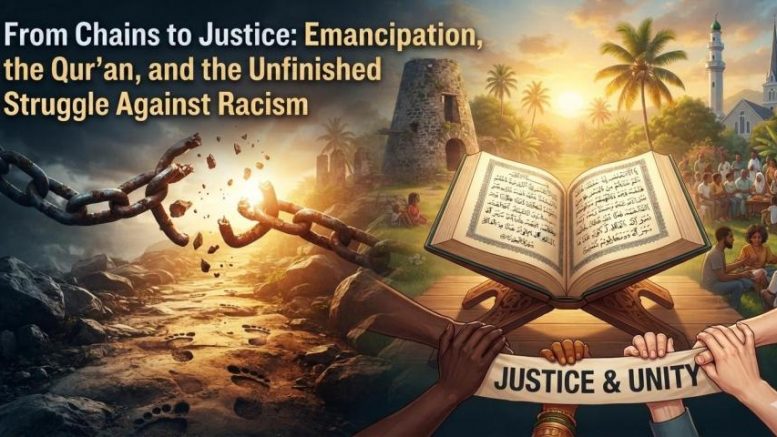
Every year on August 1, many nations across the Caribbean observe Emancipation Day, commemorating the day in 1834 when the Slavery Abolition Act came into force throughout most of the British Empire. More than 800,000 enslaved Africans and their descendants were legally freed after centuries of brutal exploitation.
Emancipation Day is more than a historical anniversary. It is a day of remembrance, reflection and moral responsibility. It invites us not only to honour those who endured one of humanity’s greatest injustices, but also to ask whether the conditions that made slavery possible have truly disappeared.
For Muslims, the answers are found in the timeless guidance of the Qur’an.
A Crime Against Human Dignity
The transatlantic slave trade was not simply an economic enterprise; it was a systematic assault on human dignity.
Millions of African men, women and children were captured, separated from their families, transported across the Atlantic under horrific conditions, and sold as property. Their names were erased. Their languages suppressed. Their cultures attacked. Their labour stolen. Their humanity denied.
The Qur’an begins from an entirely different premise.
Allah declares:
“Indeed, We have honoured the children of Adam…” (Qur’an 17:70)
This remarkable verse is one of the Qur’an’s most powerful declarations of universal human dignity. Every person, regardless of race, colour, ethnicity or social status, is honoured by Allah simply because they are descendants of Adam and Hawwa (Eve).
Slavery violated that divine honour.
Racism: The Ideology That Sustained Slavery
The slave trade could not have endured for centuries through force alone.
It required an ideology.
European colonial powers gradually developed theories of racial superiority that portrayed Africans as naturally inferior and therefore fit to be enslaved. These ideas were reinforced through law, education, politics, commerce and, regrettably, by some religious institutions that distorted scripture to justify oppression.
Racism became more than prejudice. It became an infrastructure.
The Qur’an rejects this ideology unequivocally.
Allah says:
“O mankind! We created you from a male and a female and made you peoples and tribes so that you may know one another. Indeed, the most honoured of you in the sight of Allah is the most righteous of you.” (Qur’an 49:13)
The Qur’an acknowledges human diversity but rejects every claim of racial superiority. Honour belongs not to one’s ancestry or skin colour but to one’s character and consciousness of Allah.
The Prophet Muhammad ﷺ reinforced this principle in his Farewell Sermon:
“No Arab has superiority over a non-Arab, nor a non-Arab over an Arab; neither a white person over a black person nor a black person over a white person except through righteousness.”
Nearly fourteen centuries later, these words remain among history’s clearest declarations of racial equality.
Wealth Built on Stolen Labour
The enormous wealth accumulated by European colonial empires was not created solely through innovation or commerce.
It was built, in significant measure, upon centuries of unpaid African labour.
Sugar plantations throughout the Caribbean generated fortunes.
Cotton harvested by enslaved people fuelled the textile mills of Britain and New England.
Coffee plantations in Brazil, tobacco fields in Virginia, rice plantations in the Carolinas and countless other colonial enterprises depended upon forced labour.
Banks financed plantations.
Insurance companies insured slave ships.
Ports expanded through the slave trade.
Universities, merchants and industries benefited directly and indirectly from slave-generated wealth.
The enslaved produced immense prosperity while remaining impoverished themselves.
The Qur’an condemns precisely this form of economic injustice:
“Do not consume one another’s wealth unjustly.” (Qur’an 2:188)
The wealth extracted from enslaved labour remains one of history’s greatest examples of unjust enrichment.
Muslim Africans: The Forgotten Story
One of the least known chapters of the Atlantic slave trade is the presence of thousands of African Muslims among the enslaved.
Many came from the great Islamic centres of West Africa, regions such as Senegambia, Futa Toro, Futa Jallon, Hausaland and Mali. They included scholars, judges, teachers, merchants and Qur’an memorizers.
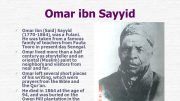
Among them was Omar ibn Said, who wrote passages of the Qur’an from memory while enslaved in North Carolina.
Another was Ayuba Suleiman Diallo, whose remarkable life challenged European assumptions about African intellectual and religious life.
Their stories remind us that slavery uprooted not merely individuals but entire civilizations.
Islam’s Path Toward Freedom
Islam emerged in a world where slavery existed across virtually every civilization. Rather than encouraging its expansion, the Qur’an consistently promoted emancipation and the restoration of human dignity.
Allah describes one of the highest acts of righteousness:
“And what will make you understand what the steep path is? It is the freeing of a person in bondage.” (Qur’an 90:12–13)
The freeing of enslaved people became an act of worship, an expiation for certain sins, and one of the legitimate recipients of zakāh.
The Prophet Muhammad ﷺ repeatedly encouraged emancipation and transformed attitudes toward those who had been enslaved.
Perhaps the greatest example is Bilal ibn Rabah.
An African who endured severe torture because of his faith, Bilāl was later honoured by the Prophet ﷺ as Islam’s first mu’adhdhin (a person who makes the formal call to prayer). His elevation demonstrated that faith, not race, wealth or lineage—is the true measure of honour.
Has the Infrastructure of Racism Disappeared?
Although legal slavery has been abolished, many of its structures continue to cast long shadows.
Across numerous former slave-owning societies, racial disparities remain evident in wealth, housing, education, healthcare, employment, political representation and criminal justice.
These inequalities did not emerge by accident.
They are, in many cases, the accumulated consequences of centuries of exclusion, discrimination and unequal opportunity.
The Qur’an reminds believers that justice requires more than the removal of chains.
Allah commands:
“Indeed, Allah commands justice, excellence and generosity…” (Qur’an 16:90)
Justice requires that societies examine their institutions honestly, confront discrimination wherever it exists, and ensure that every individual enjoys equal dignity and equal opportunity.
Remembering history is not about assigning inherited guilt. The Qur’an teaches:
“No bearer of burdens shall bear the burden of another.” (Qur’an 6:164)
Each generation is accountable for its own actions.
But every generation also bears responsibility for confronting injustice wherever it persists.
Contemporary Lessons
The moral lessons of Emancipation Day extend beyond the history of slavery.
Whenever people are dehumanized because of race…
Whenever migrant workers are exploited…
Whenever refugees are denied their humanity…
Whenever forced labour, human trafficking or modern slavery flourish…
Whenever entire populations are treated as expendable…
The principles violated are the very principles that sustained slavery.
The Qur’an calls believers to stand with justice regardless of the identity of the victim or the oppressor:
“O you who believe! Stand firmly for justice as witnesses for Allah, even if it is against yourselves, your parents or your relatives…” (Qur’an 4:135)
Justice is not selective.
It is universal.
Emancipation Is More Than a Historical Event
The abolition of slavery marked the end of legal bondage.
It did not automatically establish justice.
True emancipation is achieved only when societies reject racism, dismantle systems of discrimination, uphold the equal dignity of every human being, and refuse to build prosperity upon the exploitation of others.
As Muslims, we remember Emancipation Day not simply because slavery ended, but because the Qur’an calls us to continue the work of liberation, liberating people from oppression, prejudice, exploitation and injustice in every age.
The chains may have been broken 192 years ago.
The struggle for justice continues.
May Allah purify our hearts from prejudice, strengthen our commitment to justice, and enable us to honour every child of Adam as He Himself has honoured them.
“Indeed, We have honoured the children of Adam.” (Qur’an 17:70)
That is not merely a verse to recite.
It is a principle by which civilizations should be judged.