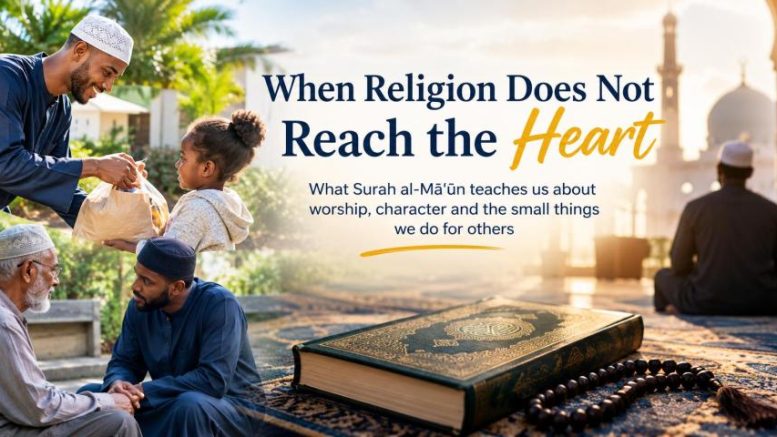
What Surah al-Māʿūn teaches us about worship, character and the small things we do for others
We often judge people by what we can see. We notice how they dress, how regularly they attend the mosque, how often they perform religious rituals and rites, how much they speak about religion, or how visibly involved they are in the religious community. Outward observance is certainly important, but is that what God ultimately expects from us? Or does He expect something deeper, a transformation of the inner self that changes our attitudes, our priorities and the way we treat other people? Is religion simply something we perform, or is it supposed to change who we become?
There is a disturbing possibility that every religious person should occasionally consider:
What if our worship is visible, but its effect on our character is not?
We pray. We fast. We attend the masjid. We give charity. We listen to lectures and share Islamic reminders on social media.
But how do the people around us experience us?
Do they experience patience, kindness and generosity? Or do they experience arrogance, harshness, indifference and self-interest?
Surah al-Māʿūn, only seven verses long, confronts this tension precisely.
God begins: “Have you seen the one who denies the Recompense?” (Qur’an 107:1)
What follows is not an abstract theological argument. God describes how that denial becomes visible in a person’s behaviour: “That is the one who repels the orphan, and does not encourage the feeding of the poor.” Qur’an (107:2–3)
Then comes the startling warning: “So woe to those who pray, those who are heedless of their prayer, those who show off, and withhold al-Māʿūn.” Qur’an (107:4–7)
The surah forces us to confront an uncomfortable truth:
Religious appearance and religious character are not necessarily the same thing.
The people we cannot benefit from
The orphan and the poor occupy a prominent place in the Qur’an because they represent people who have little power to advance our interests. That makes them a test.
It is relatively easy to be courteous to someone influential. We know that person’s position, connections or resources may matter to us. But what about the person who cannot do anything for us?
- The elderly neighbour.
- The struggling family.
- The newcomer to the community.
- The person sitting alone at the masjid.
- The employee with no influence.
- The widow trying to manage household expenses.
- The young person who has become disconnected from the community.
- The person whose accent, clothing or social circumstances make them different from us.
Surah al-Māʿūn asks us to consider how we respond to people who offer us no obvious advantage.
The Qur’an’s standard is clear: “So as for the orphan, do not oppress.” (Qur’an 93:9)
The measure of character is often revealed in how we treat people who cannot repay us.
Islam does not separate worship from responsibility
One remarkable feature of the Qur’an is how often it places worship alongside responsibility toward other people.
God commands: “Worship God and associate nothing with Him, and to parents do good, and to relatives, orphans, the needy, the near neighbour, the distant neighbour…” (Qur’an 4:36)
The sequence is significant.
Worship God and then look around you.
There are people whose rights and needs are now part of your religious responsibility.
This has implications for Muslim communities everywhere, including our Caribbean and diaspora communities.
- A mosque can have beautiful architecture, excellent programs and large congregations while still failing to notice the lonely, the elderly, the struggling or the newcomer.
- A community can raise substantial amounts of money while someone quietly sits at the edge of that community feeling invisible.
- A person can deliver a powerful khutbah about brotherhood and then refuse to speak to the Muslim with whom he disagrees.
Surah al-Māʿūn brings religion back to the level where people encounter it, in our behaviour.
The test of prayer (ṣalāh) is not only what happens on the prayer mat
The warning about those who pray is perhaps the surah’s most unsettling part.
God says: “So woe to those who pray, those who are heedless of their prayer.” (Qur’an 107:4–5)
This is not a condemnation of prayer. It warns about prayer that has lost its intended effect.
God says elsewhere: “Indeed, prayer restrains from shameful and unjust deeds.” (Qur’an 29:45)
Prayer should therefore reach beyond the prayer mat.
If we stand before God five times a day, that encounter should influence how we speak to our spouse, how we treat our children, how we deal with employees, how we speak about people who are absent and how we conduct business.
It should affect what we do when nobody is watching. That does not mean a believer becomes perfect because he/she prays. Human beings struggle, fail and repent. But prayer (ṣalāh) should continually pull us toward better character.
When the mosque becomes a place of belonging
There is another contemporary lesson here. We sometimes measure the health of a mosque by attendance, fundraising totals, programs and physical development. Those things matter. But perhaps another question deserves equal attention:
Does a person who walks through the mosque doors feel that he or she belongs?
- Does the newcomer receive a greeting?
- Does the elderly person have someone to speak with?
- Does the convert have someone to call?
- Does the young person feel heard?
- Does the struggling family know where to seek help without embarrassment?
- Does someone who has made mistakes believe that the community will help them return rather than permanently label them?
These are not merely matters of community management. They are matters of faith.
The Prophet ﷺ said: “Every act of kindness is charity.” (Sahih Muslim)
Sometimes the most important service we provide to another person costs almost nothing.
Al-Māʿūn: the small things
The final verse gives the surah its name:
“And they withhold al-Māʿūn.” (Qur’an 107:7)
The classical explanations of al-Māʿūn include ordinary useful things and small acts of assistance. That is a remarkable ending.
After discussing the orphan, the poor, prayer and sincerity, God brings us down to the level of everyday life.
- A small favour.
- Something borrowed.
- A helping hand.
- A simple kindness.
- An act that may seem too insignificant to mention.
This is where the message becomes especially relevant to ordinary life.
- Someone needs a ride to the masjid.
- Someone needs help carrying groceries.
- A neighbour needs a tool.
- An elderly person needs assistance navigating a form.
- A newcomer needs someone to explain how things work.
- A struggling family needs a meal.
- Someone needs a phone call because they have been alone for too long.
None of these acts may make the news. None may appear in a fundraising report. Nobody may post a photograph.
But God sees them.
The danger of being religious for an audience
Surah al-Māʿūn also warns against riyāʾ, i.e. performing religious deeds for recognition.
This is especially relevant in an age when religious life can be displayed publicly with unprecedented ease.
- We can photograph the iftar.
- Post the donation.
- Announce the achievement.
- Share the reminder.
- Publicize the community project.
Nothing is inherently wrong with publicizing good work, especially when it encourages others to participate.
The question is more personal: Would I still do this if nobody knew I had done it?
That is a question worth asking.
The Prophet ﷺ taught: “Actions are only by intentions.” (Sahih al-Bukhari; Sahih Muslim)
The same action can look identical from the outside while being entirely different before God because of what is inside the heart.
The small kindness may be the big deed
We sometimes think of Islamic service in terms of large projects.
- Build the mosque.
- Fund the school.
- Organize the conference.
- Raise thousands of dollars.
- Feed hundreds of people.
These are valuable forms of service. But Islam also teaches us not to underestimate the small deed.
The Prophet ﷺ said: “Do not belittle any good deed, even meeting your brother with a cheerful face.”
(Sahih Muslim)
That changes how we should view everyday encounters.
- A smile can matter.
- A greeting can matter.
- Listening can matter.
- Forgiving can matter.
- Making room for someone can matter.
- Checking on someone can matter.
- So can choosing not to humiliate someone when we have the power to do so.
What kind of Muslim community are we building?
- This is where Surah al-Māʿūn moves beyond the individual.
- What kind of community do our religious institutions produce?
Are we creating communities where people compete for recognition, or communities where people quietly serve?
- Do our leaders receive attention while the vulnerable remain invisible?
- Do we welcome people only when they contribute money, status or influence?
- Do we celebrate the successful while overlooking those who are struggling?
- Do we measure the strength of our community by the size of our buildings, or by the quality of relationships within them?
These questions are not intended to diminish the importance of institutions.
- Institutions matter.
- Mosques matter.
- Schools matter.
- Charities matter.
But institutions exist to serve people. And people exist to worship God. The two should reinforce one another.
The Qur’anic measure of righteousness
The Qur’an gives us a broader definition of righteousness:
“Righteousness is not that you turn your faces toward the east or west, but righteousness is [in] one who believes in God… and gives wealth, despite loving it, to relatives, orphans, the needy, the traveller and those who ask…” (Qur’an 2:177)
The verse begins with belief and ends with conduct. That pattern appears repeatedly throughout revelation.
- Belief should produce action.
- Prayer should produce discipline.
- Fasting should produce restraint.
- Charity should produce generosity.
- Knowledge should produce humility.
- And remembrance of the Hereafter should produce accountability.
The purpose is not to make us look religious. The purpose is to make us better servants of God and better human beings.
Perhaps Surah al-Māʿūn is asking us a different question
It is easy to read this surah and identify the people it condemns.
- The person who neglects the orphan.
- The person who ignores the poor.
- The person who shows off.
- The person who refuses to help.
But perhaps that is not the most productive way to read it.
Instead of asking: “Who are the people described in Surah al-Māʿūn?”
we might ask: “Where do I see myself in this surah?”
- Do I notice people who need help?
- Do I make it easier or harder for others to approach me?
- Do I treat people differently according to what they can offer me?
- Does my prayer (ṣalāh) affect my character?
- Would I still perform my good deeds if nobody knew about them?
And when someone asks me for a small favour, do I see an inconvenience, or an opportunity to earn something from God?
The Prophet ﷺ said: “Every act of kindness is charity.”
Perhaps that is one of the quiet messages of Surah al-Māʿūn. Islam is not only found in the extraordinary. It is found in the ordinary things we repeatedly choose to do.
- A meal given.
- A hand extended.
- A burden shared.
- A harsh word withheld.
- A neighbour remembered.
- A stranger welcomed.
- A vulnerable person protected.
- A small favour done without expectation of recognition.
The question for our communities
We often ask whether our mosques are growing, whether our programs are succeeding and whether our fundraising targets are being met. Perhaps Surah al-Māʿūn asks us to add another question:
If someone encountered our community without knowing anything about Islam, would the way we treated them give them a glimpse of the mercy, justice and compassion that Islam teaches?
And perhaps, on a personal level, the question is even more uncomfortable:
If God judged our religion not by what people saw us doing in public, but by how we treated the people who could do nothing for us in return, what would our worship say about us?
The Qur’an also challenges the hierarchies by which human beings have historically measured one another. Wealth, power, social position, family name, tribe, nationality and influence may determine how societies treat people, but they do not determine a person’s worth before God.
God says: “Indeed, the most noble of you in the sight of God is the most righteous of you.” (Qur’an 49:13)
The verse does not say the wealthiest, most powerful, most connected, most prestigious or most influential. It places human worth on a different moral foundation.
Islam therefore calls us to look beyond the circumstances into which people are born or the circumstances in which they find themselves. Some are vulnerable because of poverty. Others because they are elderly, orphaned, displaced, disabled, marginalized, newly arrived, socially isolated or simply caught in circumstances beyond their control.
The source of the vulnerability may differ. Our responsibility does not.
We may not be able to change every circumstance, but we can decide whether our presence makes another person’s experience of life a little more dignified, a little more bearable and a little less lonely.
Perhaps this is one of the deeper messages of Surah al-Māʿūn: religion should not merely change how we stand before God; it should change how we stand beside one another.
The challenge is therefore not simply to become people who perform more religious acts, but people whose worship makes the human experience better for others, especially for those with the least power to make it better for themselves.
That is the mirror Surah al-Māʿūn places before us.