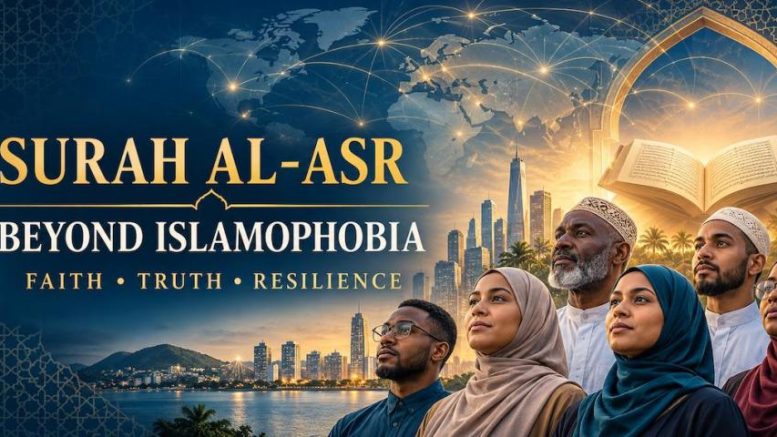
A Qur’anic examination of Muslim identity, power, resilience, collective responsibility and the struggle to preserve human dignity in contemporary global politics.
1. The central proposition
Surah Al-Asr (Chapter 103) has only three verses, yet it offers an extraordinarily comprehensive framework for understanding the condition of humanity, the obligations of believers, and the foundations of a successful society.
Its significance becomes particularly pronounced when examined against the contemporary international environment in which Muslim identity, Islamic institutions, religious practices and political aspirations are increasingly contested.
There is an important distinction to establish at the outset: Islamophobia is a documented phenomenon, but it would be analytically inaccurate to assume that every criticism of Islam, every security policy or every geopolitical conflict is part of one coordinated global strategy. Different political actors have different interests. Nevertheless, anti-Muslim prejudice, discriminatory policies, selective media narratives and the dehumanisation of Muslim populations can reinforce one another, sometimes producing a recognisable pattern of exclusion.
The question, therefore, is not simply how Muslims should respond to hostility.
It is much more fundamental:
What kind of Muslim society must we become to withstand a political environment that may seek to marginalise our identity, undermine our legitimacy, diminish our influence and weaken our confidence in our own civilisational values?
Surah Al-Asr provides a framework for answering this question.
The central proposition is that the surah moves Muslims away from a politics of reaction and towards a politics of principled agency. It calls for intellectual integrity, moral discipline, collective solidarity, truth-telling and sustained action.
It does not prescribe political passivity. Nor does it legitimise aggression. It establishes the ethical foundations upon which Muslims should exercise individual and collective agency.
2. Interrogating Surah Al-Asr
وَالْعَصْرِ
Wal-Asr – By Time. (Qur’an 103:1)
إِنَّ الْإِنسَانَ لَفِي خُسْرٍ
Innal-insāna lafī khusr – Indeed, humanity is in a state of loss. (Qur’an 103:2)
إِلَّا الَّذِينَ آمَنُوا وَعَمِلُوا الصَّالِحَاتِ وَتَوَاصَوْا بِالْحَقِّ وَتَوَاصَوْا بِالصَّبْرِ
Illal-ladhīna āmanū wa ‘amilus-sālihāti wa tawāsaw bil-haqqi wa tawāsaw bis-sabr – Except those who believe, perform righteous deeds, encourage one another towards truth and encourage one another towards patience. (Qur’an 103:3)
The surah establishes four interdependent conditions for escaping human loss:
-
Iman — conviction and intellectual-spiritual orientation.
-
Amal al-Salihat — constructive and righteous action.
-
Tawasi bil-Haqq — mutual commitment to truth.
-
Tawasi bis-Sabr — mutual commitment to perseverance.
These are not four unrelated religious virtues. Together, they constitute a programme for individual development and collective civilisation.
A. Wal-Asr: Understanding the significance of historical time
God begins by swearing by time. Classical mufassirun have discussed the meanings of Al-Asr, including time, the passage of time and the period of the afternoon. The wider significance is that human existence unfolds within a limited window of time.
For Muslims, this introduces an important political and historical question:
Are we merely experiencing history, or are we consciously shaping our place within it?
Muslim communities cannot afford to be permanently preoccupied with the events of yesterday while neglecting the institutional, intellectual and economic foundations of tomorrow.
Consider the contemporary challenges:
-
The international distribution of political and economic power.
-
The use of security narratives to define Muslim communities.
-
The representation of Muslims in international media.
-
The treatment of Muslim minorities and migrants.
-
The contestation of religious expression in public institutions.
-
The marginalisation of Muslim perspectives in discussions about international justice.
-
The vulnerability of Muslim educational, charitable and religious institutions.
These developments require historical consciousness.
A community that does not understand the forces shaping its environment will struggle to respond effectively.
Al-Asr therefore invites Muslims to understand time not simply as something that passes, but as a responsibility that requires purposeful action.
B. Innal-insāna lafī khusr: The danger of collective loss
The second verse makes a universal declaration: humanity is in loss. The Arabic expression khusr conveys loss, diminution and failure to realise one’s potential.
This matters because the Qur’an does not define human success by military supremacy, territorial expansion, economic dominance, or political control.
A Muslim society can possess considerable wealth and political influence while experiencing profound moral and spiritual deterioration.
Conversely, a Muslim minority may lack political power while retaining intellectual vitality, social cohesion, religious confidence and moral integrity.
This distinction is crucial in contemporary geopolitics.
The danger facing Muslims is not exclusively external hostility. It is also the possibility of internal disintegration.
A community may become so consumed by defending itself against external hostility that it neglects:
-
Education and intellectual development.
-
Institutional competence.
-
Economic independence.
-
Leadership accountability.
-
Social justice within its own communities.
-
The welfare and dignity of women and vulnerable populations.
-
The cultivation of future generations.
This would constitute another form of khusr. The Qur’anic warning should therefore be interrogated internally as much as externally.
We cannot attribute every difficulty to Islamophobia, colonialism or geopolitical hostility while refusing to confront our own institutional weaknesses.
C. Iman: Preserving intellectual and civilisational confidence
The first exception to loss is iman. Iman is not merely an identity declaration. It is conviction grounded in knowledge, consciousness of Allah, moral accountability and confidence in divine guidance.
In a hostile political environment, Muslim identity can become defined almost entirely by what others say about Muslims.
This creates a serious vulnerability.
When a community continually explains itself through its adversaries’ accusations, it risks allowing those adversaries to determine the terms of its existence.
The Qur’anic response begins with a different point of departure.
Muslims must understand themselves through revelation, rather than through the stereotypes imposed upon them.
This does not mean refusing to examine criticism. Islam does not prohibit scrutiny or intellectual engagement. It means that the standards by which Muslims evaluate themselves must be grounded in truth, justice and divine accountability.
The distinction is between:
-
Confidence and arrogance.
-
Religious conviction and intellectual isolation.
-
Critical engagement and cultural subordination.
-
Respectful coexistence and surrender of religious identity.
Iman gives Muslims an independent moral and intellectual foundation for participating in society.
D. Wa ‘amilus-salihat: Moving from religious identity to demonstrable social value
The Qur’an does not separate belief from conduct. The conjunction between iman and righteous action is fundamental. Faith must produce consequences in the world.
This has significant implications for how Muslims position themselves in contemporary politics.
Muslim communities should not measure their contribution exclusively by the number of mosques constructed, people attending religious programmes or the visibility of Islamic symbols.
These are important, but they are not sufficient.
The question is whether Islamic values produce societies characterised by:
-
Justice in the administration of institutions.
-
Educational excellence and intellectual contribution.
-
Economic productivity and responsible wealth distribution.
-
Protection of human dignity.
-
Care for the vulnerable and marginalised.
-
Trustworthiness in public office.
-
Compassion across religious and cultural boundaries.
-
Accountability for wrongdoing, including wrongdoing committed by Muslims.
Consider Qur’an 4:135:
O you who believe! Stand firmly for justice, as witnesses for God, even if it be against yourselves, your parents or your relatives.
This is a remarkably demanding standard.
It means that Muslims cannot credibly demand justice for themselves while excusing injustice committed by their own leaders, governments, organisations or fellow believers.
Nor can they make their commitment to justice conditional upon whether the victims are Muslim.
This becomes especially important when discussing Palestine, Sudan, Kashmir, Myanmar and other situations involving Muslim populations. The moral principle must remain consistent irrespective of the identity of the perpetrator or victim.
The credibility of Muslim political advocacy depends substantially on the consistency of its moral standards.
E. Wa tawasaw bil-haqq: The struggle over truth and public narratives
This is perhaps the most strategically important component of the surah in contemporary geopolitics.
The Arabic expression tawasi is reciprocal. It is not simply one individual speaking truth to others. It describes a community mutually encouraging, reminding and reinforcing one another in truth.
This introduces the concept of collective epistemic responsibility: a community’s responsibility to establish, preserve, and defend truthful knowledge.
Why is this important?
Because political power is not exercised exclusively through military force, economic leverage or legislation. It is also exercised through the control, construction and repetition of narratives.
Consider how a population may be represented through recurring associations:
-
Muslim identity with terrorism.
-
Muslim religious observance with extremism.
-
Muslim immigration with insecurity.
-
Muslim political participation with disloyalty.
-
Muslim advocacy for Palestinian rights with hostility towards another religious community.
-
Muslim civilisational values with incompatibility with modern society.
These associations are not necessarily produced by one central authority. They may emerge through political rhetoric, selective reporting, social media, discriminatory institutional practices and the repetition of stereotypes.
The strategic consequence, however, can be similar: Muslims become a population required to continually prove their innocence, loyalty and legitimacy.
This creates an asymmetry.
Other communities are generally understood through their diversity, internal disagreements, and individual conduct. Muslims may instead find themselves judged collectively by the actions of particular individuals or organisations.
The Qur’anic response is not to manufacture a competing propaganda system.
It is to establish a disciplined commitment to truth.
This means:
-
Developing Muslim intellectuals capable of examining international affairs.
-
Building credible Muslim media institutions.
-
Challenging misinformation with evidence rather than emotional reactions.
-
Documenting discrimination and violations of religious freedom.
-
Distinguishing criticism of governments from hostility towards entire populations.
-
Refusing to circulate unverified claims, even when they support a cause we sympathise with.
-
Ensuring that Muslim public representatives are knowledgeable, articulate and ethically credible.
The obligation to speak truth also requires the courage to challenge misinformation originating within Muslim communities.
The Qur’an declares:
O you who believe! If a transgressor brings you news, verify it. (Qur’an 49:6)
In an age of algorithmic amplification, fabricated videos, manipulated images and instant political mobilisation, this verse has extraordinary contemporary relevance.
Muslims must become producers and guardians of reliable knowledge, not merely consumers of information.
F. Wa tawasaw bis-sabr: Strategic patience without political submission
Sabr is frequently misunderstood as passive acceptance of adversity. That interpretation is inadequate.
In the Qur’anic worldview, patience involves perseverance in obedience, restraint in the face of provocation, endurance under hardship and steadfastness in pursuing what is right.
The Prophet Muhammad ﷺ experienced persecution, economic pressure, social exclusion, the loss of loved ones and armed opposition. Yet he did not abandon his principles.
Sabr must therefore be understood as disciplined endurance in the pursuit of justice.
There is a critical distinction between:
-
Patience and helplessness.
-
Reconciliation and surrender.
-
Restraint and cowardice.
-
Forgiveness and the abandonment of accountability.
-
Strategic flexibility and compromising fundamental principles.
Qur’an 8:46 warns believers against disputation that leads to the loss of collective strength.
Obey God and His Messenger and do not dispute with one another, or you would be discouraged and weakened. Persevere! Surely Allah is with those who persevere.
This has an important institutional implication.
Muslims cannot effectively defend their interests if internal disagreements continuously consume the energy, credibility and resources needed for collective advancement.
Sabr therefore requires the ability to sustain a long-term programme despite setbacks, political disappointments and provocations.
A society that reacts to every provocation on the terms established by its opponents risks surrendering its strategic independence.
3. What does the contemporary evidence tell us about Islamophobia?
The Qur’anic framework must be tested against the contemporary environment rather than treated as an abstract theological exercise.
There is documented evidence of anti-Muslim discrimination and hostility.
For example:
-
The UN Special Rapporteur on contemporary forms of racism submitted report A/HRC/56/68 in June 2024, addressing contemporary racism, discrimination, xenophobia and related intolerance.
-
The OSCE Office for Democratic Institutions and Human Rights documented anti-Muslim incidents in its 2024 hate-crime findings, including threats against Muslim families, harassment of hijab-wearing women and threats directed at mosques.
These findings are important, but they must be interpreted carefully. The OSCE evidence concerns participating states and reported incidents; it does not show that all Muslim communities face identical conditions or that all incidents stem from a coordinated political strategy.
Nevertheless, it establishes that anti-Muslim hostility is not merely a theoretical concern.
The anatomy of exclusion
A useful analytical model examines five mutually reinforcing processes.
Five dimensions of anti-Muslim exclusion
1. Narrative construction: Muslims are repeatedly associated with insecurity, extremism, cultural incompatibility or foreignness.
2. Social normalisation: Stereotypes become acceptable in political discourse, public commentary and popular culture.
3. Institutional discrimination: Religious expression, employment, education, immigration and public participation may be affected by discriminatory treatment.
4. Political delegitimisation: Muslim organisations, advocacy and political participation may be treated as inherently suspect rather than evaluated on their actual conduct and objectives.
This is an analytical framework, not a claim that every country or political institution follows all five stages.
The distinction matters. It allows Muslims to identify and document genuine discrimination without attributing every political disagreement to anti-Muslim hostility.
The Qur’an offers a powerful standard for evaluating this environment.
In Surah Al-Ma’idah 5:8,
O believers! Stand firm for God and bear true testimony. Do not let the hatred of a people lead you to injustice. Be just!
God commands believers not to let hostility toward a people lead them to depart from justice.
In Surah Al-Hujurat 49:13,
O humanity! Indeed, We created you from a male and a female, and made you into peoples and tribes so that you may ˹get to˺ know one another. Surely the most noble of you in the sight of God is the most righteous among you.
humanity is reminded that different peoples and tribes were created to know one another, and that honour before Allah is grounded in righteousness (taqwa) rather than ethnicity or social standing.
These verses directly challenge the ideological foundations of collective dehumanisation.
4. The wider Qur’anic framework: What kind of political positioning does Islam require?
Surah Al-Asr is the foundation, but its four principles acquire greater strategic meaning when read alongside other Qur’anic passages.
|
Qur’anic reference |
Principle |
Contemporary implication |
|---|---|---|
|
4:135 |
Justice, even against oneself |
Consistent standards of accountability |
|
5:8 |
Do not let hostility undermine justice |
Reject collective hatred and retaliation |
|
16:125 |
Invite through wisdom and beautiful instruction |
Intellectual and diplomatic engagement |
|
22:40 |
Protection of monasteries, churches, synagogues and mosques |
Defence of religious freedom for all |
|
49:6 |
Verify information |
Media literacy and responsible communication |
|
49:13 |
Human diversity and mutual recognition |
Intercultural engagement |
|
60:8 |
Kindness and justice towards those who do not fight Muslims on account of religion or expel them |
Constructive relations with wider society |
|
8:46 |
Avoid internal dispute that weakens collective strength |
Institutional unity and strategic coordination |
|
2:143 |
The Muslim community as a justly balanced community |
Moral witness and public responsibility |
4.1 Muslims must become advocates of universal justice
Qur’an 60:8 is particularly relevant:
God does not prohibit kindness and justice towards those who do not fight Muslims on account of religion or drive them from their homes.
This establishes that relations with non-Muslims are not inherently antagonistic.
Muslims should build alliances with people of different religious and philosophical traditions around shared commitments to human dignity, freedom of conscience, equality before the law and the protection of vulnerable populations.
This is not an abandonment of Islamic identity.
It is an expression of its ethical commitments.
4.2 Muslims must reject the politics of collective guilt
Qur’an 6:164 establishes that no soul bears another’s burden.
No one will reap except what they sow. No soul burdened with sin will bear the burden of another. Qur’an 6:164
This principle is fundamental when responding to terrorism, political violence and international conflicts.
A Muslim should not be required to apologise for crimes committed by someone merely because that individual shares their religion.
Equally, Muslims must not collectively condemn entire populations because of the actions of their governments.
The Qur’anic standard is individual responsibility and justice.
4.3 Muslims must protect the legitimacy of religious freedom
Qur’an 22:40 refers to protecting monasteries, churches, synagogues, and mosques in the context of resisting the destruction of places where God’s name is remembered.
They are˺ those who have been expelled from their homes for no reason other than proclaiming: “Our Lord is God.” Had God not repelled ˹the aggression of˺ some people by means of others, destruction would have surely claimed monasteries, churches, synagogues, and mosques in which God’s Name is often mentioned. Qur’an 22:40
This is a significant foundation for Muslim advocacy on religious freedom.
A Muslim organisation defending the right to construct a mosque should also defend the right of Christians, Jews and others to practise their faith without intimidation.
This consistency makes the Islamic case for religious freedom intelligible beyond the Muslim community.
4.4 Muslims must distinguish unity from uniformity
Surah Al-Asr uses tawasi to describe mutual encouragement.
It does not require every Muslim to share identical political opinions, cultural practices or institutional affiliations.
Muslim communities contain legitimate differences in jurisprudence, theology, political thought and approaches to public engagement.
The strategic requirement is to develop common ground around fundamental interests:
-
Protection of life and dignity.
-
Religious freedom.
-
Educational advancement.
-
Economic opportunity.
-
Freedom from discrimination.
-
Justice and accountability.
-
Protection of Muslim institutions.
Unity should be built around principles and objectives, not enforced by suppressing legitimate disagreement.
5. The Sunnah: The Prophet’s model of strategic positioning
The Prophet’s ﷺ life provides practical illustrations of how the principles of Surah Al-Asr translate into social and political action.
Three examples deserve particular attention.
A. The Constitution of Madinah: Building a pluralistic political community

The establishment of the Madinan community following the Hijrah was not simply the relocation of a persecuted religious group.
It involved building a political community with obligations, rights, alliances, and responsibilities.
The Constitution of Madinah is historically significant because it established arrangements involving the Muslims and other constituent groups, including other faith communities.
Its political significance includes:
-
Recognition of distinct religious communities.
-
Collective responsibility for the security of the community.
-
Agreed obligations between constituent groups.
-
A framework for dispute resolution.
-
Recognition that religious difference need not automatically produce political hostility.
The document should not be romanticised as a modern liberal constitution. It emerged within the political and social circumstances of seventh-century Arabia.
Nevertheless, it demonstrates that the Prophet’s approach to political organisation was not based upon permanent isolation from other communities.
Strategic lesson: Muslims should participate in constructing the political and institutional arrangements of the societies in which they live, while preserving their religious identity and commitments.
B. The Treaty of Hudaybiyyah: Strategic patience and political maturity

The Muslims initially regarded certain treaty conditions as unfavourable. Some Companions struggled emotionally with the concessions. Yet the Prophet ﷺ recognised that the agreement created political space, reduced immediate hostilities and opened opportunities for further engagement.
The Qur’an subsequently described the outcome as a clear victory (48:1). Indeed, We have granted you a clear triumph. Qur’an 48:1
There is an important lesson here.
Political effectiveness is not measured exclusively by immediate concessions, public appearances or symbolic victories.
Sometimes a community must preserve its strength, secure space for institutional development and pursue long-term objectives through negotiation.
This does not mean accepting injustice indefinitely. It means distinguishing between non-negotiable principles and negotiable arrangements.
Strategic lesson: Muslims should not allow emotional reactions to determine the timing, character or objectives of their political engagement.
C. Speaking truth to power
The Prophet ﷺ said:
The best struggle (jihad) is a word of justice before an oppressive ruler.
(Reported in Sunan Abi Dawud 4344);
This hadith establishes an important dimension of Muslim public responsibility.
Pursuing justice requires moral courage, particularly when speaking out against abuses committed by those with political authority. But it also requires knowledge, discipline and an understanding of consequences.
The hadith should not be reduced to confrontational rhetoric. It emphasises justice and truthful speech, even when doing so carries personal risk.
There is also another relevant Prophetic standard:
The Muslim is one from whose tongue and hand other Muslims are safe, and the believer is one with whom people trust their lives and property.
Reported in Jami’ al-Tirmidhi 2627.
6. Extracting a strategic framework for Muslim positioning in contemporary global politics
We can now bring together the Qur’anic principles, the Prophetic example and the contemporary geopolitical environment.
We would propose seven strategic priorities.
1. Intellectual sovereignty
Develop the capacity to understand and interpret the world independently.
Muslim universities, research institutions, think tanks and scholars must contribute to debates on international relations, economics, law, technology and public policy.
Muslims cannot depend exclusively on external institutions to explain their own societies and experiences.
2. Narrative competence
Develop credible media platforms, public intellectuals, journalists and communications professionals.
The objective should be to establish the capacity to communicate Muslim experiences accurately, challenge stereotypes, expose discrimination and contribute to public understanding.
Emotional defensiveness must give way to informed communication.
3. Coalition building
Develop relationships with other religious communities, civil liberties organisations, academics, trade unions, professional associations and human rights advocates.
Religious freedom and human dignity are not exclusively Muslim concerns.
Build relationships before a crisis occurs, rather than searching for allies only when Muslims become victims of discrimination.
4. Institutional resilience
Build financially sustainable mosques, schools, charities, social services and educational institutions.
Establish competent governance, succession planning, financial accountability and professional management.
Institutions that depend entirely on a few personalities or uncertain donations remain vulnerable.
5. Political and civic participation
Muslims should participate in democratic institutions, public administration, professional associations and policy development.
This means moving beyond occasional meetings with politicians or symbolic invitations to community events.
It requires sustained engagement with legislation, public policy, electoral processes, human rights institutions and government accountability.
6. Generational investment
Prepare the next generation to become scholars, scientists, lawyers, educators, entrepreneurs, public administrators and political leaders.
Religious identity and professional excellence should reinforce each other.
A community that fails to prepare its successors gradually loses its institutional and intellectual influence.
7. Moral consistency
Condemn oppression regardless of who commits it.
Reject violence against civilians, racism and all other forms of collective discrimination.
Muslims must demonstrate that Islamic justice is universal rather than selectively applied.
These priorities are mutually reinforcing. Intellectual capacity informs public advocacy; institutional resilience sustains civic participation; moral consistency builds credibility; and generational investment ensures continuity.
7. The danger of the wrong response
Another side of this discussion deserves serious attention.
A hostile political environment can produce two opposite responses within Muslim communities.
The first is defensive assimilation.
Muslims become so concerned about being accepted that they begin to apologise for their religious identity, avoid legitimate religious expression or distance themselves from other Muslims to demonstrate their acceptability.
This risks allowing prejudice to determine the boundaries of Muslim identity.
The second is defensive isolation.
Muslims withdraw from wider society, interpret every criticism as hostility, reject constructive engagement and become increasingly suspicious of people outside their immediate community.
This risks creating the very social separation that discriminatory narratives claim already exists.
Neither response is consistent with the full message of the Qur’an.
The Qur’anic approach is neither surrender nor isolation.
It is principled participation.
Muslims should be confident in their religious identity, critical of injustice, intellectually engaged, politically informed and committed to peaceful coexistence.
They should neither seek permission to exist nor regard other communities as adversaries.
The danger of allowing opponents to define Muslim priorities
One of the most consequential strategic errors would be to allow Islamophobia to become the organising principle of Muslim existence.
If every Muslim institution, sermon, public statement and educational programme is organised around responding to hostility, then the community’s developmental agenda becomes subordinate to the actions of those who oppose it.
This would be a profound strategic mistake.
Muslims must continue to build schools, educate children, create businesses, conduct scientific research, care for the elderly, develop technology, strengthen families and improve their societies.
Defending religious freedom is essential, but it must not consume the entire purpose of Muslim civilisation.
Surah Al-Asr reminds us that time is passing.
Our responsibility is to ensure that we are not merely reacting to the circumstances of our existence but actively fulfilling our responsibilities.
8. Applying this framework to Muslim minorities in Canada and the wider Western world
The Caribbean context provides an especially useful illustration.
Muslims are citizens, professionals, entrepreneurs, public servants, academics, healthcare workers, elected representatives and community leaders.
Their political positioning should therefore not be limited to seeking protection from discrimination.
It should encompass meaningful participation in shaping the future of their country.
There are several practical implications.
|
Area |
Strategic direction |
|---|---|
|
Religious freedom |
Defend the right to practise Islam and protect the rights of other faith communities |
|
Public policy |
Participate in legislative consultations and policy development |
|
Education |
Develop knowledgeable, professionally accomplished Muslim youth |
|
Media |
Establish credible relationships with journalists and public broadcasters |
|
Human rights |
Document discrimination and use established legal remedies |
|
Interfaith relations |
Build lasting partnerships around shared civic responsibilities |
|
Community institutions |
Improve governance, transparency and financial sustainability |
|
International affairs |
Advocate consistently for human rights and international law |
They should be centres of education, social development, intellectual exchange, community service and civic participation.
The mosque should nurture people who can contribute confidently to society without compromising their Islamic principles.
That is an important practical expression of iman and amal al-salihat.
9. A synthesis: The four dimensions of Muslim strategic agency
The four conditions in Surah Al-Asr can now be translated into a coherent strategic model.
The Al-Asr model of Muslim agency
IMAN
The foundation: Identity and intellectual independence
Know who we are, what we believe and what principles govern our conduct.
AMAL AL-SALIHAT
The expression: Institutional and social excellence
Translate belief into productive institutions, justice, education, economic contribution and service.
TAWASI BIL-HAQQ
The defence: Truth and collective accountability
Challenge falsehood, defend human dignity, communicate evidence and hold ourselves and others accountable.
TAWASI BIS-SABR
The endurance: Strategic patience and continuity
Remain steadfast, resist provocation, preserve unity and pursue long-term objectives.
The intended outcome
A confident, capable, just and contributing Muslim community.
A community that neither surrenders its identity nor withdraws from its responsibilities to humanity.
10. The ultimate theological and political interrogation
There is a profound question that emerges from this entire discussion.
If Muslims believe that Islam offers guidance for humanity, why should their collective political and social existence be defined principally by their struggle against Islamophobia?
Why should a community with a comprehensive ethical tradition, a rich intellectual heritage, and a universal conception of justice allow its contemporary identity to be reduced to defending its right to exist?
Perhaps the more important question is whether Muslims are adequately fulfilling the responsibilities that God has placed upon them.
And so We have made you ˹believers˺ an upright community so that you may be witnesses over humanity and that the Messenger may be a witness over you. Qur’an 2:143
Qur’an 2:143 describes the Muslim community as ummatan wasatan — a justly balanced community — so that it may be a witness over humanity.
This is a demanding responsibility.
Being a witness requires credibility. It requires knowledge, justice, integrity and conduct that demonstrates the values one professes.
It also requires the courage to speak when powerful institutions commit injustice and the humility to acknowledge injustice within one’s own community.
The Prophet ﷺ did not build a community whose principal occupation was complaining about Quraysh’s hostility.
He cultivated people, developed institutions, established alliances, negotiated agreements, taught knowledge, exercised patience and constructed a society.
That distinction is central to understanding the strategic implications of Surah Al-Asr.
Muslim resilience must be measured not simply by the ability to survive hostility, but by the ability to preserve moral integrity, develop institutional strength and contribute meaningfully to humanity despite hostility.
11. Concluding reflections: The message of Al-Asr for our time
The three verses of Surah Al-Asr challenge Muslims to reconsider their understanding of power.
Power is not merely the ability to control territory, influence governments or command economic resources.
It is also the capacity to preserve one’s principles under pressure, produce knowledge, build institutions, establish justice, nurture future generations and maintain human dignity.
The surah does not promise that believers will be free from adversity. Rather, it identifies the conditions by which humanity avoids ultimate loss.
The four conditions are inseparable.
Faith without constructive action risks becoming an inward-looking identity.
Action without truth can become opportunism.
Truth without patience can become reckless confrontation.
Patience without truth can become accommodation with injustice.
Together, however, they establish a comprehensive framework for Muslim individual and collective development.
The message can be distilled into five propositions:
-
Do not surrender your identity: Let revelation, knowledge and conviction determine who you are.
-
Do not surrender your intellect: Understand the political, economic and historical forces shaping your circumstances.
-
Do not surrender your moral authority: Apply justice consistently, even when it is inconvenient.
-
Do not surrender your institutional future: Build the educational, economic, social and political capacity of successive generations.
-
Do not surrender your humanity: Resist dehumanisation without becoming dehumanising towards others.
The ultimate objective should not be to establish Muslim legitimacy by obtaining the approval of those who may be hostile to Islam.
It should be to establish that Muslim participation in society is grounded in the same principles of human dignity, justice, freedom and responsibility that Muslims are obligated to uphold for all humanity.
The strategic imperative is to move from a defensive Muslim identity to a confident Muslim agency — from being defined by the hostility we encounter to being recognised for the justice, knowledge, character and contributions we bring to the world.
والله أعلم