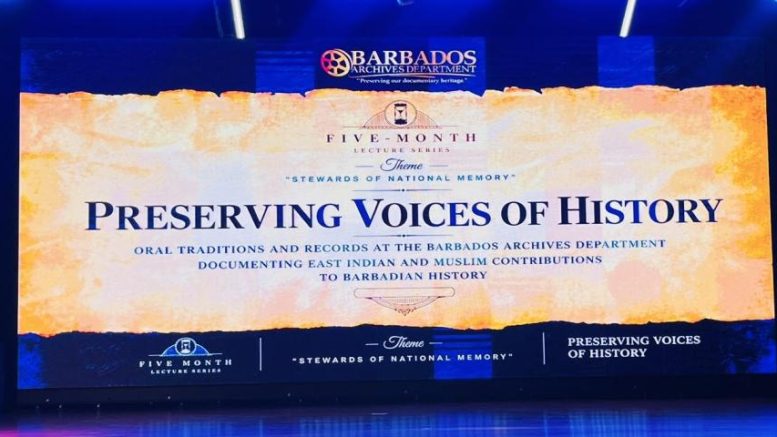
Archives lecture examines more than a century of Indian and Muslim contributions to Barbadian society
The story of Barbados is considerably more diverse than the familiar narratives of plantation society, emancipation and independence. That was one of the compelling messages emerging from a lecture by Suleiman Bulbulbia at the Daphne Joseph Hackett Theatre in Queen’s Park on August 28, as the Barbados Archives Department continued its Stewards of National Memory lecture series.
The presentation, “Preserving Voices of History: Oral Traditions and Records at the Barbados Archives Department – Documenting East Indian and Muslim Contributions to Barbadian History,” took the audience on a journey through archival records, family histories, photographs, letters and recollections to examine the presence and contribution of Indians and Muslims to Barbadian society.
Rather than presenting Indian and Muslim history as a marginal addition to the national story, the presentation positioned it as integral to the evolution of modern Barbados.
At its heart was a simple proposition: each generation has a responsibility to document the story of the generation that preceded it.
That responsibility becomes particularly important when the historical record is scattered among official archives, family collections, oral traditions, and the memories of elderly community members.
Finding history in the smallest details
One of the presentation’s most striking observations was that historical discovery does not always begin with a major document or celebrated historical figure.
A single name, phrase, footnote or seemingly incidental reference can provide the opening to a much larger story.
The presentation drew attention to the idea that every person, action and incident leaves a trace. Those traces may be found in major historical works, but they can also be hidden in plantation records, missionary accounts, family papers, cemeteries and oral recollections.
This approach provided an appropriate introduction to the role of the Barbados Archives Department, whose work in preserving and eventually digitising historical records was repeatedly emphasised.
The message was clear: records that appear insignificant today can become invaluable to researchers tomorrow.
Muslims were in Barbados before the Indian migration
An important distinction made during the presentation was between Indian identity and Muslim identity.
Although the majority of Muslims in Barbados are of Indian descent, not all Muslims are Indian and not all Indians are Muslim. More importantly, evidence exists of Muslims among the enslaved population of Barbados long before the arrival of the Indian Muslim merchants who would become prominent during the twentieth century.
One example cited was a woman and a girl named Fatimore, also recorded as Fattemoor, among enslaved people on Codrington Plantation in the 1740s. The name Fatima was identified in the historical source cited as an unmistakably Muslim name.
Another reference came from a 1826 Moravian missionary account concerning John Adamson, an enslaved African at Mount Tabor Plantation. The missionary recorded that Adamson was the son of an African tribal king and spoke Arabic fluently.
Such fragments provide tantalising glimpses into the religious and cultural identities that existed among Africans brought to Barbados under slavery.
They also demonstrate why the search for historical evidence must continue.
The arrival of the Bengali Muslims
The presentation then moved to the emergence of the Indian presence in Barbados, highlighting Bashart Ali Dewan, identified as coming from Jinpoor Village in West Bengal and arriving in Barbados around 1910.
Dewan began as an itinerant trader, lived in the Milk Market area, and later opened stores on Swan Street and in Speightstown. He married in Barbados and had children, while other Bengalis subsequently followed him to the island. His departure from Barbados during the 1937 riots marked a difficult chapter in the early Indian experience, after which Bengali migration effectively stopped by 1938.
The story of another Bengali, Anwar Ali, provided a more intimate glimpse into the lives of these early migrants.
Ali, Dewan’s nephew, was born in 1912 and arrived in Barbados from India in November 1938. From 1957 until the late 1980s, he served as the muezzin of the City Mosque. For more than three decades, his distinctive call to prayer became part of the soundscape of Bridgetown. He died in June 1990.
Particularly evocative was the reference to a letter Ali penned in the Milk Market on August 29, 1947.
The document is more than a historical curiosity. It offers a personal connection to a moment almost eight decades ago and illustrates how an individual letter can open possibilities for understanding an entire community.
The presentation suggested that such stories need not remain confined to archives. They could provide material for Barbadian writers, filmmakers, playwrights, musicians and other cultural practitioners to transform into new works of cultural expression.
Gujarati Muslims expand the story
The Bengali experience was followed by the arrival of Gujaratis.
According to the presentation, four Gujaratis arrived in Barbados on February 8, 1929, with further Gujarati migration occurring during the 1930s. The Bengalis and Gujaratis were predominantly Muslim and played a foundational role in establishing and maintaining Islam on the island. They were also heavily involved in itinerant trading.
Their arrival, however, was not the whole Indian story.
The presentation also examined the subsequent arrival of Sindhis and South Indians. Sindhis began arriving around 1932 and were associated primarily with the Hindu faith and commercial activity in Bridgetown, while South Indians arrived particularly during the 1960s, including professionals working on contract, many of whom were Christian.
The distinction was important because it challenged any simplistic idea of an undifferentiated “Indian community”.
The Indian presence in Barbados developed through different migrations, regions, languages, religions and occupations.
Six dimensions of contribution
The presentation identified six broad areas in which Indians and Muslims have contributed to Barbadian society:
religion,
culture,
food,
language,
philanthropy and
the economy.
The religious contribution was among the most enduring.
The early Indian migrants maintained their Islamic practices of prayer, fasting, and religious observance and established mosques, institutions, and organisations that laid the foundations for the continuing Muslim presence in Barbados.
The cultural contribution is perhaps even more visible in everyday Barbadian life.
Samosas and rotis have become familiar foods. Eid celebrations, Diwali, Phagwa, mehndi and elements of Indian languages and traditions have entered the wider cultural landscape. The presentation also highlighted the presence of Indian characters and references in Barbadian folklore and popular culture.
The significance of that cultural integration was not lost on the audience.
When a community’s people, traditions and stories begin appearing in the folklore, songs and cultural expressions of the wider society, it is evidence that the community has moved beyond being merely a migrant population.
It has become a part of the landscape.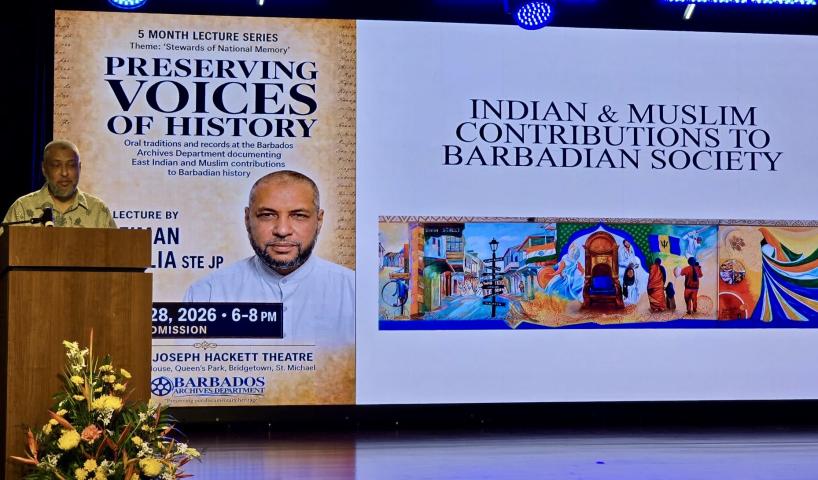
Philanthropy: an old tradition, not a new phenomenon
Philanthropy was another area highlighted.
The presentation deliberately highlighted some of the earliest documented charitable activities by members of the Indian and Muslim communities, underscoring that community giving was not a recent development. It has existed across generations and continues through both public and private acts of generosity.
This aspect of the story provides another opportunity for historical research.
Charitable donations, assistance to families, support for institutions and contributions to public life can easily disappear from the historical record because they are often undertaken quietly.
Yet such actions can reveal much about the relationship between a migrant community and the society in which it has made its home.
The itinerant trader and the Barbadian economy
Perhaps the most significant area identified for further research was the economic contribution.
The presentation deliberately left the economic story until later, arguing that its impact requires much greater study and documentation. The economic and religious contributions were described as among the most enduring and consequential elements of the Indian and Muslim experience in Barbados.
Central to that story was the itinerant trader.
The traders travelled throughout Barbados selling goods, frequently providing credit to customers who might otherwise have struggled to obtain clothing and household necessities.
Former Prime Minister Freundel Stuart recalled seeing traders in Marchfield, St Philip, assisting families who could not afford school uniforms and extending credit during Christmas. Such repeated interactions helped create relationships and friendships between the traders and the communities they served.
But the story was not without controversy.
The presentation also documented opposition to the itinerant traders. During the inquiry following the 1937 riots, Chamber of Commerce president Archibald Delise Innis argued that such business should be conducted by people of British origin. The Dean Commission report similarly criticised Indian and foreign peddlers and their practice of selling goods on credit.
The historical record therefore presents two contrasting pictures: one of traders providing a valuable service to Barbadians, and another of established economic interests viewing their presence with suspicion.
Both are part of the story.
The “thorns” in the story
The presentation did not attempt to portray the Indian and Muslim experience as an uninterrupted success story.
The historical record also contains examples of prejudice and hostility.
In 1965, newspaper commentary questioned whether the East Indian community made any social or economic contribution to Barbados. Then Premier Errol Barrow rejected that proposition, defending the service provided by Indian traders and arguing that consumers were choosing freely to purchase their goods.
The hostility reached a disturbing level in 1987 when the City Mosque was stoned and racist graffiti was painted on its walls during a period of national debate about the place of Indians in Barbadian society.
These episodes were presented not simply as uncomfortable historical incidents but as reminders that the “thorns” encountered by minority communities are not new.
The difference today is that social media can provide an immediate platform for such sentiments.
Historical records, however, allow society to see that these tensions have deeper roots and to recognise patterns in how communities have responded to them.
The importance of preserving the record
Running through the presentation was a strong appreciation of the Barbados Archives as a custodian of national memory.
But there was also a sense of urgency.
Many of the stories that remain outside the formal historical record exist only in the memories of older people or in private collections of photographs, letters and documents.
Once those people die and those collections are dispersed or discarded, irreplaceable pieces of the national story can disappear.
The presentation therefore placed considerable emphasis on combining archival research with oral history, collecting material from families and communities, and digitising records to ensure they survive and can be accessed by future generations.
The work already undertaken by researchers and community historians demonstrates what can be achieved when these sources are brought together.
But the presentation made it clear that the existing record is still only the beginning.
A history still waiting to be written
The overall impression left by the lecture was less that the Indian and Muslim story of Barbados had been conclusively documented than that a door had been opened.
There are still families to research, graves to identify, letters to preserve, photographs to interpret and oral histories to record.
There are businesses whose economic impact has never been properly assessed.
There are religious institutions whose histories remain largely within community memory.
There are individuals whose names appear briefly in an archival document but whose lives have yet to be reconstructed.
And there are stories that may exist only in the memories of Barbados’ elders.
The challenge is to capture them before they disappear.
Part of the Barbadian story
After more than a century, the Indian and Muslim presence is no longer an external story being added to Barbados.
It is part of the Barbadian story itself.
The mosques, businesses, foods, festivals, charitable traditions, cultural references and family connections are visible manifestations of a community that has become deeply embedded in the island’s social fabric.
The presentation ultimately offered a broader lesson about nationhood.
A country’s history becomes richer, not poorer, when it acknowledges the experiences of all the communities that helped build it.
For Barbados, preserving the Indian and Muslim experience is therefore not simply an exercise in community history.
It is an exercise in preserving Barbadian history.
And perhaps the most appropriate message to emerge from the evening was that the task belongs not only to historians and archivists.
It belongs to everyone who possesses a photograph, a letter, a family story, a name, a memory or a piece of evidence that can help future generations understand how Barbados became the country it is today.
As the presentation concluded, the message was one of cohesion: after more than 100 years of Indian and Muslim presence, these communities have become part and parcel of the Barbadian landscape.
The task now is to ensure that their stories remain part of the national memory.