
Fatel Razack 1845 Arrival Passenger List
Arrived on the very first ship to bring indentured immigrants from India the Fath al Razack. He is listed No 4 on the ship’s manifest. Wife Sonia accompanied him, she died later. They travelled to Trinidad with their two sons Khuda and Illahi Baksh. Dookie Meah was a tall, extremely big and white in complexion. He was assigned to Exchange Estate – Couva where he completed his 5 years indentureship. On completion government offered him 20 acres of land at Calcutta Settlement but he accepted only 10 acres. This 10 acres is owned today by his great, great grandson Zainul Mohammed. He also purchased 26 acres of land at Arena in 1904.
He got blind at Calcutta but is reported not to be as a result of diabetes. He made representation to the Crown and was allotted a Crown Grant for lands to build a mosque at Calcutta (reportedly the first in Trinidad and Tobago). He was the founder of this mosque. In 1868, the then Governor, in a hand-written document, exempted the first masjid in Calcutta from the payment of rates and taxes. This legal document is honoured by the government of Trinidad and Tobago to this day.
In spite of his blindness, he was the family treasurer and everyone gave him all the money for safekeeping. He trusted all and all trusted him. His two sons Khuda and Illahi Baksh as well as his grandson Kurban Ali were married at Calcutta. He completed building a house in Arena in 1910, but continued to live in an old building across the street. Ousman his great grandson was his “seeing eye” guide. This information was compiled by Shahid Ali on research done by Abdool Aleem and Qamarah Aleem on information provided by Ousman Hosein.
Labourer founds Calcutta MosqueMonday, October 23 2006 |
First published in Newsday Monday, October 23 2006
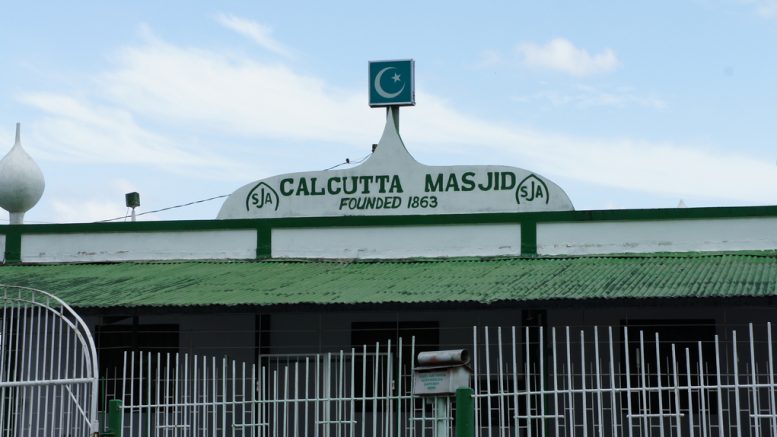
As our multi-cultural and multi-religious nation celebrates double festivities, both Hindus and Muslims are observing their own sacred ceremonies alongside each other. Just like the Church is of central importance in Christianity so to the Mosque or Masjid is of great relevance within Islam as it represents not just a place of worship but a forum for community affairs such as charity. The Calcutta ASJA Masjid of Freeport is reportedly one of the oldest of its kind in TT and was established in the year 1863.
When the first shipment of indentured labourers arrived in TT on the Fatel Razack in 1845 there were not many Muslims aboard as the part of India that these people came from was predominantly a Hindu state. But there was one man that arrived on that first load who eventually moved on to things greater than working on the plantations. With the label “Labourer #6” on his back, Dookhie Meah worked in the sugar cane fields alongside his fellow countrymen with the hope that after his five-year period he would either return to Mother India or receive a piece of land of his own to build a life in his new found home. And as noted in TT’s history, both Muslims and Hindus lived as brothers and sisters and usually addressed themselves as “Jahajis” and “Jahajins.”

Calcutta Masjid
However, the colonial promises did not materialise as the masters consistently moved the labourers from estate to estate, which then prevented them from serving a consecutive five-year period on any one plantation that would give them the right of returning home or attaining land. The labourers began to feel the harsh reality of living without freedom and in 1863 there was a massive rebellion from the indentured labourers that eventually led to their freedom after much tears, sweat and blood had been spilt.
Meah received his portion of land in a village in central Trinidad called Calcutta. It is this very land that the Calcutta ASJA Masjid is now situated. After all the legalities were finalised he immediately undertook the challenge of constructing a Masjid for the small Muslim population in his community.
In an area close by a Hindu Temple was built as to also serve the religious forum of the people. This area is now known as Balmain village. Soon after the inception of the Masjid, Meah also established a school on the compound in 1865 which was eventually closed down by the colonial powers in 1868. This school was re-opened in 1871 and continued until 1877 when it was removed to another location to be administered by the colonial government. It is now the present day Couva Anglican Primary School.
Despite the so-called freedom that the indentured labourers now enjoyed there were still many disputes that involved the government and its treatment of the people that often resulted in some degree of uproar. So before the Couva Court was established in 1880, Meah organised a “Panchiate” system that allowed for the discussion of grievances to take place in a controlled environment. Even in contemporary TT society the word “Panchiate” is frequently used within the East Indian community to refer to the coming together of people to discuss matters of public interest.
One of the benefits of these “Panchiates” that the Masjid still enjoys is the exception from water rates and land taxes as Meah negotiated with the then Governor, Lord Harris for this cause.
Today the Calcutta ASJA Masjid is of great prominence because of the visions of the Late Dookhie Meah and the Imams that followed always pay their respects to the man who built a place for the early Muslims in TT as to protect and cultivate their spiritual beliefs.




Be the first to comment on "Dookie Meah – Founder of the first Trinidad Mosque in Calcutta Settlement, Freeport"