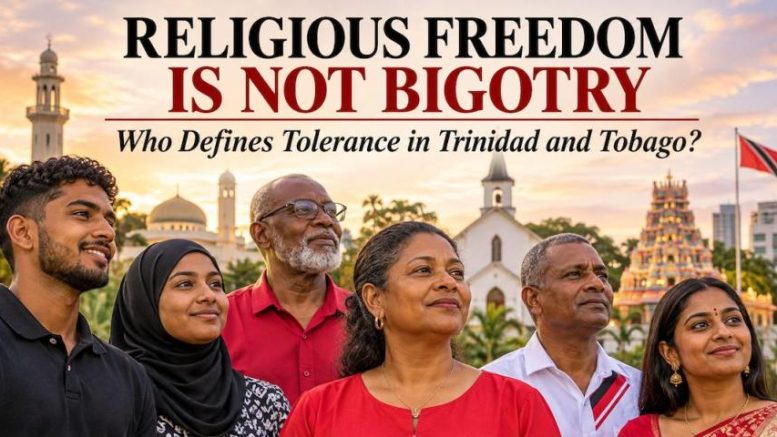
Religious freedom must protect not only the right to celebrate one’s faith, but also the right to decline participation in another’s religious observances. The JMU controversy tests whether Trinidad and Tobago understands that distinction.
The Trinidad Guardian published an opinion by Mr Israel Rajah-Khan under the headline “I condemn Islamic institute’s call for religious bigotry in T&T.” This follows the Trinidad Express’s earlier report on the matter.
The debate over Muslim guidance on Christmas and Diwali greetings raises a question that goes beyond religious etiquette: must citizens dilute their religious convictions to show respect for others’ beliefs? In a society founded on religious freedom and equal citizenship, the answer should be no.
The recent controversy surrounding the Jaamia Madinatul Uloom Institute (JMU) and its Darul Iftaa advisory on Christmas and Diwali greetings deserves a more considered public discussion than the exchange of accusations that has followed it.
At the centre of the controversy is a straightforward question: does advising Muslims to refrain from particular religious greetings and celebrations amount to bigotry against Christians and Hindus?
The distinction between religious conviction and religious intolerance is fundamental. Yet in public debate, people increasingly treat the two as interchangeable.
They are not.
The right to teach one’s faith
The Darul Iftaa advisory expressed the Institute’s position that Muslims should avoid greetings and participation associated with religious celebrations whose underlying beliefs and rituals conflict with Islamic teachings on the oneness of God.
Its reasoning was explicitly theological, rooted in the Islamic principle of Tawhid — the absolute oneness of God.
The Institute subsequently clarified that its guidance was intended for Muslims within its educational institutions and wider community. It was not an attempt to dictate how Christians or Hindus should practise their religions. It acknowledged their right to their respective beliefs and affirmed the Islamic obligation to treat people of other faiths with dignity, kindness, justice and compassion.
One may disagree with the Institute’s interpretation. Indeed, Muslim scholars themselves differ on the permissibility of seasonal greetings, with some distinguishing between expressions of goodwill and words understood as affirming another religion’s theological claims.
That disagreement is legitimate and should be acknowledged.
But differing interpretations do not make the Institute’s position inherently bigoted. Nor does it deprive the Institute of the right to teach its understanding of Islam to those who look to it for religious guidance.
A religious institution cannot fulfil its educational responsibility if it is expected to set aside its foundational beliefs whenever those beliefs are unpopular or misunderstood by the wider public.
The freedom to practise religion must include the freedom to teach, explain and preserve its doctrines. That freedom belongs to Muslims no less than it belongs to Christians, Hindus or members of any other religious community.
The more important question is not whether a religious institution teaches boundaries. It is whether those boundaries are accompanied by hostility, discrimination, or a denial of others’ rights.
There is no evidence in the statements reported that JMU sought to prevent Christians from celebrating Christmas, Hindus from observing Diwali, or anyone else from exercising their religious freedoms.
Respect does not require religious endorsement
A distinction must be made between respecting people and endorsing their religious beliefs.
A Muslim may respect a Christian neighbour, colleague or friend without affirming the theological claims associated with Christmas. A Muslim may maintain a warm and respectful relationship with a Hindu family without participating in Diwali worship.
Equally, a Christian or Hindu should not be expected to affirm Islamic beliefs or participate in Islamic religious observances as a condition of being regarded as tolerant.
This is not hostility. It recognises that people can live together peacefully while holding fundamentally different convictions.
Islam makes this distinction clear.
The Qur’an states:
“God does not forbid you from being kind and just to those who have not fought you because of religion and have not driven you from your homes. Indeed, God loves those who act justly.” (Qur’an 60:8)
The verse establishes an important principle: religious difference does not justify injustice or unkindness.
Similarly, Surah al-Kafirun concludes:
“For you is your religion, and for me is my religion.” (Qur’an 109:6)
This is not a declaration of indifference towards others. It affirms that religious conviction cannot be manufactured through compulsion or surrendered merely to secure social approval.
The Qur’an also declares, “There is no compulsion in religion” (2:256), and instructs Muslims not to insult those whom others invoke besides God “And do not insult those they invoke other than God, lest they insult God in enmity without knowledge.” (6:108).
Taken together, these teachings establish a framework in which Muslims are expected to preserve their beliefs, respect others’ religious freedom, and conduct themselves with justice and restraint.
The Institute’s advisory should be assessed against that framework, not on the assumption that declining to participate in another religion’s observance equals disrespecting its adherents.
When disagreement becomes an accusation of bigotry
In his commentary on the controversy, Israel B. Rajah-Khan SC strongly condemned the Institute’s position, describing it as religious bigotry and dismissing its guidance in highly disparaging terms.
He also questioned the place of such religious views in a country that is not an Islamic state and went so far as to suggest that Muslim scholars who object to the greetings could leave the country.
Mr Rajah-Khan is entitled to disagree with JMU. He is entitled to defend the right of Christians and Hindus to celebrate their religious festivals and to express his preference for inclusive public greetings.
However, disagreement does not automatically establish bigotry on the part of the person or institution being criticised.
Calling a religious teaching bigotry requires more than demonstrating that one disagrees with its theology. It requires considering whether that teaching promotes hostility, prejudice, unequal treatment, or the denial of another person’s rights.
The reported statements from JMU do not, on their face, establish any of those things.
There is also an uncomfortable contradiction in demanding tolerance from one religious community while suggesting that its scholars should leave the country because their beliefs are unwelcome.
If Trinidad and Tobago is a society in which every creed and race finds an equal place, that promise must extend to Muslims whose religious interpretations may not reflect the preferences of other citizens.
The right to belong to this country cannot depend on making one’s religious convictions more palatable to the majority.
One may challenge an argument vigorously. One may expose what one considers to be errors in its reasoning. But telling religious scholars to leave their homeland because of a theological position is hardly an example of the tolerance being advocated.
What does the Constitution promise?
Trinidad and Tobago’s Constitution provides an important starting point for this discussion.
Recognition and Declaration of Rights and Freedoms4. It is hereby recognised and declared that in Trinidad and Tobago there have existed and shall continue to exist without discrimination by reason of race, origin, colour, religion or sex, the following fundamental human rights and freedoms, namely:- a. the right of the individual to life, liberty, security of the person and enjoyment of property and the right not to be deprived thereof except by due process of law; b. the right of the individual to equality before the law and the protection of the law; c. the right of the individual to respect for his private and family life; d. the right of the individual to equality of treatment from any public authority in the exercise of any functions; e. the right to join political parties and to express political views; f. the right of a parent or guardian to provide a school of his own choice for the education of his child or ward; g. freedom of movement; h. freedom of conscience and religious belief and observance; i. freedom of thought and expression; j. freedom of association and assembly; and k. freedom of the press. |
Section 4 recognises and protects fundamental rights and freedoms, including freedom of conscience and religious belief and observance under Section 4(h), and freedom of thought and expression under Section 4(i).
These protections reflect a constitutional commitment to a society in which the State does not dictate religious belief, and citizens are not required to conform to a single religious outlook.
The Constitution’s recognition of the Supremacy of God in its preamble does not establish one exclusive interpretation of God or prescribe a particular religious doctrine for the nation.
Nor does the fact that Trinidad and Tobago is not an Islamic state mean that Islamic institutions must dilute their teachings to conform to a secular or majority preference.
A country does not have to be an Islamic state to protect the right of Muslims to practise and teach Islam. The same principle applies to every other religious community.
Constitutional rights are not unlimited, and their exercise remains subject to applicable law and the rights of others. But nothing in the constitutional commitment to religious freedom suggests that a religious institution must abandon its foundational teachings simply because those teachings are contested.
The Constitution protects a plural society, not a compulsory theological consensus.
Equal place does not mean identical beliefs
Trinidad and Tobago’s national anthem offers a powerful expression of the country’s aspirations:
“Here every creed and race finds an equal place, and may God bless our nation.”
The national watchwords- Discipline, Production and Tolerance- reinforce the values on which a diverse society should be built.
But what does tolerance mean?
It cannot mean that everyone must agree with everyone else. It cannot mean that every religious community must participate in the celebrations of every other community. And it cannot mean that people must conceal or compromise their beliefs to avoid offending those who disagree with them.
Tolerance means accepting that others have the right to hold beliefs different from our own, even when we consider those beliefs mistaken.
It also requires reciprocal restraint. Christians must be free to teach Christianity, Hindus to teach Hinduism and Muslims to teach Islam. No one should face exclusion or intimidation simply because their religious teachings differ from another community’s.
The Prime Minister’s Diwali message, extending greetings and promoting unity and mutual respect, is a welcome expression of national goodwill. Such gestures can strengthen the bonds between communities.
But a national leader’s public expression of goodwill does not create a religious obligation for every citizen to use the same greetings or participate in the same observances.
The freedom to extend a greeting must coexist with the freedom to refrain from doing so for conscience reasons.
The responsibility of religious institutions
Defending JMU’s right to issue religious guidance does not mean that every word in its advisory is beyond scrutiny.
Religious institutions have a responsibility to communicate with precision, especially when addressing matters that touch the sensitivities of other communities. Theological explanations should make clear the distinction between rejecting a religious belief and showing contempt for those who hold it.
Similarly, public commentators and media organisations have a responsibility to distinguish religious disagreement from prejudice.
The first Trinidad Express report presented the Institute’s strong theological position. Its subsequent report gave space to JMU’s clarification that the advisory was intended as internal religious guidance, not an attack on other communities.
Both parts of the story matter.
A fair public discussion should also acknowledge that Muslim scholars do not speak with one voice on every aspect of this issue. Readers should be given enough context to understand that a particular institutional ruling is not necessarily a universal Muslim position.
There is a legitimate place for debate about whether particular language is appropriate, whether an interpretation is persuasive and how religious institutions should communicate in a plural society.
But such debate is weakened when theological disagreement is immediately labelled bigotry without examining what is actually being taught and what conduct is being encouraged.
The real test of tolerance
The JMU controversy presents Trinidad and Tobago with an opportunity to reflect on the meaning of religious freedom.
Can a Muslim institution teach that certain religious celebrations are incompatible with Islamic belief without being accused of hostility towards Christians and Hindus?
Can a Christian institution teach that certain practices conflict with Christian doctrine without being accused of intolerance towards Muslims?
Can a Hindu institution preserve its own religious boundaries without being expected to compromise them for the sake of public approval?
If the answer to any of these questions is no, then our understanding of religious freedom is considerably narrower than our national ideals suggest.
No faith should be required to water down its foundational principles to earn acceptance in a plural society. Equally, no faith should use its convictions as a licence to demean, discriminate against or deny the rights of others.
That is the balance a mature society must protect.
The national promise is not that every creed will believe alike, celebrate alike or express its faith in identical ways. It is that every creed and race will find an equal place.
We should not have to surrender our religious convictions to earn that place. And we should never deny another person the dignity and freedom that we expect for ourselves.
That is not merely tolerance. It is the foundation of peaceful coexistence.