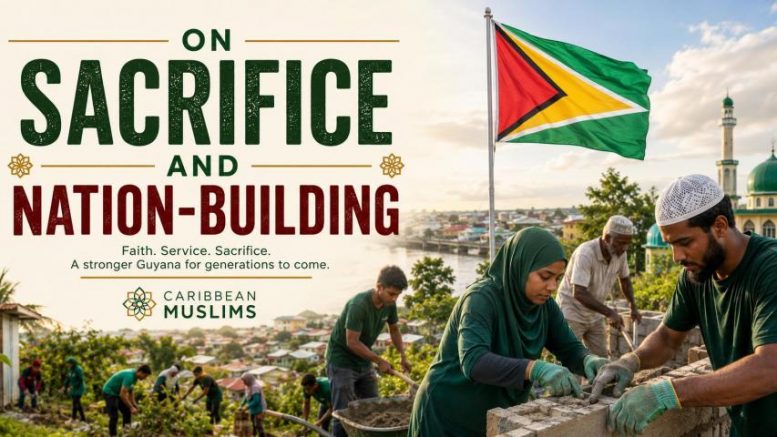
Every thirty years or so, Guyana’s Independence and the Muslim holiday of Eid-ul-Adha align, though never perfectly. This year marks the first time in our nation’s history that the day we celebrate Independence is followed by the Islamic “Festival of Sacrifice.” I wonder whether there might be a greater meaning in the moment.
The Shared Language of Duty and Freedom
Independence Day is a national celebration; Eid-ul-Adha is a religious observance and is the story of faith. Yet both speak, in different ways, about freedom, duty, obedience, gratitude, and the sacrifice required to build something larger than oneself.
This Eid comes at the culmination of the Hajj, the annual pilgrimage to Mecca performed by Muslims who are able to afford it, at least once in a lifetime. It commemorates Prophet Abraham’s willingness to sacrifice his son in obedience to God, and God’s mercy in replacing his son with a ram. It is one of the most profound stories in the Abrahamic tradition, shared in different forms by Muslims, Christians, and Jews.
The 10th of Dhul Hijjah, observed this year on May 27, will be marked by prayer, charity, family gatherings, and qurbani, the ritual sacrifice of an animal. But the deeper meaning of the day is not found merely in the act itself. It is found in submission to God, trust in divine wisdom, gratitude for His mercy, and sharing with others, especially the poor and vulnerable.
Beyond the Ritual: The Deeper Meaning of Qurbani
The word “sacrifice” is worth pausing over. In Arabic, it is tied to qurbani and ‘udhiyah, the act of slaughter that is physical, visible, and ritualised. But in English, sacrifice has travelled into a much wider moral world. It speaks of giving up comfort for duty, private interest for public good, ego for principle, and selfishness for service. And in that wider meaning, the story of Abraham becomes especially relevant to us as Guyanese.
One Man as a Nation: The Power of Character
In the Qur’an, Abraham is not remembered merely as a prophet who was tested. He is described as upright, obedient to God, devoted in faith, and, remarkably, as “a nation” all by himself. That is a powerful description. It suggests that one person, when rooted in faith, discipline, courage, and moral clarity, can embody the qualities upon which an entire civilisation may be built.
Abraham’s greatness lay not only in his willingness to give up what he loved. It was that he trusted God enough to place obedience above impulse, duty above desire, and a higher purpose above personal attachment. He teaches that sacrifice is not simply about loss; it is about bringing the self under the authority of truth.
And that, too, is the essence of nation-building.
From Government Plans to Citizen Character
For Guyana, our Independence is not only a celebration of sovereignty won in 1966, but it is also a reminder of the task upon every generation to build, protect, and honour that sovereignty. A country may gain its flag in a single historic moment, but a nation is built every day by the choices of its people.
President Irfaan Ali has spoken repeatedly over the past year about a Guyana that is modern, inclusive, productive, confident, and united. But such a nation cannot be built by government alone, no matter how ambitious its plans or how vast its resources.
It requires citizens who are willing to sacrifice past grievances and old prejudices for a shared future built on unity and equal opportunity.
The strength of a nation begins with the character of its people. If the people are disciplined, generous, honest, and guided by a higher sense of duty, much like Prophet Abraham was, then the nation has a chance to become great.
We are living at a defining moment in Guyana’s history. The opportunities before us are extraordinary. The world is watching, and our influence is growing. But the question is not whether Guyana will become richer. The deeper question is whether Guyana will become better.
The Great Exchange: What We Must Give Up to Grow
That will depend on what we are prepared to sacrifice. Can we sacrifice the politics of permanent hostility for the politics of national purpose? Can we sacrifice ethnic suspicion for genuine brotherhood? Can we sacrifice laziness for productivity, and complaint for contribution?
Eid-ul-Adha reminds Muslims that sacrifice is not meaningful when it is an empty ritual. It must soften the heart, strengthen obedience, increase gratitude, and deepen concern for others. Independence Day, on the other hand, reminds us that freedom is not meaningful when it is treated as an entitlement. It must produce responsibility, discipline, creativity, and service.
Conclusion: Building a Nation Rich in Spirit
Together, these two moments offer a message larger than dates on the Islamic lunar or the Gregorian calendars. They remind us that a nation is not built merely by what it possesses, but by what its people are willing to contribute. Prosperity without selflessness can leave a society poor in spirit.
As Guyana marks its Independence and Eid-ul-Adha, remember that Prophet Abraham is described as a nation because he embodied the moral qualities from which nations are made. If we want a Guyana that is prosperous and strong, united and patriotic, respected and resilient, then we too must become a people willing to give up what weakens us to build what ultimately uplifts us.
This column was first published in the Sunday Chronicle, May 24, 2026