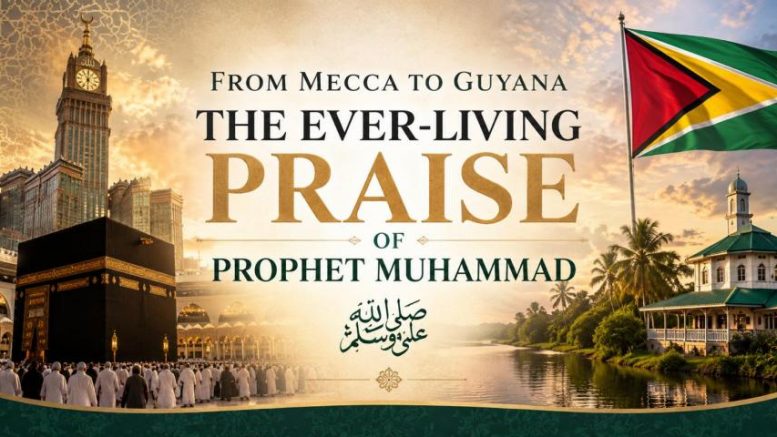
Georgetown, Guyana: As Muslims in Guyana gather to celebrate the birth of Prophet Muhammad, peace and blessings be upon him, it is impossible to ignore the magnitude of his presence in human history.
His name has travelled far beyond the cities of Mecca and Medina, beyond the Arabic tongue and well beyond the countries with Muslim majorities. Love and reverence for the Prophet have entered the languages, imaginations, poetry, and even music of peoples who may not have fully understood him, but could not ignore the magnitude and impact of his message, nor the loyalty, discipline, and love his followers have for him.
In 1811, the great German composer Ludwig van Beethoven set to music a chorus in praise of the Prophet Muhammad as part of his score for a play. Although his age was burdened by political prejudices born out of hostilities between the Ottoman Empire and Europe, Beethoven’s “Chorus of the Dervishes” is regarded as a celebration of Prophet Muhammad.
The chorus invoked the Ka‘bah in Mecca, which Muslims circumambulate when visiting the “House of Allah,” as it is described in the Quran. It included the miracle of the splitting of the moon by Prophet Muhammad, and “Buraq,” the majestic animal that God’s Messenger rode on his Night Journey from Mecca to Jerusalem. There, the chorus states, the Prophets of the Old and New Testaments greeted him as a “Great Prophet.”
In 1774, at the age of 23, the outstanding European poet Johann Wolfgang von Goethe wrote an ode to the Prophet called “Muhammad Gesang.” His poem presents the Arabian Prophet as a spring that grew into a mighty river which gained its strength by uniting people of diverse cultures and ethnicities. Goethe’s portrayal of Prophet Muhammad bears testimony to the fact that many of Europe’s literary class saw the Prophet as a powerful, life-giving and transformative leader whose mission changed the course of history.
Poetry in praise of the Prophet Muhammad has long served as a lifeline of spiritual attachment to him; a devotional remembrance of the exalted esteem God accords him in revelation, and of the blessed, humane and civilising power of his noble teachings.
Guyana is no exception. Poetry in praise of Prophet Muhammad has always been a cornerstone of Muslim religious life. If one were to attend a gathering at their local masjid today, they’d likely hear poems in praise of Prophet Muhammad taken from a collection written more than a hundred years ago, known as the Milad Al-Akbar of Khawaja Mohamad Abkar Warsi Meeruthi.
Another collection by Imam Ahmad Raza Khan Brelvi, known as Hadaiq-e-Bakhshish, contains gems such as “Mustafa Jaan-e-Rehmat Pe Laakhon Salaam”, a 171-couplet salutation to the Prophet that is recited globally in congregational gatherings, and “Lam Yaati Nazeeru Kafi Nazarin,” a multilingual masterpiece that seamlessly blends Arabic, Persian, Hindi, and Urdu in a single poem in praise of Prophet Muhammad.
At the climax of these gatherings in Guyana, there will be the “Grand Salam,” when the entire congregation stands to send greetings of peace and blessings to the last and noble Prophet who “was sent as a mercy to all of mankind.”
It is with poetry that Muslims are constantly reminded that God’s Prophet is the “Leader of all creation” – humans and jinns, Arabs and non-Arabs – of his status as the “Ultimate intercessor,” on the Day of Judgement, the “Embodiment of divine light”, an “Unmatched paragon of virtue”, and a “Healing and solace for the soul.”
The Burda of Imam Al-Būṣīrī, written in the 13th century, is regarded as the most famous poem in honour and praise of Prophet Muhammad. Translated from its original Arabic into dozens of languages, including English, it evokes scenes and images of the Prophetic biography that increase yearning for his blessed company.
Upon his birth, the formidable balconies of the palaces of the Persian King crumbled, and the fire of the Magians was extinguished after burning for more than 1000 years.
Būṣīrī brings to life the scene of the Prophet and his companion taking refuge in a cave from his enemies during their migration from Mecca to Madina. The assassins on their heels would have looked into the cave had it not been for the miracle of a spider’s web covering its entrance.
In some of the most cinematic language, Būṣīrī reminds readers of the time when the Prophet called a tree, and it uprooted itself and came to him, and of the grief of a palm trunk after he stopped using it to brace himself during his sermons to his community during the Friday congregational prayers.
The celebration of Youman Nabi in Guyana is more than a remembrance of his noble birth in seventh-century Arabia. It is a renewal of an inheritance of faith carried across deserts, languages and oceans; through, first and foremost, the Arabic revelation of the Quran, Persian and Urdu verse, European poetry and music, and the humble gatherings of Muslims settled in communities along our country’s coastline.
In the hearts that send blessings upon Prophet Muhammad, his presence is not confined to history. His name continues to gather people, soften hearts and call humanity to a state of mercy, justice, humility and love.
More than fourteen and a half centuries after his birth, and nearly two centuries after the first Muslims arrived on these shores, Guyana’s Muslims continue to proclaim the enduring truth of that devotion: peace and blessings upon Muhammad – the one whom the Quran describes as “a mercy to all of mankind.”
First published in the Guyana Chronicle on August 25th 2026, included as part of the CIOG’s Youman Nabi message.