There are moments when a nation must fall silent.
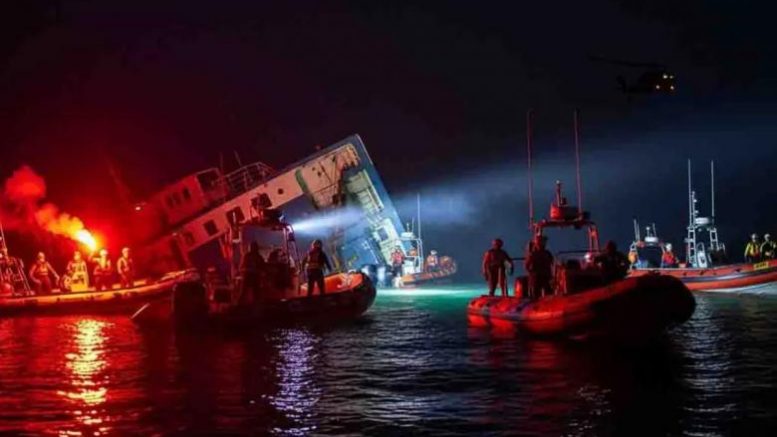
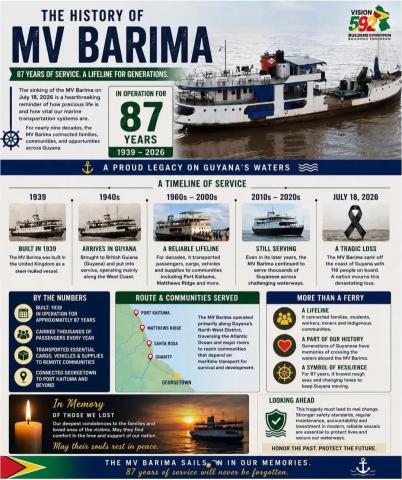
In the wake of the MV Barima tragedy, as the waters off Guyana’s coast yielded body after body, the instinct has been to ask why. Why this vessel, why that night, why these lives. The chorus has been intense this past week – firing away at questions of infrastructure, of decisions made and not made, of responsibility and redress.
But there is another language available to us, one that does not begin with blame, but with submission.
In the Islamic tradition of West Africa, the word maktub is invoked at times like this – that which is divinely written.
 Maktub is not a dismissal of accountability, nor an excuse for negligence. It is, rather, a recognition of a deeper order to existence, one that humbles even the most urgent human arguments. For those who believe, tragedy is folded into layers of meaning.
The Holy Qur’an speaks directly to moments such as these:
“We will surely test you with something of fear and hunger and a loss of wealth and lives and fruits, but give glad tidings to the patient, those who, when disaster strikes them, say: ‘Indeed, to Allah we belong, and to Him we will return.”
“Allah does not burden a soul beyond what it can bear.”
These are not easy words. They do not erase grief nor do they soften the anguish of families waiting on shorelines, or the finality of a name added to the list of the dead, now more than seventy, and still rising.
But they offer a framework within which grief can breathe.
The Qur’an reminds us:
“Indeed, with hardship comes ease. Indeed, with hardship comes ease.”
“Do not lose hope or grieve.”
“Nothing will happen to us except what Allah has written for us.”
“Every soul shall taste death.”
These are not abstract verses; they serve as an anchor for our troubled hearts.
The Prophet Muhammad, peace be upon him, was described as the most tranquil of God’s servants. He was always calm, assured and unshaken in the face of calamities. That same quality is attributed to Prophet Abraham, the Patriarch of Monotheism, and his son Ishmael. It is not the absence of sorrow, but the presence of certainty.
For the Qur’an also tells us:
“Indeed, mankind was created anxious: when evil touches him, he is fretful; and when good touches him, he withholds, except those who are constant in prayer.”
The Quran is reminding us that while calamities reveal our fragility and impatience, we could never have full control of the world we inhabit.
The great Islamic scholar Al-Izz ibn Abdus Salam wrote that within adversity are hidden gifts, difficult, often painful, but transformative. Among them: the recognition of God’s absolute power over us; the realisation of our own brokenness and dependence; sincerity in faith; return to worship; humility; patience; and, eventually, a state of gratitude and thankfulness.
These are not immediate outcomes. They do not arrive in the first hours of loss. Grief must take its course. Tears must fall. Names of the dead must be called and remembered.
And yet, even now, something else has been happening.
President Irfaan Ali declared three days of mourning. We will have many more vigils and Nights of Reflection and Prayer across our nation, at mosques, temples, and churches. We are a country formed from every major faith tradition on earth, choosing, when it matters most, not to grieve identically, but to grieve together for the same lives, the same loss, the same names.
In time, there must be accounting. The dead of the Barima deserve more than mourning; they deserve truth, responsibility, and a seriousness of care that does not fade with the news cycle. That reckoning should come, and it must be unsparing.
But not yet.
For now, there is this: a nation in prayer, a people holding their dead in the quiet language of faith, long after the news cycle has moved on.
The bodies that have been recovered belong to the difficult space between memory and eternity. They were our fathers and mothers, sons and daughters, friends and neighbours. They boarded a vessel expecting arrival. Instead, they met their divine decree.
Inna lillahi wa inna ilayhi raji’un. The Qur’an reveals: To Allah we belong, and to Him is our return.
For now, perhaps that is enough.
This column was first published in the Sunday Chronicle on July 26, 2026