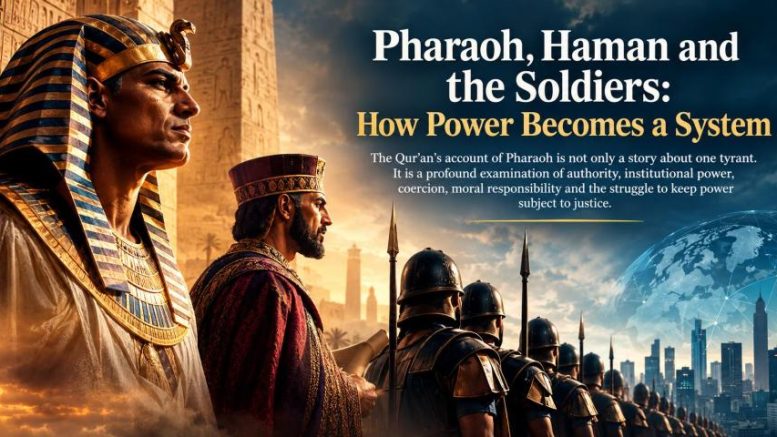
The Qur’an’s account of Pharaoh is not simply the story of a cruel ruler from the distant past. It is a profound examination of authority, institutional power, coercion, moral responsibility and the struggle to keep power subject to justice.
It is a study of how power becomes organized, supported and enforced.
Three figures repeatedly appear together in the story: Pharaoh, Haman and the soldiers.
“Indeed, Pharaoh, Haman and their soldiers were sinners.” Qur’an 28:8
Taken together, they reveal three dimensions of Pharaoh’s order:
- Pharaoh: the ruler who claims authority.
- Haman: a senior figure within that ruling order who acts on Pharaoh’s commands.
- The soldiers: the coercive force of the regime.
This is not a claim that the Qur’an explicitly defines Haman as a “bureaucrat” or gives us a modern organizational chart of Pharaoh’s government. Rather, the Qur’anic narrative places him close to Pharaoh and assigns him a significant role in carrying out Pharaoh’s command.
That distinction is important.
The Qur’an gives us enough to examine the structure of power, without requiring us to impose modern political categories upon an ancient narrative.
Pharaoh: Authority without accountability
Pharaoh’s defining characteristic is not simply cruelty. It is arrogance in exercising authority.
When Moses calls him to recognize God as Lord, Pharaoh responds:
“I have not known for you any god other than me.” Qur’an 28:38
His claim is therefore larger than ordinary political leadership. He presents his authority as effectively ultimate.
The Qur’an describes this political arrogance:
“Indeed, Pharaoh exalted himself in the land and made its people into factions…” Qur’an 28:4
This is the first element of the system:
political authority that no longer recognizes meaningful accountability.
Pharaoh is the centre of the political order, but he does not operate alone.
Haman: The senior figure within Pharaoh’s order
This is where Haman becomes significant.
Pharaoh says:
“O Haman, kindle for me a fire over the clay and construct for me a tower…” Qur’an 28:38
And in Qur’an 40:36, Pharaoh again says:
“O Haman, build for me a tower that perhaps I may reach the pathways” (to heaven).
The Qur’an therefore presents Haman as someone close enough to Pharaoh and empowered enough within his order to receive and act on a major command from him.
That is what we can say with confidence.
It is more cautious, and more faithful to the text, than describing Haman simply as a “bureaucrat,” “minister”, or “administrator” in the modern sense.
Classical Muslim exegetes, however, understood Haman as a powerful figure associated with Pharaoh’s court and government. The precise nature of his office is less important to the Qur’anic moral argument than his position within Pharaoh’s power structure.
Haman therefore helps us see something important:
Pharaoh’s authority depended upon people within his ruling order who carried his will into action.
The ruler commands.
A subordinate acts.
Power therefore becomes more than the ruler’s personal will. It acquires people capable of translating that will into reality.
That pattern is not unique to ancient Egypt. It is a recurring feature of organized political power.
The soldiers: Power backed by force
The third element is the coercive apparatus.
The Qur’an repeatedly associates Pharaoh with his soldiers. They possess the physical power necessary to enforce the regime’s will.
A decree is one thing.
The capacity to compel obedience is another.
The Qur’an ultimately says:
“So We took him and his soldiers and threw them into the sea.” Qur’an 28:40
The soldiers therefore represent the organized force supporting Pharaoh’s rule.
Thus the Qur’anic picture can be expressed simply:
- Pharaoh – The ruler who commands.
- Haman – A powerful figure within the ruling order who carries out Pharaoh’s command.
- The soldiers – The force that supports and enforces Pharaoh’s rule.
This is the structure we actually see in the Qur’anic narrative.
It is better understood as a triad of political authority, institutional support and coercive power than as a rigid three-part organizational system.
The moral question
The Qur’an, however, does not portray the people living within Pharaoh’s system as merely passive components of an institution.
- Some comply.
- Some serve.
- Some resist.
The believing man from Pharaoh’s household speaks against the proposed killing of Moses:
“Will you kill a man because he says, ‘My Lord is God’…?” Qur’an 40:28
The magicians likewise make a decisive choice after witnessing Moses’ signs. Pharaoh threatens them with punishment, yet they refuse to surrender what they have come to recognize as truth.
The Qur’anic story therefore introduces a crucial principle:
Political structures may constrain human beings, but they do not erase moral responsibility.
People do not all possess the same degree of power or freedom. Yet the Qur’an repeatedly presents individuals making consequential choices within the political order.
This is why the story is not merely about Pharaoh.
It is also about what people do in relation to Pharaoh’s power.
When power becomes systemic
None of the three elements is inherently illegitimate.
- Leadership is necessary.
- People serving within government are necessary.
- Security forces have legitimate functions.
The danger arises when these elements become instruments of zulm (wrongdoing and injustice).
Then the ruler’s authority is supported by powerful figures within the ruling order and backed by coercive force.
What begins as one ruler’s will can become embedded in society’s wider structure.
This is how personal power can become systemic power.
And because human beings operate these structures, questions of conscience and responsibility remain unavoidable.
From Pharaoh’s Egypt to the Modern World
The distance between Pharaoh’s Egypt and the modern geopolitical order is measured in millennia, but the distance between the concentration of power and the human temptation to misuse it is considerably shorter.
Modern political systems are vastly more complex. Authority may be distributed among presidents, parliaments, courts, ministries, militaries, intelligence agencies, corporations and international institutions. Power may be exercised through legislation, financial systems, technology, diplomacy, information and military force rather than through the visible command of a single ruler.
Yet complexity can obscure rather than eliminate the underlying moral question.
The Qur’anic account asks us to look beneath the formal names of institutions and examine how power actually operates.
- Who possesses the authority to decide?
- Who within the system translates those decisions into policy?
- Which institutions provide support or legitimacy?
- Who possesses the capacity to enforce compliance?
- And what happens when the interests of political power begin to take precedence over justice?
This is where the story of Pharaoh, Haman and the soldiers acquires contemporary significance.
The Qur’an is not giving us a modern political theory or predicting the institutional structure of today’s states. It is giving us a moral lens through which human beings can examine power in every age.
That lens becomes particularly important in a world in which governments invoke national security, sovereignty, territorial integrity, economic necessity and political stability to justify consequential decisions affecting millions of people.
Those concepts can represent legitimate concerns. But none of them, by themselves, answers the Qur’anic question of justice.
The central issue, then, is not whether today’s leaders resemble Pharaoh personally.
It is whether the dynamics that the Qur’an exposes can reappear in modern forms:
- authority becoming insulated from accountability;
- powerful officials converting political objectives into institutional action;
- coercive forces enforcing decisions made at the top;
- and ordinary people being asked to accept the consequences as necessary, inevitable or beyond question.
The forms have changed. The moral problem has not.
And this is why the Qur’anic story should not be confined to the study of ancient history. It invites every generation to examine the political structures under which it lives and, just as importantly, to examine its own response to power.
When institutions stop asking questions
A healthy political order requires more than the ability to issue commands.
It requires accountability.
The danger begins when those serving authority no longer distinguish between what is commanded and what is just.
The Qur’an commands:
“O you who believe, stand firmly for justice, as witnesses for God, even if it be against yourselves…” Qur’an 4:135
Justice therefore cannot be reduced to obedience.
Nor can legality, procedure or political loyalty by themselves settle every moral question.
The Qur’anic standard is higher: human beings are accountable for justice even when justice is inconvenient.
The danger of dehumanization
Pharaoh’s system also demonstrates another recurring feature of oppressive power: the fragmentation and dehumanization of a population.
The Qur’an says: “He made its people into factions, weakening a group among them, slaughtering their sons and keeping their women alive…” Qur’an 28:4
Political domination becomes easier when people cease to be seen as individuals possessing dignity and become categories to be managed.
This remains a danger in every age.
People can be reduced to ethnic categories, nationalities, political labels, security classifications or demographic statistics.
Once that happens, their suffering can become easier to rationalize.
The Qur’anic response is to restore the human being to the centre of moral consideration.
Justice cannot be tribal
Perhaps the most important contemporary application of this story is applying the Qur’anic standard consistently.
It is easy to condemn oppression when our adversary commits it.
The harder test comes when the same principle challenges our own interests.
Qur’an 4:135 commands believers to stand for justice even when it is against themselves or those closest to them.
That principle has profound implications for the modern geopolitical order.
If civilian life matters, it must matter regardless of nationality.
If sovereignty matters, it must not matter only when convenient.
If international law matters, it must be applied consistently.
If human dignity matters, it cannot be reserved for populations with whom we identify.
The Qur’anic ethic does not permit justice to become a tool of political convenience.
Pharaoh is a warning, not merely a name
The deepest lesson of Pharaoh’s story is therefore not simply:
“Pharaoh was a tyrant.”
It is:
How does tyranny become possible?
The Qur’an gives us part of the answer through the relationship between Pharaoh, Haman and his soldiers.
- Pharaoh commands.
- Haman, as a powerful figure within Pharaoh’s order, acts upon the command.
- The soldiers provide the coercive force supporting the regime.
Around them are people who must decide how to respond to power.
That is why the story remains relevant.
- The names change.
- The institutions change.
- The technologies change.
- The political vocabulary changes.
But the underlying questions remain:
- Who commands?
- Who carries the command into action?
- Who enforces it?