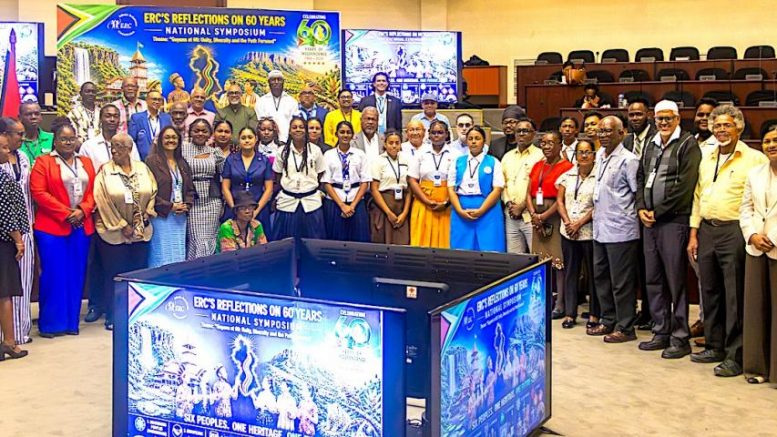
There is a version of Guyana’s 60th Independence Anniversary that writes itself easily: oil revenues, record growth, new bridges, houselots by the tens of thousands. It is a story of transformation so rapid it staggers the imagination. But on June 30, at the Arthur Chung Conference Centre, the Ethnic Relations Commission convened a different kind of national conversation, asking whether the people being transformed are being transformed together.
The answer, by the end of the day, was: mostly yes, but the work is nowhere near done.
That was the thread running through every address at the ERC’s National Symposium, “Guyana at 60: Unity, Diversity and the Path Forward” – a gathering that brought together government ministers and opposition parliamentarians, diplomats and civil society leaders, and indigenous elders to grapple with the question that has haunted this country since before its independence.
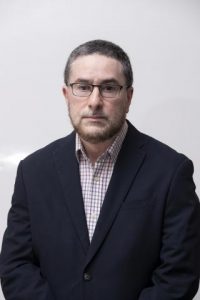
ERC Chairman Shaykh Moeen ul-Hack
Framing the conversation was ERC Chairman Shaykh Moeen ul-Hack, and his opening remarks set a tone that was neither triumphalist nor defeatist, but demanding. “Harmony cannot be manufactured in a vacuum,” he said. “It requires active, deliberate work.” Ul-Hack committed the ERC to producing not another glossy report, but an actionable, evidence-based document – structured dialogue, empirical data, and concrete recommendations – drawn from the day’s proceedings.
Senior Minister Dr Ashni Singh began by calling out a national character flaw: the Guyanese instinct toward modesty that keeps us quiet about our own achievements. “We are more comfortable speaking about our challenges and our failures than our successes,” he said – and then, having made the diagnosis, he refused to be bound by it. He spoke of ancestors dragged to these shores by force and deception, who nonetheless forged what he called “a richly and beautifully diverse, kaleidoscopic tapestry” that is modern Guyana.
Dr Singh cited the halving of unemployment in five years, the creation of 104,000 jobs that went to Guyanese of every background in every region, the reduction of youth unemployment from 30.2% to 12.1%. These were not statistics deployed as political armour – they were offered as evidence that President Ali’s “One Guyana” platform is a governing philosophy, not a slogan.
But Dr Singh also looked his audience in the eye: “We need to be frank about separating rhetoric and soundbites from reality. Our work is certainly not done.”
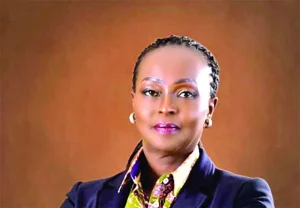
United Nations Resident Coordinator Jean Kamau
United Nations Resident Coordinator Jean Kamau brought the weight of global experience to bear in her presentation. Her country, Kenya, had torn itself apart along ethnic lines after the 2007 elections and had spent years rebuilding trust through constitutional reform, devolution, and sustained civic investment. She did not use Kenya as a cautionary tale to frighten Guyanese; she used it as proof that recovery is possible and that it is always institutional.
Her five prescriptions for Guyana –
- deeper cross-community engagement among youth;
- civic education;
- robust public dialogue against disinformation;
- trusted institutions;
- a shared national vision
– were not abstract. They were a work plan. “The opportunity before Guyana,” she said, “is not simply to manage diversity, but to harness it as a source of strength, creativity, and national progress.”
Two voices gave the day its moral centre. Susan English, President of the Amerindian Action Movement of Guyana, delivered a quiet masterpiece of historical accounting – from Stephen Campbell’s pre-independence lobbying, through the Amerindian Lands Commission of 1967, to the $11.7 billion in village development funds, to the 15% of carbon-credit earnings now flowing directly to indigenous communities.
“Sixty years ago, we asked only to be counted,” she said. “Today we are titled, funded, self-governed, and recognised as an equal people in an equal nation.”
And then came 24-year-old Nikhil Sankar, born one month after the ERC itself was established, and carrying none of the diplomatic caution of his elders. He named slavery. He named indentureship. He named the violence inflicted on indigenous peoples. He invoked Cuffy, Quamina, Rodney, Cheddi, and the Enmore Martyrs, not as a history lesson, but as moral debt.
And he turned to the ERC with a direct challenge: stop merely fostering harmony, and start naming racism where it lives. “Establish tribunals. Measure harm empirically. Prove it through data. Build the safeguards that protect basic dignity when it is being eroded.” He asked the gathering a simple question that hung in the air long after he sat down: Can we do it? And then answered it himself: Yes. Yes, we can.
That Guyana’s private sector – represented at the symposium by the Private Sector Commission – issued a statement affirming that social cohesion “remains critical to continued progress” is, in itself, a signal worth noting. When business adds its voice to the language of inclusion, the conversation shifts from aspiration to architecture.
Sixty years after the Union Jack came down over Georgetown, the Ethnic Relations Commission under Shaykh Moeen ul-Hack insists that independence without unity leaves our collective work unfinished business.
Although the ERC symposium produced no silver bullets, it produced something rarer in national life: an honest reckoning. And in a country moving as fast as Guyana, that may be the most indispensable thing of all.
This column was first published in the Sunday Chronicle on July 05, 2026