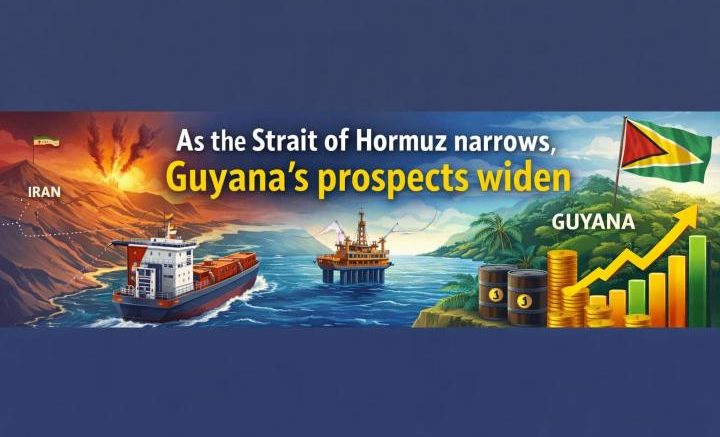
War and a Windfall
When President Irfaan Ali promised a cash grant to the people of Guyana last August, no one could have predicted that it would arrive at a time of an insane war in the Middle East that is fueling a climate of global economic uncertainty.
While the juvenile Opposition leader spent the week moving around coins and small bills in two wheelbarrows, the steady Dr Ashni Singh was unveiling the first phase of the grant for 50,000 government employees. Another promise made and kept, and it couldn’t have come at a better time.
Hormuz Matters
The longer Iran can effectively close the Strait of Hormuz, which handles the traffic of some 20% of global oil supply, the Brent, now near or above US$100, will have refiners scrambling for alternative barrels. Although Guyana’s BPD output is relatively small, comparatively speaking, it nevertheless stands to benefit from this turn of events. Still, though, there is no escaping the impact this war will have on our lives, as President Irfaan recently forecasted.
Iran Expands the Fight
Drone strikes and missile launches certainly make for flashy headlines, but Iran’s real strategy is to push the battlefield far beyond the Middle East. It knows it cannot win a conventional war; that’s not a debate. With much of its leadership gone, the war is already lost, but Tehran’s fight is far from over.
For nearly two decades or more, Iran has been planning to export the consequences of this very existential moment in its 47 years of the Islamic Republic. The shockwaves of Iran’s fall will ricochet in the Middle East, first and foremost, but it will spread to the far corners of the world, and that’s what victory smells like in Tehran. We are already seeing glimpses of what is to come.
Bab el-Mandeb Threat
The next move on Iran’s chessboard, and remember the Persians invented the game of chess, is to urge the Houthis in Yemen to effectively blockade the 32‑kilometre‑wide Bab el‑Mandeb Strait between the Arabian Peninsula and the Horn of Africa. That choke point handles nearly 300 ships a week to and from the Suez Canal, the vital shortcut linking Asia and Europe. Taken together, blockades in both straits would bring close to 800 ships to a standstill and cripple the global trade in vital resources.
The potential consequences of blockading the Bab el-Mandeb mean that Egypt will lose its primary source of income from the traffic of carriers through the Suez, forcing them to take the longer Cape of Good Hope route, adding 10 to 18 extra days to their journeys and driving up the cost of goods even more.
Insurance Shock
If you’re thinking it would be impossible for a militarily degraded Iran to block the traffic of ships through the two straits, you may be right. However, Iran needs only to sink or cripple a ship or two, something it has already done, for it to bring a halt to commercial traffic.
The reason has to do with the risk coverage tankers require from the largest and oldest insurance market on earth – Lloyd’s of London. If a tanker loses its insurance, it’s essentially grounded. Before the war, the insurance premium was 0.25 per cent of hull value, renewed weekly. War sent premiums up to 1 per cent. Say, a supertanker’s hull value is $100 million, its insurance premium is now four times as high and climbing fast.
Europe’s Energy Risk
Qatar supplies 20 per cent of all global liquified natural gas (LNG), and all of it travels through the Strait of Hormuz. After Russia’s war in Ukraine in 2022, Europe built its entire winter energy system on Qatar’s LNG. To put it in simple terms, Europe’s heat in the winter is dependent on the Strait of Hormuz being open.
Fertiliser Crunch
An estimated 40 per cent of India’s LNG comes from Qatar. The story with India is not only about heating homes, but LNG is used to produce ammonia, and from it, urea, the most widely used fertiliser in agriculture. Some 33 per cent of the globally traded fertiliser passes through the Strait of Hormuz.
We are now in the early stages of spring, a time when farmers in the north begin to prep for planting season and without a third of the global supply of natural gas, they are left in the dirt, to put it mildly.
Farm Fallout
The average fertiliser bill for a mid-size American corn farm of, say, 500 acres, is approximately US$80,000. With the war, the cost, on average, increases by an additional $50,000. Translated in layman’s terms, it means more closures in a sector that is in decline.
In 2025, 15,000 American farms were shuttered. American farmers walked away from 160,000 farms between 2017 and 2024. These are staggering numbers, and the real impact on our pockets will only be felt when crops reach global markets in September.
Guyana’s Advantage
The US-Israel war with Iran and the closure of the Strait of Hormuz may determine the price of oil and the global LNG supply, but how President Ali, Dr Singh and Minister Zulfikar Mustapha steady our own ship will determine how we pull through this crisis.
Guyana’s real test is not about a cash grant, but about how wisely we use this moment to our advantage. And given the ridiculous antics of the Opposition, I can’t imagine why anyone could question or doubt the prudence of this president and his ministers.
This column was first published in the Sunday Chronicle on March 22nd, 2026